“That” in Italian (or “those if you’re talking about more than one thing) is a really useful word when you want to make clear what you’re talking about.
For example, you might point in a café and say “that focaccia” or “those croissants ”.
But there isn’t just one word for “that” in Italian. There are… well, a few more 😅
Don’t worry, though. In this lesson, we’ll take you through them piano piano so you’ll learn which one to choose in different situations, with useful phrases for your next trip to Italy.
Quel – “that” used in front of masculine words
Ti ricordi quel ristorante a Napoli? -Do you remember that restaurant in Naples?
Vorrei quel cornetto per favore. -I’d like that croissant please.
Quel is the Italian word for “that” that you use in front of words like ristorante or cornetto which are masculine and singular. Masculine words in Italian usually end in -o, or sometimes -e.
Here are some more examples:
Dobbiamo attraversare quel ponte. -We need to cross that bridge.
Quel vino era davvero buono . -That wine was really good.
If you’re wondering how to decide between masculine and feminine in Italian, you might find it useful to have a look at our lesson on how to know if a word is masculine or feminine in Italian .
Quello – “that” used in front of masculine words that start with certain special sounds, like s+consonant, z, y and ps.
Quello spettacolo era molto divertente . -That show was really funny.
Quello zio vive in Sicilia . -That uncle lives in Sicily.
You use quello before masculine words like spettacolo or zio that begin with s+consonant or z.
Here are some other examples with quello :
Quello stadio è molto lontano dal centro. -That stadium is a long way from the centre.
Quello zaino è mio. -That backpack is mine.
Quella – “That” used in front of feminine singular words
In quella zona ci sono molti ristoranti. -In that area there are lots of restaurants.
Quanto costa quella borsa? -How much does that bag cost?
You use quella for “that” in Italian in front of words like zona and borsa , which are feminine and singular. Feminine nouns in Italian usually end in -a, or sometimes -e.
Here are some more examples:
Possiamo parcheggiare in quella strada? -Can we park on that street?
Quella spiaggia è libera o privata? -Is that beach public (lit. free) or private?
Quell’ – “that” used in front of singular words starting with a vowel
Quell’edificio in fondo è la stazione. -That building at the end is the station.
Quell’isola è vicino a Napoli*. -That island is near Naples.
You use quell’ for “that” in Italian in front of words like edificio and isola, which are singular and start with a vowel. You use quell’ for both masculine and feminine singular words.
Here are some more examples:
Quell’aperitivo ieri era molto buono. -That aperitif yesterday was really good.
Quell’uscita porta alla piazza principale. -That exit leads to the main square.
Quell’agenzia organizza escursioni in barca. -That agency organises boat trips
Complimenti! You’ve made it through all the different forms for “that” in Italian. ( Phew!! ) Now here are the different ways of saying “those” in Italian.
*By the way, there are lots of nice islands near Naples, where Matteo is from. You might have heard of Capri , which gets quite a lot of tourists. But a less-well known spot is Procida. It’s an old fishermen’s island and we talk about it a bit on our podcast episode magari in Italian: what it means and how to use it .
Quei – “those” used in front of masculine plural words
Quei biscotti sembrano buoni. -Those biscuits look good.
Cosa sono quei dolci? -What are those desserts?
You use quei in front of words like biscotti and dolci, which are masculine and plural. Most masculine plural nouns in Italian end in -i.
Here are some more examples:
Vorrei provare quei formaggi. -I’d like to try that cheese.
Quei treni vanno tutti a Firenze? -Do those trains all go to Florence?
Quei taxi sono liberi? -Are those taxis available (lit. free)?
Quei ristoranti sembrano un po’ turistici. -Those restaurants seem a bit touristy.
Quegli – “those” used in front of masculine plural words that start with a vowel, or certain special sounds, like s+consonant, z, y and ps .
Quegli antipasti sono tipici di questa zona. -Those starters are typical of this area.
Quegli autobus vanno in centro? -Do those buses go to the centre?
You use quegli before words like antipasti and autobus which are masculine plural words beginning with a vowel, or in front of words beginning with certain special sounds like s+consonant, z, y and ps.
Here are some more examples:
Quegli stivali sono in offerta? -Are those boots on sale?
Quegli scaffali hanno prodotti locali. -Those shelves have local products.
Quegli sportelli sono aperti? -Are those ticket windows open?
Quegli stuzzichini* sono inclusi nel prezzo? -Are those nibbles included in the price?
*You often get nibbles, like olive and focaccia , served with your drink in Italy. We talk about it in our lesson on an aperitivo in Italy.
Quelle – “Those” used in front of feminine plural words
Quelle scarpe in vetrina sono belle. -Those shoes in the shop window are nice (lit. beautiful).
Quelle valigie sono nostre. -Those suitcases are ours.
You use quelle in front of words like scarpe and valigie which are feminine and plural. Feminine, plural words in Italian usually end in -e.
Here are some other examples:
Possiamo prendere quelle sedie vicino alla porta? -Can we take those chairs near the door?
Quelle file sono per i biglietti? -Are those lines for the tickets?
Quelle visite guidate sono in italiano? -Are those guided tours in Italian?
How to Say “That One” and “Those Ones” in Italian
Sometimes, you might not want to repeat a word that’s already been used in Italian.
For example, if an Italian said to you quale cornetto vuole (which croissant do you want?), instead of saying vorrei quel cornetto (“I’d like that croissant) you could say vorrei quello (“I want that one”).
Here are a few more examples with “that one” and “those ones” in Italian:
- Quale vino preferisci? -Which wine do you prefer
Quello . -That one.
And:
- Quali pantaloni compri? -Which trousers are you buying?
Quelli. -Those ones.
The ending changes depending on what you’re talking about:
-
quello — that one, masculine
-
quella — that one, feminine
-
quelli — those ones, masculine
-
quelle — those ones, feminine
Questo vs Quello: What’s the Difference?
Questo (and its different forms) is Italian for “this”. You generally use it for something that’s nearer to you. On the other hand, quello (and its different forms) is Italian for “that”, so it’s usually for things that are further away.
For example, if you’re choosing pastries at a bakery, you might say:
Vorrei questo cornetto. -I’d like this croissant.
E anche quello al cioccolato, per favore. And that chocolate one too, please.
Here, questo is the croissant close to you, while quello is the one a bit further away.
But the difference isn’t always about physical distance. You can also use quello and its different forms when you’re talking about a place, moment or experience that isn’t here or happening now.
For example:
Ti ricordi quella trattoria a Roma? -Do you remember that trattoria in Rome?
By the way, if you want to read more about how “this” works in Italian, you can read our lesson on how to say “this” in Italian with words like “questo” and “questa” .
A Very Italian Way to Make “This” and “That” Clearer
Questo Qui and Quello Lì
Sometimes, just saying “that” isn’t quite enough. For example, if you’re in a panetteria, bakery, asking for “that cake” might not narrow it down very much 😬
In Italian, you can add qui (“here”) or lì (“there”) to make it extra clear which one you mean. Or you might hear Italians use it to ask you to double check.
For example:
- Quale panino vuole? Questo qui? -Which sandwich would you like? This one here?
- No, quello lì, per favore. -No, that one there, please.
And:
Quale torta preferisci? Questa qui o quella lì ? -Which cake do you prefer? This one here or that one there?
The endings still change depending on whether you’re pointing to something masculine, feminine, singular or plural.
How to Say “That” or “Those” in Italian: Review
| English | Italian | Pronunciation | Used with | Example |
| that | quel | KWEHL | most masculine singular words | quel cornetto (that croissant) |
| that | quello | KWEHL-loh | masculine singular words that start with certain special sounds, like s+consonant, z, y and ps | quello spettacolo (that show) |
| that | quell’ | KWEHLL | singular words starting with a vowel | quell’edificio (that building) |
| that | quella | KWEHL-lah | feminine singular words | quella lasagna (that lasagna) |
| those | quei | KWEH-ee | most masculine plural words | quei biscotti (those biscuits) |
| those | quegli | KWEH-lyee | masculine plural words words that start with a vowel, or certain special sounds, like s+consonant, z, y and ps | quegli antipasti (those starters) |
| those | quelle | KWEHL-leh | feminine plural words | quelle valigie (those suitcases) |
| that/those one(s) | quello/a/i/e | KWEHL-loh/ah/ee/eh | when the word isn’t repeated | quello rosso (the red one) |
Although it seems like a lot to remember, the more you use “that” in practical phrases like the ones you’ve seen in this lesson, the more it will feel natural and you won’t have to stop and think about all the rules.
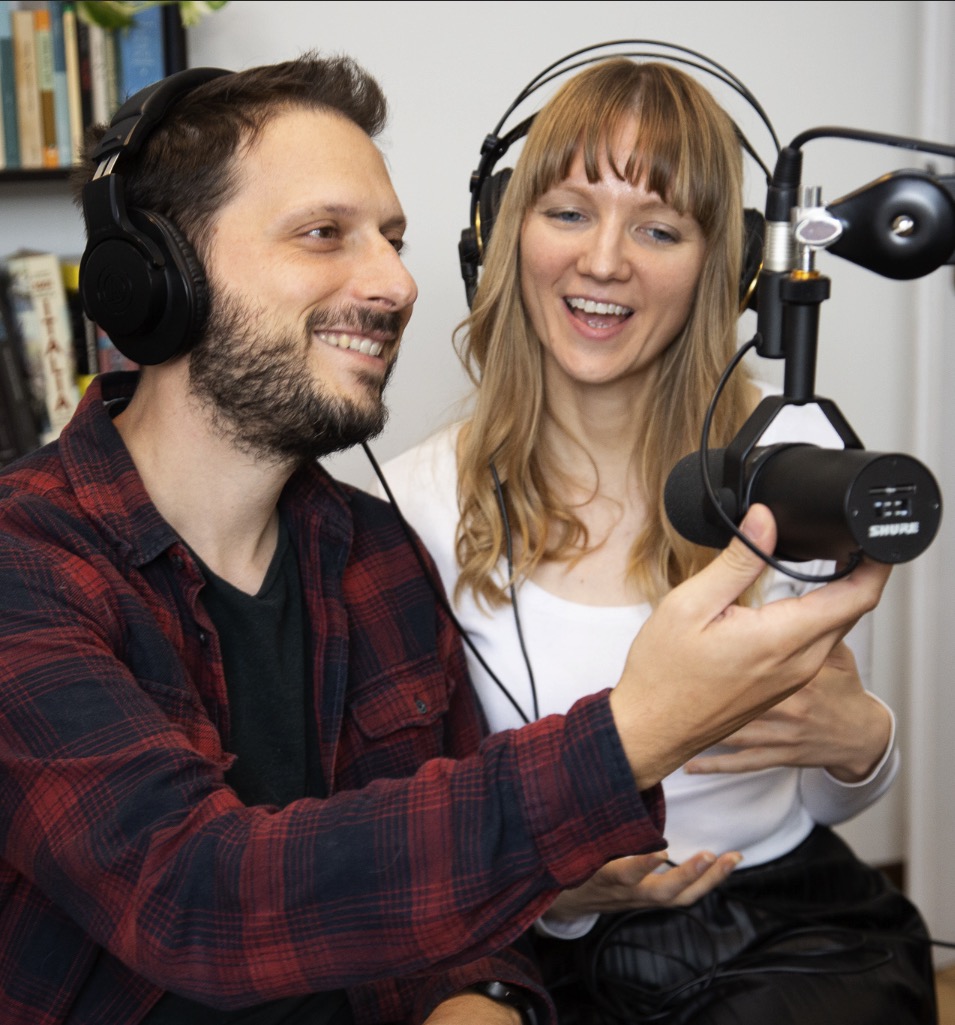
K: Ciao a tutti e benvenuti! Hi everyone and welcome to Learn Italian with Joy of Languages.
M: In today’s episode, you’ll hear how to use “that” and “those” in Italian and how you can use them in everyday situations you can easily find yourself in in Italy, like ordering at the bakery or shopping at the market.
K: But before we get started, can we ask you a quick favore ? If you’re listening to this on your podcast app, could you click the subscribe or follow button? This way you’ll get notified when we release a new episode and you’ll help our podcast grow so we can keep making free lessons like this. Grazie!
M: You’re going to hear a conversation between me and Katie where we talk, or well, actually complain, about a restaurant that we went to recently.
K: For a bit of context, it was a fancy restaurant and we usually prefer more low key ones. Especially in a place like Italy where you don’t normally have to pay a lot of money to get good food.
M: See if you can hear the different ways of saying “that” and “those” in Italian.
K: Comunque in quel ristorante mai più!
M: No infatti. Quella bistecca era terribile.
K: E quei contorni? Niente di speciale.
M: E quelle porzioni erano minuscole.
K: E i prezzi?
M: Quelli sono pazzi!
K: I started by saying:
M: Comunque, in quel ristorante, mai più! - By the way, in that restaurant, never again. Literally:
Comunque - by the way, or anyway
In - in
Quel - that
Ristorante - restaurant
Mai - never
Più - more
K: As a little aside, that first word you heard, comunque , is one of those useful filler-type words you’ll hear a lot in Italian. You can use it when you’re about to introduce a new topic, or when you want to change the subject. Comunque can mean “by the way” or “anyway”.
M: You also heard the first word for “that” in Italian: quel (x2).
K: So quel , spelt q-u-e-l , is the word for “that” that you use when you’re talking about a masculine word in Italian. It can be hard to know whether a word is masculine or feminine in Italian, but looking at the ending can help. Usually masculine words in Italian end in -o.
M: Like cappello , hat. For example, you could say quanto costa quel cappello? How much does that hat cost? Quanto costa quel cappello? You use quel as the Italian word for “that” because cappello is masculine.
K: Sometimes though, masculine nouns end in the letter -e, pronounced “eh”, like the word ristorante. Il ristorante is masculine, so to say “that restaurant”, we say:
M: Quel ristorante
After I said I didn’t want to go back to quel ristorante again, Matteo said: M: No infatti. Quella bistecca era terribile. - No for sure. That steak was terrible. Literally:
No - no
Infatti - indeed
Quella - that
Bistecca - steak
Era - was
Terribile - terrible
K: You heard another word for “that” in Italian.
M: Quella (x2).
K: You use quella, spelt q-u-e-l-l-a, with a word like bistecca because bistecca is a feminine word. We know because it ends in an -a.
M: Another word like this would be torta, cake. For example, at the bakery, you might point and say vorrei quella torta. I’d like that cake. Vorrei quella torta.
K: Then I said:
M: E quei contorni? Niente di speciale. - And those side dishes? Nothing special. Literally:
E - and
Quei - those
Contorni - side dishes
Niente - nothing
Di - of
Speciale - special
K: In English, we say “that” for one thing, and “those” when we’re talking about more than one thing. Italian also has words for talking about more than one thing.
M: For example quei . Those. Quei.
K: This one is quite hard to pronounce because there are three vowels together, u-e-i. But usually in Italian you say each vowel, very carefully, they don’t get smushed together like you sometimes can in English, so you have to enunciate each one in this word as well.
M: Quei (slowly, x2)
K: And we’re using quei because the next word is contorni , a masculine word that’s plural. Masculine plural words often end in the letter -i, pronounced ee, in Italian. Contorni.
M: Like the word giardini , gardens. For example, an Italian might give you information like quei giardini sono chiusi oggi. Those gardens are closed today. Quei giardini sono chiusi oggi.
K: Then Matteo replied:
M: E quelle porzioni erano minuscole. - and those portions were tiny. Literally:
E - and
Quelle - those
Porzioni - portions
Erano - were
Minuscole - miniscule
K: You heard another word for “those” in Italian.
M: Quelle (x2)
K: We use quelle, spelt q-u-e-l-l-e, as a word for “those” in front of porzioni because it’s a feminine word. We know this because it ends in “-zioni”. “Zioni” words in Italian are normally feminine, like “le porzioni”, (the portions), “le stazioni” (the stations) and “le lezioni” (the lessons). So to say “those portions”, we have:
M: Quelle porzioni
K: Another feminine plural in Italian is valigie, suitcases. This time it ends in the letter -e, pronounced eh. This is a more common feminine plural. Usually plurals that end in e (eh) are feminine. Those suitcases would be:
M: Quelle valigie (x2)
So if you were talking to the receptionist at your hotel, you might say something like, quelle valigie sono nostre . Those are our suitcases. Quelle valigie sono nostre.
K: Then I said:
M: E i prezzi… - and the prices…Literally:
E - and
I - the
Prezzi - prices
K: and then Matteo added:
M: Quelli sono pazzi - Those people are crazy. Literally:
Quelli - those
Sono - are
Pazzi - crazy
K: So quelli can be used to mean “those” as in “those people”, a bit like how in English we have phrases like “there are those who say that”. Here, Matteo is using quelli to mean “those” as in the owners or the people who run the restaurant.
K: As you’re probably guessed by now, there are quite a few different words for “that” in Italian, and if you’re finding them all a bit hard to remember, that’s very comprensibile , or understandable.
M: Don’t feel like you have to memorise them all today, or remember all the rules straight away. It helps to start by learning phrases like the ones in today’s episode.
K: For now, let’s review the main ones. How do you say “that” when you want to say something like “that restaurant” or “that hat” You use this word for “that” when you’re talking about masculine words.
M: Quel (x2) For example, Quel ristorante , or quel cappello.
K: And how about the word for “that” that you use with a word like “that steak”, or “that cake”? It’s the word for “that” that you use with feminine words.
M: Quella (x2) . For example, quella bistecca or quella torta .
K: And what about the word for “those” that you use when you say something like “those side dishes” or “those gardens”? It’s the word for “those” that you use in front of masculine words.
M: Quei (x2) For example, quei contorni or quei giardini .
K: And what about the word for “those” that you use with words like “those portions” or “those suitcases”? It’s the word for “those” that you use in front of feminine words.
M: Quelle (x2). For example, quelle porzioni or quelle valigie.
K: Let’s hear the whole conversation again.
K: Comunque in quel ristorante mai più!
M: No infatti. Quella bistecca era terribile.
K: E quei contorni? Niente di speciale.
M: E quelle porzioni erano minuscole.
K: E i prezzi?
M: Quelli sono pazzi!
K: Over on our website, you’ll also see some ways of saying “that” that we didn’t mention in this episode, but you’ll definitely need them to say certain things in Italian. And you’ll also see the different forms of “that” in useful phrases for Italy, like ones for shopping or ordering food.
M: To see all the different ways of saying “that” in Italian, just click the link in the description to head over to our website, or go to italian.joyoflanguages.com/podcast and search for episode 247.
M: See you next time.
K: Or as we say in Italian:
Alla prossima!
Time to check your understanding and remember everything you just learned! Below you’ll find a mini-quiz and some vocabulary cards to help it all go in.
Quiz: How to Say “That” or “Those” in Italian (And Useful Phrases)
How much did you learn? Find out in the quiz!
Vocabulary
Vorrei quel cornetto, per favore = I’d like that croissant, please
Quello zaino è mio = That backpack is mine
Quella spiaggia è libera o privata? = Is that beach public or private?
Quell’uscita porta alla piazza principale = That exit leads to the main square.
Quei taxi sono liberi? = Are those taxis available (lit. free)?
Quelle visite guidate sono in italiano? = Are those guided tours in Italian?
Quale torta preferisci? Questa qui o quella lì? = Which cake do you prefer? This one here or that one there?
Quanto costa quel cappello? = How much does that hat cost?
Vorrei quella torta = I’d like that cake
Quei giardini sono chiusi oggi = Those gardens are closed today
Quelle valigie sono nostre = Those suitcases are ours
Flashcards: How to Say “That” or “Those” in Italian (And Useful Phrases)
Not sure how it works? Click here to watch the tutorial