In Italian , people have a gender, but things do too. This can feel a bit strange if you’re an English speaker. Like why is mozzarella feminine, but then pomodoro (tomato) is masculine?
The good news is, although the gender of Italian words can seem random, there is often a pattern to them.
In this post, you'll learn some tips on how to recognise masculine and feminine Italian words, as well as the exceptions to look out for.
Masculine Words in Italian
Here, you'll learn the most common endings of masculine words in Italian. So if you come across another word with the same ending, there's a good chance it'll be masculine too.
Masculine Singular Words Ending in -o
If you want to use a word in Italian and it ends in -o, it’s usually masculine. For example:
Prendo il treno alle nove. -I’m taking the train at nine.
Vorrei un tavolo per stasera. -I’d like a table for this evening.
Il negozio apre alle dieci. -The shop opens at ten.
Non c’è un supermercato vicino. -There isn’t a supermarket nearby.
As you can see, the masculine words treno, tavolo, negozio e supermercato go together with the Italian words “the” and “a”.
For more on how words like “a” and “the” work in Italian, you can see our lesson on Italian definite articles: how to say “the” in Italian and also our lesson Italian indefinite articles: un, una, uno, and un .
Masculine Singular Words Ending in -e
Mostly masculine words in Italian end in -o, but there are some that also end in -e. :
Il pesce in Italia è molto buono. -Fish in Italy is really good.
Il ristorante è vicino all’hotel. -The restaurant is near the hotel.
Volete un dolce, un caffè ? -Do you (plural) want a dessert, a coffee?
What can be a bit tricky about this (as you’ll see later) is that feminine words can also sometimes end in -e.
So how can you tell if a word ending in -e is masculine or feminine?
One tip is to learn the Italian for “the” that goes with each word. So not just ristorante , but il ristorante (the restaurant). Because il goes with masculine words, it can help you to remember whether the word is masculine or not.
And sometimes there are little rules that can help to know if a word is masculine or feminine, even if it ends in -e.
For example, words ending in -ore are usually masculine.
Here are a few examples:
Stefano è un professore di Joy of Languages. -Stefano is a Joy of Languages teacher.
Questo risotto ha un ottimo sapore . -This risotto has a great flavour.
Masculine Plural Words Ending in -i
Here are some useful masculine words ending in -i.
Dove sono i bagni ? -Where are the bathrooms?
I tavoli fuori sono tutti occupati. -The tables outside are all taken. .
Possiamo lasciare i bagagli alla reception? -Can we leave our luggage (lit. the) luggage at reception?
I musei oggi sono gratuiti*. -Museums today are free.
Often, if a word ends in -i in Italian and you’re talking about more than one thing, it’s a clue that it’s a masculine word. For example you’d say il tavolo , (the table), but if you’re saying more than one it’s i tavoli (the tables).
💡Good to know: *If you’re in Italy on the first Sunday of the month, you’re in luck! Lots of museums, castles and archaeological sites are free to visit.
Masculine Words from Other Languages
If you’re using an Italian word borrowed from another language (like English), you can usually assume it’s masculine.
For example:
Vuoi vedere un film stasera? -Do you want to see a film this evening?
Non porto il computer in vacanza. -I’m not taking my (lit. the) computer on holiday.
L’hotel ha un bar ? -Does the hotel have a bar?
Feminine Words in Italian
Here, you'll learn the most common endings of feminine words in Italian. So if you say or hear a word with these endings, it’s very likely that it’s a feminine word.
Feminine Singular Words Ending in -a
If a singular Italian word ends in -a, it’s usually feminine. For example:
Prendiamo una bottiglia di prosecco? - Shall we get a bottle of prosecco?
Devono pulire la camera . -They need to clean the room.
Vorrei comprare una maglietta come souvenir. - I’d like to buy a T-shirt as a souvenir.
La panetteria è chiusa oggi. -The bakery is closed today.
Feminine Singular Words Ending in -e
Here are some useful feminine words in Italian which end in -e:
La colazione non è inclusa. - Breakfast isn’t included.
Ecco la chiave per l’appartamento. -Here’s the key for the apartment.
Dormiamo qui per una notte . -We’re staying (lit. sleeping) here for one night.
La gente a Napoli è molto simpatica. -People in Naples are very nice.
As you saw above, words ending in -e can be either masculine or feminine, so the ending doesn't help us as much.
One thing you can do to help you is learn the Italian for “the” that goes with each word. So not just chiave , but la chiave (the key). Because la goes only with feminine words, it helps you to remember that the word is feminine.
But there are still some useful patterns. For example, words ending in -zione are usually feminine. Here are a few examples:
Ho una lezione di italiano adesso. -I have an Italian lesson now.
La prenotazione è per le otto. -The reservation is for 8 pm.
La stazione è a destra. -The station is on the right.
Feminine Plural Words Ending in -e
Here are some feminine words ending in -e in Italian:
Le spiagge in Liguria sono bellissime . -The beaches in Liguria are very beautiful.
Le bottiglie d’acqua in camera sono offerte. -The bottles of water in the room are complimentary.
Le camere hanno l’aria condizionata? - Do the rooms have air conditioning?
If you hear or use a word in Italian that ends in -e, and you’re talking about more than one thing, it’s usually a feminine word. For example, you’d say la birra (the beer), but le birre (the beers).
Feminine Words from Other Languages
Some words borrowed from other languages are feminine in Italian if they’re similar to an Italian feminine word.
For example:
Ascolto una playlist di musica italiana. -I listen to an Italian music playlist.
Lista is the Italian word for “list” and it’s feminine, so a word like playlist borrowed from English follows a similar pattern.
La reception è al piano terra. -The reception is on the ground floor.
As you saw above, words with -ion at the end in Italian are often feminine, like la stazione (the station).
Mando un’email all’hotel. -I’ll send an email to the hotel.
Email is probably feminine in Italian because you’d literally translate it with posta elettronica (electronic post), which is a feminine word.
Italian Words That Don’t Follow the Usual Rules
Like most rules, these ones have a few exceptions 😅. The patterns you've seen above will help you most of the time, but there are some Italian words that don't follow them.
For example:
La mano -The hand
La foto -The photo
La radio -The radio
Il problema -The problem
Mano , foto and radio end in -o but are feminine. Problema and programma end in -a but are masculine. With these words, the best thing to do is learn them as they are. Because they’re exceptions, there won’t be many words like this.
Don’t worry about memorising every exception at once. Start with the words you’re most likely to use and learn them with the word for “the”.
A Simple Way to Remember the Gender of Italian Words
Rules can help, but it’s often easier to remember the gender of a word when you learn it inside a useful phrase.
Instead of learning camera on its own, you could learn:
La camera è pronta. -The room is ready.
Instead of learning biglietto on its own, you could learn:
Ho un biglietto per Roma. -I have a ticket to Rome.
This way, you remember the article and the word together, while also learning a phrase you could actually use in Italy.
Occhi di Santa Lucia: A Puglian Biscuit Recipe
In the podcast for this lesson, Matteo and Katie talk about making occhi di Santa Lucia , a type of biscuit from Puglia traditionally prepared around Saint Lucia’s Day on the 13th December.
Here’s how to make it:
-
Farina 250g
Flour 8.8 once
-
Vino 50g
Wine 1.76 once
-
Olio 50g
Oil 1.76 once
-
Uovo 1
Egg 1
-
Zucchero a velo 150g
Powdered sugar 5.3 once
-
Acqua bollente 25g
Boiling water 0.88 once
-
Un limone (succo e buccia)
One lemon (juice and rind)
-
Anice - un cucchiaino opzionale
Aniseed - one teaspoon optional
Recipe:
-
Pre-heat the oven to 350 degrees Farenheit
-
Pour the flour into a bowl.
-
Add the wine, olive oil, one egg, and a bit of lemon zest.
-
Mix everything first with a spoon, then with your hands.
-
Transfer the dough onto a flat surface and continue kneading.
-
Wrap the dough in plastic wrap so it doesn’t dry out while making the tarallini.
-
Take a small piece of dough and roll it into a cylinder about 0.6 inches thick.
-
Shape the cylinders into small rings to form the tarallini.
-
Put the tarallini in the oven for 20 minutes.
-
Take out of the oven and leave to cool.
-
For the glaze, mix powdered sugar, water, and lemon zest.
-
Dip one side of each tarallino into the glaze, then flip it over.
Italian Words: How to Know if They’re Masculine or Feminine: Review
Here’s a handy table to help you remember if a word is masculine or feminine in Italian.
| If a word ends in... | It's usually... | Example |
| -o | masculine | il vino |
| -a | feminine | la camera |
| -i | masculine plural | i tavoli |
| -e | feminine plural | le birre |
| -e (singular) | masculine or feminine | il ristorante , la notte |
Some words don’t follow the usual patterns, like la mano (the hand) and il problema (the problem). That's why it can be helpful to learn new words together with the word for "the" that goes with them.
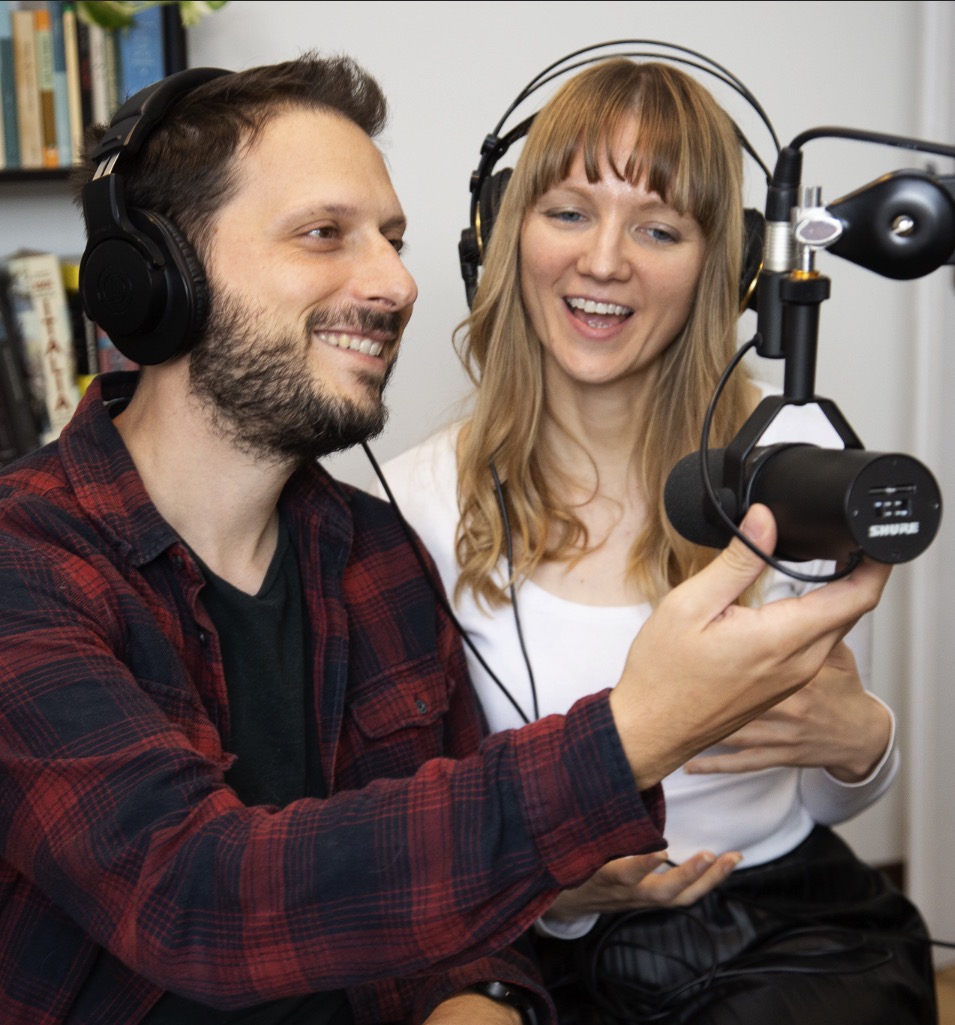
K: Ciao a tutti tutti benvenuti! Hi everyone and welcome to Learn Italian with Joy of Languages.
M: In this episode, you’ll learn how to know whether a word is masculine or feminine in Italian, so you can use it the right way without having to guess.
K: But before we get started, can we ask you a quick favore ? If you’re listening to this on your podcast app, could you click the subscribe or follow button? This way you’ll get notified when we release a new episode and you’ll help our podcast grow so we can keep making free lessons like this. Grazie !
M: You’re going to hear a conversation between me and Katie where we talk about making a dessert for when some friends come over.
K: And I thought it would be a good idea for Matteo to make something he once made during one of the live events we run for our Online Italian School. A few times a year, we get together with our students for live lessons where you get to practise useful phrases for everyday situations in Italy and learn some of the little customs and cultural details that tourists don’t always know about. And in one of those sessions, Matteo showed everyone how to make Occhi di Santa Lucia , literally: Lucia’s eyes.
M: If you think it sounds a bit weird to eat Lucia’s eyes, that’s understandable! Before you hear our conversation, we’ll explain a bit what they are. Occhi di Santa Lucia are a type of biscuit, also known as taralli from Puglia, in the south of Italy, that Italians make around Saint Lucia’s Day on the 13th of December.
K: You might have heard of taralli as the savoury snacks you get with an aperitivo in Italy: those little round, cracker-like biscuits. But they can also be sweet. And because of this round shape with a hole in the middle they look like little eyes, so that’s why some people think they’re called "Lucia’s eyes".
M: And there are lots of legends connected to Saint Lucia’s eyes, like one that says she took her eyes out to protest against an arranged marriage, and another that says that she was a martyr and had her eyes taken out as a torture.
K: Anyway, enough of the gory details, let’s hear the conversation.
K: Cosa compro?
M: La farina, il vino, un limone… e le birre.
K: Le birre? Per i taralli?
M: No, le birre sono per me.
K: Matteo and I divided up the tasks. Obviously, he's cooking, and I'm offering to go buy the ingredients we're missing:
M: Cosa compro ? What should I buy? Literally:
Cosa - what
Compro - I buy
K: Then Matteo started to give me the list:
M: La farina, or flour.
K: Farina is a feminine word. In Italian, words ending in -a are often feminine, so if you hear or use another word ending in -a, you can usually assume it's feminine too. There are exceptions, so this rule doesn't work every single time, but it works a lot of the time.
M: Other everyday words that follow this pattern are la strada, “the street”, la macchina, “the car” or la piazza, “the square”.
K: When you learn a new Italian word, a useful tip is to learn it together with the word for “the”. That way you have a little reminder for whether the word is masculine or feminine. For example, instead of learning just the word strada, you could learn la strada. La helps us because it’s the word for “the” that we use with feminine nouns if they start with a consonant.
K: The next item in the list was wine.
M: Il vino
K: Vino is a masculine word. And like lots of masculine words, it ends in -o. So if you learn a new word in Italian and you see it ends in -o, it’s probably going to be masculine.
M: Other useful words to know like this are il prezzo, the price, il treno, the train and il bagno, the bathroom.
K: So to help you know whether a word is masculine or feminine in Italian, you usually look at the end of the word to help you know. It’s not usually to do with what the word means or what it makes you think of.
M: A word that can help to show this idea is the Italian word for dress, which is il vestito. We might think of it as more of a feminine thing, but because it ends in an -o, it’s a masculine word in Italian.
Then for the next thing on the list Matteo said:
M: Un limone
K: Limone in Italian is a masculine word. It ends in the letter e, pronounced as “eh”. Sometimes words ending in -e are masculine in Italian.
M: For example, you would say il ristorante , the restaurant. Or il ponte , the bridge.
K: But words ending in -e can also be feminine in Italian, like la notte, the night. Because words ending in -e can be masculine or feminine, again, learning the word for “the” with them can help.
M: So instead of just ristorante and notte , you can learn il ristorante and la notte. Literally “the restaurant” and “the night”.
K: Sometimes there are little rules that can help to know if a word is masculine or feminine even if it ends in -e. For example, words ending in - zione , spelt z (or zee), i, o, n, e are feminine. Like la stazione , the station, or la lezione , the lesson. And words ending in -ore, spelt o, r, e, are masculine. Like il professore , a male teacher, or il sapore, flavour, are masculine.
Then for the next thing on the shopping list, Matteo said:
M: Le birre
K: Le birre is a feminine word in Italian. If there’s a word in Italian that ends in -e, and you're talking about more than one thing, that’s usually a sign that it’s a feminine word.
M: For example, if there was just one beer, you’d say la birra, literally: “the beer”. But if you have more than one it’s le birre.
Other words that are like this are le pizze, the pizzas, le vacanze, the holidays, or le strade, the streets.
K: After Matteo he told me he wanted me to get some beers, I replied:
M: Le birre? Per i taralli? - Beers? For taralli? Literally:
Le - the
Birre - beers
Per - for
I - the
Taralli - taralli
K: So that last word I mentioned, i taralli , is a masculine word. If you’re talking about more than one thing in Italian, and it ends in an -i, it’s often masculine. For example, if there was just one biscuit, you’d say il tarallo , literally “the tarallo”, ending in -o. But if you have more than one, it’s i taralli .
M: Other words like this would be i biglietti, the tickets, or i tavoli, the tables.
K: After I asked if the beers were for i taralli, Matteo answered:
M: No, le birre sono per me. No, the beers are for me. Literally:
No - no
Le - the
Birre - beers
Sono - are
Per - for
Me - me
K: So you’ve heard that one of the ways to know if a word is masculine or feminine is to look at the ending.
M: Let’s see if you can remember some of the clues to tell whether a word is masculine or feminine in Italian.
K: What would a word ending in -a be? Like the Italian word for “flour”.
[…]
M: We’d say la farina (x2). Words like this are usually feminine and singular.
K: And what about a word ending in -o, like the Italian word for “wine”.
[…]
M: We’d say il vino (x2). Words like this are usually masculine and singular.
K: And what happens with words ending in -e, like the Italian for a lemon?
M: We’d say un limone. Words ending in -e can be masculine or feminine when they’re singular.
K: And what about if a word is plural and ends in -e, like beers?
[…]
M: We’d say le birre. Words like this are feminine and plural .
K: And what about words ending in -i, like the Italian word for a special type of biscuit?
[…]
M: You’d say i taralli (x2). Words like this are masculine and plural.
K: Let’s hear the whole conversation again:
K: Cosa compro?
M: La farina, il vino e un limone. E le birre.
K: Le birre? Per i taralli?
M: No, le birre sono per me
K: If your head is swimming with all the endings, that’s completely normal. To see all the explanations written down in one place, so you can read them through at your own pace and visit them as many times as you like, you can go to our website.
M: There, you’ll also find lots of practical phrases to help masculine and feminine words stick much better.
K: Because although knowing these rules can help you, we find it works much better if you can learn words as part of a phrase that you’ll actually use in Italy.
M: And you’ll also see the full recipe if you wanted to make occhi di Santa Lucia at home. Just click the link in the description to head over to our website, or go to italian.joyoflanguages.com/podcast and search for episode 243.
K: See you next time.
M: Or as we say in Italian:
Alla prossima!
Time to check your understanding and remember everything you just learned! Below you’ll find a mini-quiz and some vocabulary cards to help it all go in.
Quiz: Italian words: how to know if they’re masculine or feminine
How much did you learn? Find out in the quiz!
Click here to take the quiz for this episode: Italian words: how to know if they’re masculine or feminine
Vocabulary
Vorrei un tavolo per stasera = I’d like a table for this evening.
Il ristorante è vicino all’hotel = The restaurant is near the hotel
Dove sono i bagni? = Where are the bathrooms?
La panetteria è chiusa oggi = The bakery is closed today
La prenotazione è per le otto = The reservation is for 8 pm
Le spiagge in Liguria sono bellissime = The beaches in Liguria are beautiful
Ecco la chiave per l’appartamento = Here’s the key for the apartment
Il ristorante è vicino all’hotel = The restaurant is near the hotel
La farina = The flour
Il vino = The wine
Un limone = A lemon
Le birre = The beers
I taralli = a type of biscuit that can be sweet or savoury. They’re often served as a part of an aperitivo
Flashcards: Italian Words: How to Know If They’re masculine or Feminine
Not sure how it works? Click here to watch the tutorial