You’ll hear “welcome” used a lot in Italy. For example, a receptionist might say it to you when you arrive at a hotel, or a friend or relative might say it when you go to their house.
But there’s not just one way to say “welcome” in Italian. There are actually four, depending on who you’re talking to.
In this post, you’ll see how and when to use the different forms of “welcome” in Italian, as well as some extra phrases you might hear when someone is welcoming you in Italy.
How to Say Welcome in Italian
Benvenuto
Pronunciation: Ben-veh-NOO-toh
In Italy, you could say:
Ciao Matteo, benvenuto! -Hi Matteo, welcome!
You use benvenuto, with an -o on the end, to say “welcome” when you’re welcoming someone who is male.
Here are some other ways you might hear it in Italy if an Italian is talking to someone male:
Benvenuto in Italia! -Welcome to (lit. in) Italy!
Benvenuto, è la sua prima volta qui? -Welcome, is it your (formal) first time here?
Benvenuta
Pronunciation: Ben-veh-NOO-tah
If you’re in Italy, you could also hear:
Ciao Katie, benvenuta! -Hi Katie, welcome!
You use benvenuta, with an -a on the end, when you’re welcoming someone who is female.
Here are some other examples you could hear an Italian use if they’re talking to someone female:
Benvenuta nel nostro hotel! -Welcome to our hotel!
Benvenuta, che bello vederti! -Welcome, how lovely (lit. beautiful) to see you!
Benvenuti
Pronunciation: Ben-veh-NOO-tee
When you start your speaking class with Joy of Languages, the teacher might say:
Benvenuti a tutti! -Welcome everyone!
You use benvenuti, with an -i on the end, when you’re talking to a mixed group of people, or just a group of uomini (men).
Here are some other ways you could hear it used:
Benvenuti a Napoli! -Welome to Naples!
Benvenuti a bordo! -Welcome on board!
Benvenute
Pronunciation: Ben-veh-NOO-teh
If there’s just a group of donne (women) in Italy, you might hear:
Benvenute! Grazie di essere venute! -Welcome! Thank you for coming.
You use benvenute, with an -e on the end, when you’re talking to more than one woman.
Here are some other ways an Italian could use it if they’re talking to a group of women:
Benvenute! Da quanto tempo!* -Welcome! It’s been a while!*
Ciao Mary e Giorgia, benvenute! -Hi Mary and Giorgia, welcome!
To learn other friendly Italian phrases like “how lovely to see you” or “it’s been a while”, you can see our lesson on Italian greetings .
Other phrases to welcome someone in Italian
Benvenuto and its different forms works well as a way of saying “welcome” in Italian, but it’s not the only phrase you might hear in Italy when someone wants to give you a warm greeting. Here, you’ll see some other phrases that Italians might use.
Prego
Pronunciation: PREH-goh
You might know the word prego as the Italian word for “you’re welcome”. And it does mean that.
But what lots of learners don’t know is that prego can also mean “right this way” or “please, come on in”. And it works in both formal and informal situations.
So if an Italian is standing at the door, they might move out of the way to let you through and say prego!
If you want to know more about how prego works, you can read our lesson on the 8 meanings of prego in Italian .
Entra pure
Pronunciation: EN-trah POO-reh
We can translate entra pure as “come on in”.
Entra looks a bit like the English “enter”. There’s not a perfect direct translation of pure in English, but it’s a bit like saying “go ahead”, “feel free”.
You use entra pure when you’re speaking to one person in Italian.
Entrate pure
Pronunciation: En-TRAH-teh POO-reh
Entrate pure is the phrase you use to say “come on in” in Italian when you’re talking to more than one person.
Accomodati
Pronunciation: ah-koh-moh-DAH-tee
Accomodati literally means “make yourself comfortable”, but an Italian might also use it to say “take a seat” or “make yourself at home”.
Accomodatevi
Pronunciation: Ah-koh-moh-DAH-teh-vee
Accomodatevi is the Italian version for “make yourself comfortable” or “make yourself at home” when you’re talking to more than one person.
Benarrivato
Pronunciation: Behn-ahr-ree-VAH-toh
Benarrivato literally means “well arrived”, but a more natural translation in English would be something like “glad you made it”.
You use it in Italian when the other person has had a bit of distance to travel to get there.
The only thing to watch out for with benarrivato is that you have to change the endings to match who you’re talking to. But the good news is that it works exactly like benvenuto, so you’d say:
Benarrivato → For welcoming someone male
Benarrivata → For welcoming someone female
Benarrivati → For welcoming a male group or mixed group
Benarrivate → For welcoming a female group
How to Say Welcome in Italian (With Handy Phrases for Italy): Review
Now you’ve learnt the different ways to say “welcome” in Italian, let’s review what you’ve learnt.
Here are the four different ways to say “welcome” in Italian.
| Benvenuto | To welcome one man | Ben-veh-NOO-toh |
| Benvenuta | To welcome one woman | Ben-veh-NOO-tah |
| Benvenuti | To welcome a group of people (mixed group or all men) | Ben-veh-NOO-tee |
| Benvenute | To welcome a group of women | Ben-veh-NOO-teh |
And here are the other phrases an Italian might use to welcome you:
-
Prego = “Right this way”, “come on in” in both formal and informal situations
-
Entra pure = "Come on in", when you're inviting one person inside.
-
Entrate pure = "Come on in", when you're inviting more than one person inside.
-
Accomodati = "Make yourself comfortable", "take a seat", or "make yourself at home", when welcoming one person.
-
Accomodatevi = "Make yourselves comfortable", "Take a seat", or "Make yourselves at home", when welcoming more than one person.
-
Benarrivato = "Glad you made it", when someone has travelled to get there.
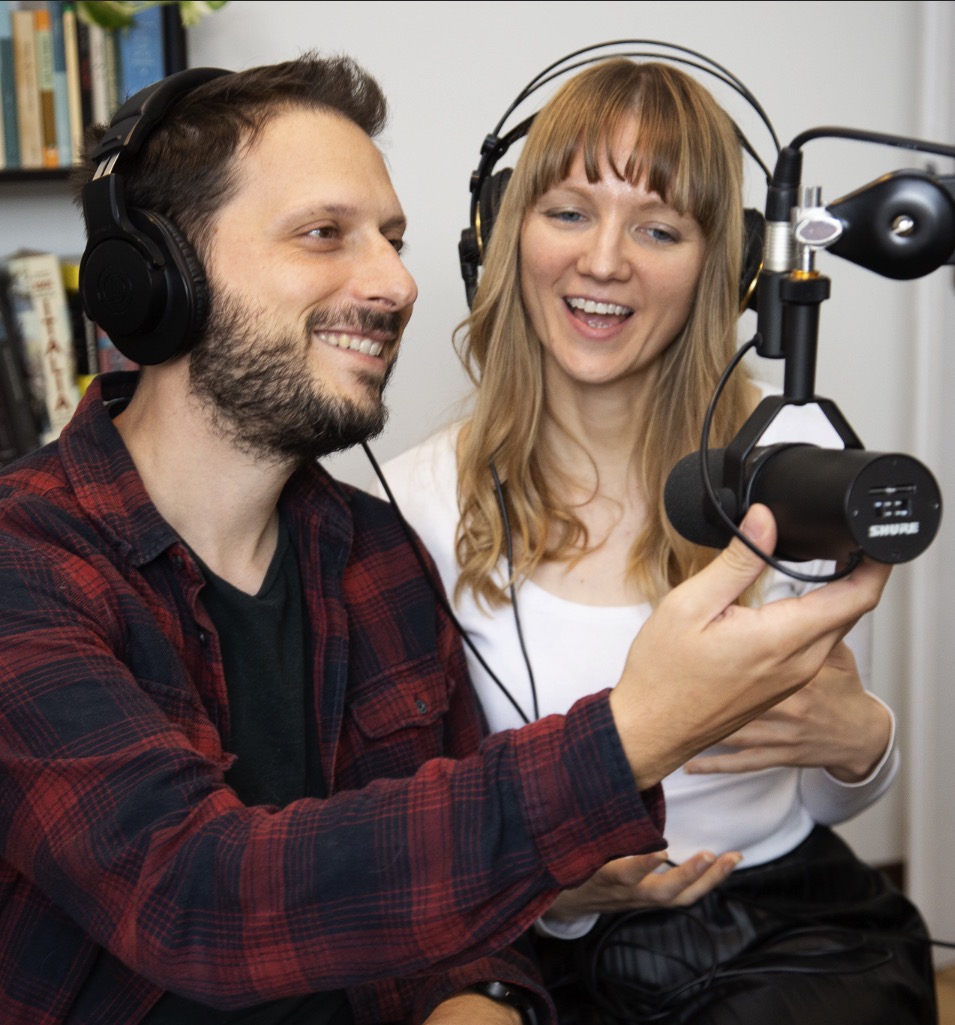
K: Ciao a tutti e benvenuti! Hi everyone and welcome to Learn Italian with Joy of Languages. In today’s episode, you’ll learn the word for “welcome” in Italian.
M: But there are actually four different ways of saying the Italian word for “welcome”. Today you’ll find out when to use each one.
K: But before we get started can we ask you a quick favore ? If you’re listening to this on your podcast app, could you click the subscribe or follow button? This way you’ll get notified when we release a new episode and you’ll help our podcast grow so we can keep making free lessons like this. Grazie !
M: So one way of saying “welcome” in Italian is benvenuto (x2) .
K: As an interesting aside, the literal meaning of benvenuto is really similar to the English. In Italian bene means “well”, although you drop the final “e” when you say it in benvenuto. And venuto is the past form of “come”.
M: If someone is welcoming me to their house, they might say: Ciao Matteo, benvenuto. Hi Matteo, welcome. Ciao Matteo, benvenuto.
K: The reason they would say benvenuto , with an -o on the end, is because Matteo is a man. But if someone was greeting me, they would say:
M: Benvenuta (x2) . For example, ciao Katie, benvenuta . Hi Katie, welcome. Ciao Katie, benvenuta.
K: So we say benvenuta, with an -a on the end, when we’re welcoming someone female. It’s really common for learners to not realise that they have to change the ending of benvenuto to match the person that they’re talking to, and so they just say benvenuto for everyone.
M: It’s nothing to worry about, people understand you, but to say it correctly, you need to change the last vowel at the end.
K: And if someone was welcoming both of us, so me and Matteo, they’d say a different form of the word.
M: Benvenuti (x2).
K: Benvenuti with the letter -i on the end, pronounced ee , is like a plural form. We say benvenuti when welcoming two or more men, or a mixed group of people, so women and men. In fact, it’s the word we use at the start of these episodes when we say ciao a tutti e benvenuti. Hi to everyone and welcome.
If we were welcoming just a group of women, like if we were inviting Mary and Giorgia, two of our friends who also work with us at Joy of Languages, there would be another way of saying “welcome”.
M: Benvenute (x2).
K: So we say benvenute, with the letter -e on the end, pronounced eh, when we’re welcoming two or more women.
There’s also another word that Italians use all the time when welcoming people. It’s a word you might already know in Italian, but lots of learners don’t realize it also has this other meaning.
M: The word is prego (x2)
K: You might know the word prego as “you’re welcome”. But it can also be used to mean “please, come on in”, or “right this way”. For example, you could use it if you wanted to invite someone in if they’re standing at the door.
M: And you could use both benvenuto and prego together. For example, if someone wanted to say to Katie, “welcome, come right in”, they would say benvenuta, prego. Or the other way around: prego, benvenuta . Come right in, welcome. Prego, benvenuta.
K: And the good news about using prego is that you don’t have to worry about who you’re talking to, so there’s no difference between masculine, feminine and plural. You would always just say prego.
Now that you’ve heard a few different ways to say “welcome” in Italian, let’s see what you can remember.
What’s the way of saying “welcome” that you’d use with Matteo?
[...]
M: Benvenuto (x2) .
K: And how would you say “welcome” if you were talking to me?
[...]
M: Benvenuta (x2) .
K: And if you were talking to both of us, what form of “welcome” would you say?
[...]
M: Benvenuti (x2).
K: And what about the way of saying “welcome” in Italian if you were saying “welcome” to our friends Mary and Giorgia?
[...]
M: Benvenute (x2) .
K: And lastly, what’s a word that you can use in Italian to mean “come on in”.
M: Prego (x2) .
K: If you want to see the different endings of benvenuto written down in one place you can go to our website.
M: There, you’ll also find other friendly words and phrases like prego that Italians use to be welcoming. Like the Italian for “make yourself at home” or “glad you made it”.
K: It's not a super long list, just the phrases that we think will be useful to you to know for Italy.
M: If you go to our website, you can see all the phrases in one place, just click the link in the description to head over to our website, or go to italian.joyoflanguages.com/podcast and search for episode 241.
K: See you next time.
M: Or as we say in Italian:
Alla prossima!
Time to check your understanding and remember everything you just learned! Below you’ll find a mini-quiz and some vocabulary cards to help it all go in.
Quiz: How to Say Welcome in Italian (With Handy Phrases for Italy)
How much did you learn? Find out in the quiz!
Vocabulary
Benvenuto in Italia! = Welcome (to one man) to Italy!
Benvenuto, è la sua prima volta qui? = Welcome (to one man) is this your (formal) first time here?
Benvenuta, che bello vederti! = Welcome (to one woman) it's so lovely to see you!
Benvenuti a tutti! = Welcome (mixed group) everyone!
Benvenuti a bordo! = Welcome (mixed group) on board!
Benvenute! Grazie di essere venute! = Welcome (to a female group)! Thanks for coming!
Ciao Mary e Giorgia, benvenute! = Hi Mary and Giorgia, welcome!
Ciao Matteo, benvenuto = Hi Matteo, welcome
Ciao Katie, benvenuta = Hi Katie, welcome
Benvenuta, prego = Welcome (to one woman), please come in
Flashcards: How to Say Welcome in Italian (With Handy Phrases for Italy)
Not sure how it works? Click here to watch the tutorial