The word for “suitcase” in Italian is valigia (pronounced vah-LEE-jah).
And it’s a word you’ll probably want to know if you’re travelling to Italy because it comes up in lots of situations, like if you need to ask a receptionist “can I leave my suitcase here”, or if you want to ask if you can check it in at the airport.
In this post, you’ll learn how to say “suitcase” in Italian, along with practical words and phrases you can use when travelling.
How to Say Suitcase in Italian
As mentioned, the most common word for suitcase in Italian is valigia.
Like most words ending in -a in Italian, valigia is a feminine word.
Here’s how it changes depending if you’re talking about one or several suitcases:
La valigia = the suitcase
Le valigie = the suitcases
A phrase you might want to use in Italian with “suitcase” is fare la valigia (to pack, lit. “to do the suitcase”) or disfare la valigia (to unpack, lit. “to undo the suitcase”).
For example:
Stasera devo fare la valigia. -This evening, I need to pack.
Faccio la valigia domani. -I’ll pack tomorrow.
Quando torno a casa devo disfare la valigia -When I go back home, I need to unpack.
But you might not just be travelling with a suitcase in Italy, so here are some other everyday words for bags and luggage.
| Il* trolley | Carry-on suitcase | Eel TROL-lee |
| Il beauty case | Make-up bag | Eel BYOO-tee kayz |
| La borsa | Bag / Handbag | Lah BOR-sah dah vee-AHJ-joh |
| Lo zaino | Backpack | Lo DZAH-ee-noh |
*Italian has different words for “the” depending on what word you’re talking about. If you want to know more about how this works, you can read our blogpost Italian definite articles: how to say "the" in Italian?
For example:
Non porto una valigia, porto solo uno zaino. -I’m not bringing a suitcase, I’m just bringing a backpack.
Il mio zaino è pronto. -My backpack is ready.
Metto il beauty case in valigia. -I’ll put the make-up bag in (my) suitcase
💡Good to know You can see that there are lots of English words that Italians use (said with an Italian accent, ovviamente ), although they’re not always used in the same way as in English.
Things to Put in Your Suitcase in Italian
The Italian words for the things you’ll put in your suitcase are useful to learn because they’re everyday objects you might talk about in other situations.
| I vestiti | Clothes | Ee veh-STEE-tee |
| La maglietta | T-shirt | Lah mahl-YET-tah |
| Le scarpe | Shoes | Leh SKAR-peh |
| Il pigiama | Pyjamas | Eel pee-JAH-mah |
| Il costume da bagno | Swimsuit | Eel koh-STOO-meh dah BAHN-yoh |
| L’asciugamano | Towel | Lah-shoo-gah-MAH-noh |
| Lo spazzolino | Toothbrush | Loh spat-tsoh-LEE-noh |
| Il dentifricio | Toothpaste | Eel den-tee-FREE-choh |
| Il caricabatterie | Phone charger | Eel KAH-ree-kah-baht-teh-REE-eh |
| Gli occhiali da sole | Sunglasses | Lyee ok-KYAH-lee dah SOH-leh |
| La giacca | Jacket | Lah JAHK-kah |
| Il libro | Book | Eel LEE-broh |
| La crema solare | Sun cream | Lah KREH-mah soh-LAH-reh |
| Lo shampoo | Shampoo | Loh SHAM-poo |
| Il balsamo | Conditioner | Eel BAL-sah-moh |
| Il fon / l’asciugacapelli | Hairdryer | Eel fohn / lah-SHOO-gah-kah-PEHL-lee |
For example:
Posso chiedere un fon per favore? -Can I ask for a hairdryer please?
Devo comprare la crema solare. -I need to buy suncream.
Posso usare il tuo caricabatterie? -Can I use your phone charger?
Vorrei un asciugamano per la piscina. -I’d like a towel for the swimming pool.
Porto delle scarpe comode. -I’ll bring some comfortable shoes.
Words to Do With Suitcase in Italian
When you’re travelling through Italy, there are lots of everyday travel words that you’ll hear around you.
Il problema is that textbooks and apps can give you too many words at once, and it’s not always clear which ones are actually useful to remember.
So instead of overwhelming you with long lists, here are some handy, practical words to do with suitcases and travelling in Italian, the ones you’re most likely to hear and use.
| I controlli | Security checks | Ee kon-TROL-lee |
| La bilancia | Scales | Lah bee-LAHN-chah |
| Il peso | Weight | Eel PEH-zoh |
| Il limite di peso | Weight limit | Eel LEE-mee-teh dee PEH-zoh |
| Il carrello portabagagli | Luggage cart | Eel kah-REHL-loh por-tah-bah-GAHL-yee |
| L’etichetta | Label / tag | Leh-tee-KEHT-tah |
| Il bagaglio a mano | Hand luggage | Eel bah-GAHL-yoh ah MAH-noh |
| Il bagaglio da stiva | Checked luggage | Eel bah-GAHL-yoh dah STEE-vah |
| La stiva | The hold | Lah STEE-vah |
| La cappelliera | Overhead locker | Lah kahp-pehl-LYEH-rah |
| Il ritiro bagagli | Baggage claim | Eel ree-TEE-roh bah-GAHL-yee |
| Il nastro bagagli | Baggage carousel | Eel NAH-stroh bah-GAHL-yee |
For example:
Metto la valigia nella cappelliera. -I’ll put the suitcase in the overhead locker.
Può mettere la valigia sulla bilancia? -Can you (formal) put your suitcase on the scales?
Non vedo la mia valigia sul nastro bagagli. -I don’t see my suitcase on the luggage carousel.
If you want to know more everyday words for the airport, you can see our blogpost on airport in Italian: phrases you need when flying in Italy
Useful Phrases with Suitcase in Italian
| Vorrei imbarcare la* valigia | I’d like to check in my suitcase | Vor-RAY eem-bar-KAH-reh lah vah-LEE-jah |
| Può aprire la valigia? | Can you (formal) open your suitcase? | Pwoh ah-PREE-reh lah vah-LEE-jah? |
| Metto (qualcosa) in valigia | I’ll put (something) in my suitcase | MEHT-toh kwal-KOH-zah een vah-LEE-jah |
| Metto la valigia in macchina | I’ll put the suitcase in the car | MEHT-toh lah vah-LEE-jah een mahk-KEE-nah |
| Posso lasciare la valigia qui? | Can I leave my suitcase here? | POHS-soh lah-SHAH-reh lah vah-LEE-jah kwee |
| C’è spazio per la valigia? | Is there space for my suitcase? | Cheh SPAH-tsyoh pehr lah vah-LEE-jah |
| Ho spazio in valigia | I have space in my suitcase | Oh SPAH-tsyoh een vah-LEE-jah |
| Non ho spazio in valigia | I don’t have space in my suitcase | Nohn oh SPAH-tsyoh een vah-LEE-jah |
| La valigia è piena | The suitcase is full | Lah vah-LEE-jah eh PYEH-nah |
| La valigia è pronta | The suitcase is ready | Lah vah-LEE-jah eh PROHN-tah |
| La valigia è troppo pesante | The suitcase is too heavy | Lah vah-LEE-jah eh TROH-poh peh-ZAHN-teh |
| Cerco la mia valigia | I’m looking for my suitcase | CHER-koh lah MEE-ah vah-LEE-jah |
*Often where Italian uses “the” suitcase, we’d say “my” in English.
How to Say Suitcase in Italian and Other Useful Phrases: Review
-
The word for “suitcase” in Italian is valigia .
To say “to pack/unpack” you literally say “to do/undo the suitcase”: fare/disfare la valigia.
For example:
Stasera devo fare la valigia. -This evening, I need to pack.
Quando torno a casa devo disfare la valigia -When I go back home, I need to unpack.
-
You also learned some other common words for bags and luggage in Italian.
For example:
Il trolley - Carry-on suitcase
Il beauty case - Make-up bag
La borsa - Bag / handbag
Lo zaino - Backpack
-
There are also lots of useful words you might hear when travelling with your suitcase, especially at the airport.
For example:
I controlli - security checks
Il bagaglio a mano - hand luggage
La cappelliera - overhead locker
-
The things you put in your suitcase are everyday items, so they’re useful to know for lots of other situations too.
For example:
Posso chiedere un fon per favore? -Can I ask for a hairdryer please?
-
Vorrei un asciugamano per la piscina. -I’d like a towel for the swimming pool.
-
And you saw some useful phrases with valigia that you can use when travelling in Italy.
For example:
Devo fare la valigia - I have to pack my suitcase
Vorrei imbarcare la valigia - I’d like to check in my suitcase
Posso lasciare la valigia qui? - Can I leave the suitcase here?
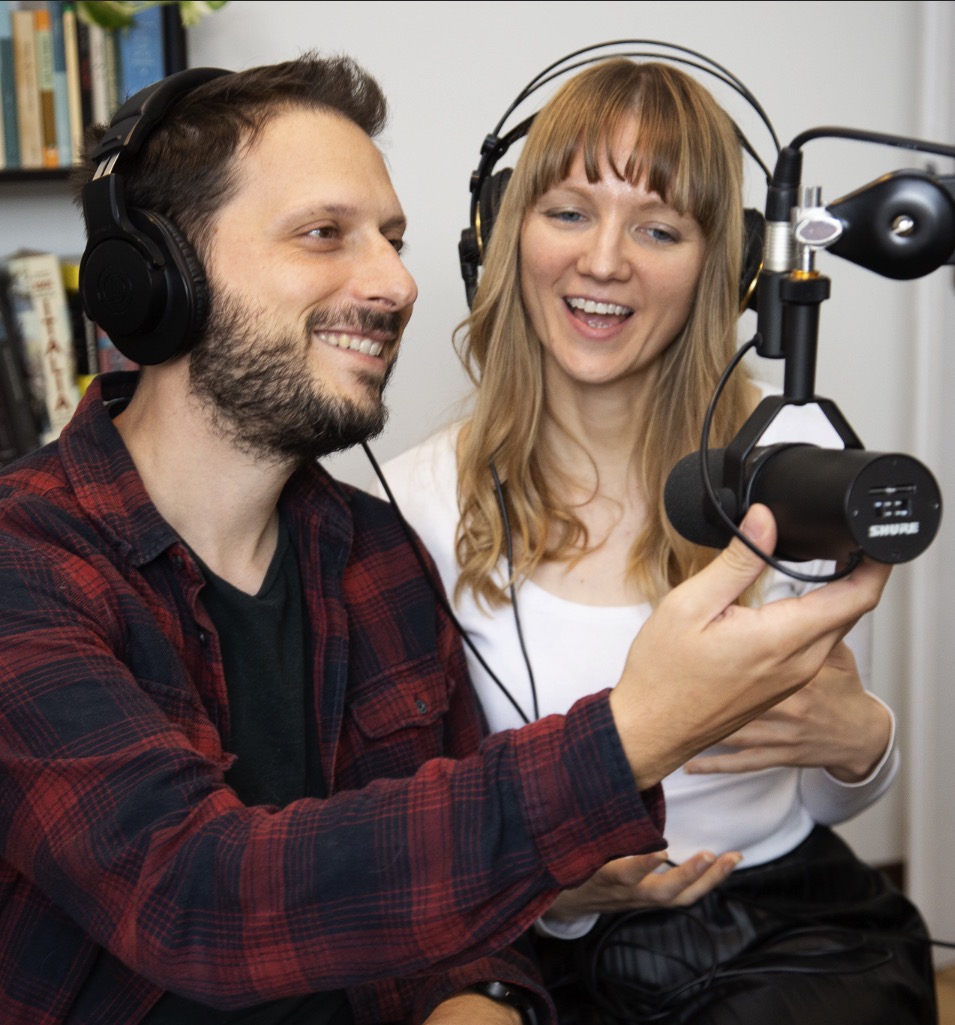
K: Ciao a tutti e benvenuti! Hi everyone and welcome to Learn Italian with Joy of Languages.
M: In today’s episode, you’ll learn lots of practical words and phrases for traveling, and you’ll also get to find out a bit more about a town in Northern Italy that you can visit on your next trip.
K: But before we get started, can we ask you a quick favore ? If you’re listening to this on your podcast app, could you click the subscribe or follow button? This way you’ll get notified when we release a new episode and you’ll help our podcast grow so we can keep making free lessons like this. Grazie !
M: You’re going to hear a conversation between me and Katie where we talk about getting ready for a trip to Valdobbiadene. Valdobbiadene is a town in the Veneto region, which is the same region that Venice and Verona are in.
K: See if you can hear the different things we talk about taking with us on the trip.
K: Dobbiamo fare le valigie
M: Il mio zaino è pronto
K: Porto delle scarpe comode, una giacca leggera per la sera…
M: E la crema solare
K: Mmm..questa valigia è troppo piccola, porti tu il fon?
M: Ok
K: E prendi anche dei libri?
M: Dobbiamo bere del prosecco, non leggere.
K: I started out by saying:
M: Dobbiamo fare le valigie - We need to pack. Literally:
Dobbiamo - we have to Fare - to do Le - the Valigie - suitcases
K: So the word for suitcase is valigia in Italian. Valigia. It ends with the letters -g-i-a, but you don’t hear the “i” in the middle. So it’s not pronounced “val-ee-jee-yah”, it’s pronounced “val-ee-jah”. The “i” after the letter “g” is just there to tell us that it’s pronounced as a “juh” sound instead of a “guh” sound.
M: Valigia (x2)
K: But when you talk about more than one, so suitcases, it’s valigie, with an “e”. Again, you don’t hear the “i”, so it’s not “val-ee-jee-yeh”, but “val-ee-jeh”.
M: Valigie (x2) .
K: And you also heard a really useful phrase that you can use if you need to talk about packing:
M: Fare le valigie . To pack, or to pack your suitcases. Fare le valigie.
K: Fare means “to do”, so Italians literally say “to do the suitcases” Because I was talking about Matteo and I packing, I said suitcases, plural, but if you just had one suitcase to pack, you’d say valigia instead.
M: So fare la valigia. For example, devo fare la valigia - I have to pack, or I have to pack my suitcase.
K: Literally “I have to do the suitcase”
M: Devo fare la valigia.
K: Then Matteo said:
M: Il mio zaino è pronto - My backpack is ready. Literally: Il - the Mio - my Zaino - backpack È - is Pronto - ready
K: You heard another everyday Italian word:
M: Zaino. Backpack. Zaino.
K: This one’s good to know if you’re at the airport and you’re explaining you just have a backpack, rather than a suitcase, or to understand Italians if they use this word as well. Like at museums they often ask to check your backpack or ask you to put it away in a locker.
Then I said to Matteo
M: Porto delle scarpe comode. I’ll bring some comfortable shoes. Literally: Porto - I bring Delle - some Scarpe - shoes Comode - comfortable
K: And then I added:
M: una giacca leggera per la sera… - a light jacket for the evening…Literally: Una - a Giacca - jacket Leggera - light Per - for La - the Sera - evening
K: You heard a word that’s very useful when you’re talking about packing in Italian.
M: Porto . Literally I bring. Porto. It comes from the verb portare , to bring.
K: And the reason that I talked about bringing comfy shoes with me, or scarpe comode , is because there are lots of hills in Valdobbiadene, so it’s a great place for walking.
M: And Katie also mentioned bringing una giacca leggera . A light jacket. Una giacca leggera . Partly because Valdobbiadene is in the hills, it can get cool at night there, even in the summertime.
K: Going back to our conversation about packing, Matteo also reminded me of something else that’s important to bring:
M: E la crema solare - And the sun cream. Literally: E - and La - the Crema - cream Solare - sunny
K: So because I’m not italiana, I usually bring suncream with me if it’s hot and I know I’m going to be spending time outside. Italians tend to worry a lot less about suncream, especially if they’re not going to the beach.
But I was starting to see I didn’t have much room in my suitcase, so I said to Matteo:
M: Mmm… questa valigia è troppo piccola - Hmm… this suitcase is too small. Literally: Questa - this Valigia - suitcase È - is Troppo - too Piccola - small
K: This phrase troppo piccola is useful to talk about your suitcase, but it’s a structure that’s handy for other situations too. Because you can use troppo and then replace piccola for another word.
M: For example, if you want to make small talk with Italians, you could talk about the fact that it’s troppo caldo. Too hot. Troppo caldo. Or troppo freddo, too cold. Italians love to complain when it’s too hot or too cold. Or you can say troppo grande, too big, if the t-shirt you’ve tried on isn’t the right size.
K: And because my suitcase was too small, I asked Matteo
M: porti tu il fon? can you bring the hairdryer? Literally:
M: Porti - you bring Tu - you Il - the Fon - hairdryer
K: Earlier you heard the word for “I bring”, which was porto, with an -o on the end. Now you’ve heard the word for “you bring”.
M: Porti (x2).
K: Porti has an -i on the end, but it’s pronounced with an -ee sound. And usually in Italian we leave out little words like you, or tu, because the ending of the word already makes it clear who I’m talking about. Porti, on its own, already means “you take”. But in this case I used it when I said porti tu , because I wanted to emphasize that it was Matteo who would be bringing the hairdryer, instead of me. In English we do this with our voice, “ You bring it”. In Italian we add “tu”. Porti tu?
M: And you also heard the word for hairdryer in Italian. Fon (x2) .
K: You might be thinking that fon doesn’t sound very Italian and that’s because it isn’t an Italian word originally. It comes from a German word for a type of warm wind. It should be spelt f-o-n, which is closer to the spelling of the German word, but many Italians also spell it p-h-o-n.
And there are a few situations where you might need this word in Italian, like if you need to ask the hotel receptionist or B&B host if they have a hairdryer you can use.
When I asked Matteo if he could bring the hairdryer, he said:
M: Ok - Ok. In Italian it’s the same: ok.
K: And then I asked him:
M: E prendi anche dei libri? - And can you take some books as well? Literally: E - and Prendi - you take Anche - also Dei - some Libri - books
K: So you heard another useful word to talk about what you’re going to pack in Italian.
M: Prendi. You take. Prendi. It comes from the verb prendere - to take.
K: And I also spoke about another everyday thing: books, or libri. If you were talking about just one, you’d say libro.
But Matteo didn’t think it was a good idea for me to bring books, so he said:
M: Dobbiamo bere del prosecco, non leggere - We need to drink prosecco, not read. Literally: Dobbiamo - we have to Bere - to drink Del - some Prosecco - prosecco Non - not Leggere - to read
K: Veneto is the region where prosecco is from, so that’s why Matteo thought it would be a good idea for us to drink it there. If you like prosecco as well, there are loads of wineries in the area where you can go for degustazioni , or tastings. Now you’ve heard a few different everyday words and phrases in Italian. Let’s see what you can remember.
K: How would you say to pack? It literally means “to do the suitcases”
[...]
M: Fare le valigie (x2). Or, if you just had one suitcase to pack, fare la valigia (x2).
K: How would you say “backpack” in Italian? You heard it when Matteo said “my backpack is ready”.
[...]
M: Zaino (x2). For example, il mio zaino è pronto.
K: And what’s the Italian for “I bring” or “I’ll bring”? You heard it when I said “I’ll bring comfortable shoes, a light jacket for the evening”.
[...]
M: Porto (x2). For example, Porto delle scarpe comode, una giacca leggera per la sera.
K: And what’s the Italian for “suncream”? A word you’ll definitely need for sunny days on the beach.
[...]
M: Crema solare (x2)
K: How would you say “too small”, like in the phrase “this suitcase is too small”.
[...]
M: Troppo piccola (x2). For example, questa valigia è troppa piccola.
K: And what’s the Italian for hairdryer? Like in the phrase “can you bring the hairdryer”, or literally “you bring the hairdryer”.
[...]
M: Fon (x2). For example porti tu il Fon.
K: And what about you take, like in the phrase “can you take some books as well”, or literally “you take some books as well”.
[...]
M: Prendi (x2). For example, prendi anche dei libri.
K: Let’s hear the conversation again.
K: Dobbiamo fare le valigie
M: Il mio zaino è pronto
K: Porto delle scarpe comode, una giacca leggera per la sera…
M: E la crema solare
K: Mmm…questa valigia è troppa piccola, porti tu il fon?
M: Ok
K: E prendi anche dei libri?
M: Dobbiamo bere del prosecco, non leggere.
K: So you’ve heard a few words and phrases to do with suitcases and travelling in Italian. Over on our website you can find more, but don't worry, not endless lists. We selected just the ones that we think you're more likely to hear and use in Italy, so you’re not wasting time on things you don’t need.
M: Like the phrases “can I leave my suitcase here”, “is there space for my suitcase” or “where do I check in my suitcase”?
K: To see all these words and phrases together in one place, click the link in the description to head over to our website, or go to italian.joyoflanguages.com/podcast and search for episode 229.
K: See you next time.
M: Or as we say in Italian.
Alla prossima!
Time to check your understanding and remember everything you just learned! Below you’ll find a mini-quiz and some vocabulary cards to help it all go in.
Quiz: How to Say Suitcase in Italian and Other Useful Phrases
How much did you learn? Find out in the quiz!
Vocabulary
Posso lasciare la valigia qui? = Can I leave my suitcase here?
C’è spazio per la valigia? = Is there space for my suitcase?
Posso chiedere un fon per favore? = Can I ask for a hairdryer please?
Posso usare il tuo caricabatterie? = Can I use your phone charger?
Vorrei un asciugamano per la piscina = I’d like a towel for the swimming pool
Dobbiamo fare le valigie = We need to pack (lit. do the suitcases)
Il mio zaino è pronto = My backpack is ready
La crema solare = Sun cream
Il fon = Hairdryer
Una giacca leggera = A light jacket
Delle scarpe comode = Some light shoes
Flashcards: How to Say Suitcase in Italian and Other Useful Phrases
Not sure how it works? Click here to watch the tutorial