No is one of those little words you’ll find yourself needing in Italian.
But just like in English, saying a flat "no" on its own can sometimes sound a bit too blunt or impolite.
Like if an Italian waiter asks if you’d like another drink, or your Italian friend offers you another scoop of gelato.
In this lesson, you’ll learn some other phrases you can use alongside no in Italian so you can still sound warm and polite.
How to Pronounce “No” in Italian
No in Italian is spelt the same as the English “no”, but in Italian the -o on the end is a much shorter sound.
So it’s pronounced: noh.
English speakers sometimes make the mistake of stretching out the -o sound. But in Italian, you usually don't hold the final vowel of words for long.
No, grazie - No, thank you
Pronunciation: Noh GRAHTS-yeh
Instead of just saying no in Italian, you can sound more polite by adding a word you probably already know: grazie (Italian for “thank you”).
For example:
-Vuoi un caffe? -Do you want a coffee?
-No, grazie. -No thank you.
Or:
-Vuole un sacchetto? -Do you (formal) want a bag?
-No, grazie -No, thank you.
You can often use no, grazie with the phrase sono a posto (pronounced: SOH-noh ah POS-toh), which you can translate as “I’m (all) good”, “I’m fine” or also “I’ve had enough” when you’re talking about food or drink.
For example:
-Vuoi un’altra birra? -Do you want another beer?
-No grazie, sono a posto. -No thank you, I’m fine.
Or:
-Vuoi più pane? -Do you want more bread?
-No grazie, sono a posto. -No thank you, I’ve had enough.
If you want to read more about how to use grazie in Italian, you can read our lesson on how to say thank you in Italian: the most useful phrases .
No, ma grazie lo stesso - No, but thanks anyway
Pronunciation: Noh mah GRAHTS-yeh loh STESS-oh
When you have to say no, but still show appreciation for an Italian’s kindness or effort, you can say grazie lo stesso. It literally means “thank you the same”, so it’s like the English phrase “thanks all the same”.
For example:
-Volete un passaggio per l’aeroporto? -Do you (plural) want a ride to the airport?
-No, andiamo in treno, ma grazie lo stesso! - No, we’re taking the train, but thanks anyway!
Or:
-Vuole una mano con le valigie? -Do you (formal) want a hand with your suitcases?
-No, ma grazie lo stesso. -No, but thanks anyway.
No, mi dispiace - No, I’m sorry
Pronunciation: Noh mee dee-SPYAH-cheh
If you’re sorry about having to say “no” in Italian, you can pair no with mi dispiace (Italian for “I’m sorry”).
For example:
-Scusi, sa dov’è la stazione? -Excuse me, do you (formal) know where the station is?
-No, mi dispiace. Non sono di qui. -No, I’m sorry. I’m not from here.
Or:
-Sei libero questo weekend? -Are you free this weekend?
-No, mi dispiace. Andiamo al mare. -No, I’m sorry. We’re going to the seaside.
Non riesco, mi dispiace - I can’t, I’m sorry
Pronunciation: Nohn ree-EH-skoh mee dee-SPYAH-cheh
If you can’t do something in Italian, you can say non riesco . It literally means “I can’t manage to”, so you can use it if there’s something stopping you from going, like another plan.
And you can pair non riesco with mi dispiace to show you’re sorry you’re not able to do something.
For example:
-Vieni alla cena stasera? -Are you coming to the dinner this evening?
- Non riesco, mi dispiace. Domani devo* partire presto. -I can’t, I’m sorry. Tomorrow I have to leave early.
Or:
-Può scaricare l’app? -Can you (formal) download the app?
-Non riesco, mi dispiace. Non ho internet. -I can’t, I’m sorry. I don’t have internet.
*When you’re giving an excuse for why you can’t make something, devo (I have to) is a useful word to know. You can see how it works in our lesson on how to use dovere in Italian to say “have to” and “must”.
Vorrei, ma non posso - I’d love to, but I can’t
Pronunciation: Vor-RAY mah non POS-soh
To show you wish you could go to something, but can’t, vorrei, ma non posso is a useful phrase.
For example:
-Vuole un altro bicchiere di vino? -Do you (formal) want another glass of wine?
- Vorrei, ma non posso. Devo guidare! -I’d like to, but I can’t. I have to drive.
Or:
-Vieni al pranzo? -Are you coming to the lunch?
-Vorrei, ma non posso. Questo pomeriggio vengono i miei nipoti. -I’d like to, but I can’t. This afternoon my grandchildren are coming over.
Magari un’altra volta - Maybe another time
Pronunciation: Mah-GAH-ree oo-NAHL-trah VOHL-tah
If you want to say “no” for now, but give the idea that you’d genuinely like to do something in the future, you can use magari un’altra volta.
Magari in Italian means “maybe”, but it can also mean “hopefully”, so this phrase gives the idea that you’re optimistic that you can do something another time.
For example:
- Volete assaggiare il tiramisù? -Do you (plural) want to try the tiramisu?
-Magari un’altra volta. Siamo molto pieni! -Maybe another time. We’re very full!
Or:
-Facciamo una passeggiata? -Shall we go (lit. make) a walk?
-Magari un’altra volta. Oggi sono un po’ stanco. -Maybe another time. Today I’m a bit tired.
For more on how to use magari (or “maybe”) in Italian, you can see our lesson on magari in Italian: what it means and how to use it .
Magari domani - Maybe tomorrow
Pronunciation: Mah-GAH-ree doh-MAH-nee
If you want to suggest doing something another day without sounding like you're saying a flat “no”, magari domani works well. It shows you'd like to, just today isn’t good timing.
For example:
- Andiamo ai giardini botanici? -Shall we go to the botanical gardens?
- Magari domani. Oggi piove. -Maybe tomorrow. Today it’s going to rain.
Or:
- Andate al museo oggi? -Are you (plural) going to go to the museum today?
-Magari domani! Oggi abbiamo già altri piani. -Maybe tomorrow! Today we already have other plans.
Forse più tardi / forse dopo - Maybe later
Pronunciation: FOR-seh pyoo TAR-dee / FOR-seh DOH-poh
Forse più tardi literally means “maybe more late”, while forse dopo literally means “maybe afterwards”.
You saw how we can translate “maybe” in Italian with magari. But you can also use the word forse. There’s not much difference in meaning between magari and forse . But magari implies you're actually hoping it happens, whereas forse sounds a bit less enthusiastic, like you think it’s unlikely to be possible, or even that you’re not so keen on the idea.
So if instead of saying a direct “no”, you say forse più tardi or forse dopo as a gentler way of turning an Italian down. It’s a way of putting off something to some point in the future, without committing to a specific time.
For example:
-Vuoi andare alla nuova mostra alla Pinacoteca*? -Do you want to go to the new exhibition at the Pinoteca?
-Non adesso, forse più tardi. -Not now, maybe later.
Or:
-Facciamo un giro in bici? -Shall we go for a bike ride?
-Forse dopo. Adesso preferisco stare in piscina. -Maybe later. Right now I prefer to be in the pool.
💡 Good to know: Pinacoteca is a word that’s used for a gallery that mostly has paintings. There are a few famous ones in Italy, like the Pinacoteca di Brera in Milan.
Sarà per la prossima volta - Maybe next time
Pronunciation: sah-RAH pehr lah PROSS-see-mah VOL-tah
Sarà per la prossima volta literally means “it'll be for next time.” You can use it when something doesn’t work out this time, but you’re hoping that it can happen in the future. You’re not just not exactly sure when.
For example:
- Avete tempo per assaggiare il vino locale? -Do you (plural) have time to try the local wine?
- No, mi dispiace, sarà per la prossima volta! -No, I’m sorry, we’ll have to try it next time! (lit. it will be for the next time)
Purtroppo no - Unfortunately no / Unfortunately not
Pronunciation: Pur-TROP-poh noh
When you have to say no, but wish you could say yes, you can use purtroppo no . It literally means “unfortunately no”.
For example:
-Hai un caricabatteria per caso? -Do you have a charger by any chance?
-Purtroppo no. -Unfortunately not.
Or:
-Vieni in Italia quest’estate? -Are you coming to Italy this summer?
-Purtroppo no. Magari l’anno prossimo! -Unfortunately not. Maybe next year!
And:
- Vai a Firenze? -Are you going to Florence?
- Purtroppo no, non abbiamo tempo. -Unfortunately not, we don’t have time.
Per ora no - For now no / not for now
To show that you’re just saying no for now, but that your answer could change later, you can say per ora no , literally “for now no”.
For example, in a shop you might hear:
-Ha bisogno di aiuto? -Do you (formal) need (lit. have need of) help?
- Per ora no, grazie. Sto solo guardando. -For now no, thank you. I’m just looking.
Non penso - I don’t think so
-C'è un autobus diretto per Venezia? - Is there a direct bus to Venice?
-Non penso. Dovete cambiare a Padova. - I don't think so. You (plural) have to change in Padua.
Or:
-È libero questo posto? - Is this seat free?
-Non penso. Mi dispiace. I don't think so. I’m sorry.
Temo di no - I’m afraid not
Pronunciation: TEH-moh dee noh
If you want to say “no” when you think it might be disappointing for the other person, you can say temo di no . It’s similar to the English phrase “I’m afraid not”.
For example:
- Il negozio è aperto la domenica? -Is the shop open on Sundays?
- Temo di no. -I’m afraid not
Or:
- C’è posto sull’autobus? -Is there room on the bus?
- Temo di no, è pieno. -I’m afraid not, it’s full.
Learn How to Say “No” in Italian and Still Sound Nice: Review
Here’s a quick recap of the phrases you’ve learned:
-
No, grazie = “No, thank you.” A simple, polite way to turn down something you’ve been offered.
-
Magari un’altra volta / Magari domani = “Maybe another time” or “maybe tomorrow.” Use these when you like the idea, but the timing doesn’t work.
-
Forse più tardi / Forse dopo = “Maybe later.” You can use these when you don’t want something now, but might change your mind.
-
Non riesco, mi dispiace = “I can’t make it, I’m sorry.” You can use this when another plan or commitment is stopping you from doing something.
-
No, mi dispiace = “No, I’m sorry.” A simple way to soften your answer and show that you’re sorry to say no.
-
Per ora no = “Not for now.” You can use this when your answer is no at the moment, but it could be different later.
-
Non penso = “I don’t think so.” You can say this when you think the answer is probably no, but you’re not completely certain.
-
No, ma grazie lo stesso = “No, but thanks anyway.” You can say this to show that you appreciate the offer, even though you don’t need or can’t accept it.
-
Purtroppo no = “Unfortunately not.” You can use this when you’re disappointed that the answer has to be no.
-
Temo di no = “I’m afraid not.” A soft, polite way to give someone an answer they might not want to hear.
-
Vorrei, ma non posso = “I’d like to, but I can’t.” You can use it to show that you like the idea, or invitation even though you can’t accept it.
-
Sarà per la prossima volta = “Maybe next time.” You can use it after saying no to end on a friendly note and suggest doing it another time.
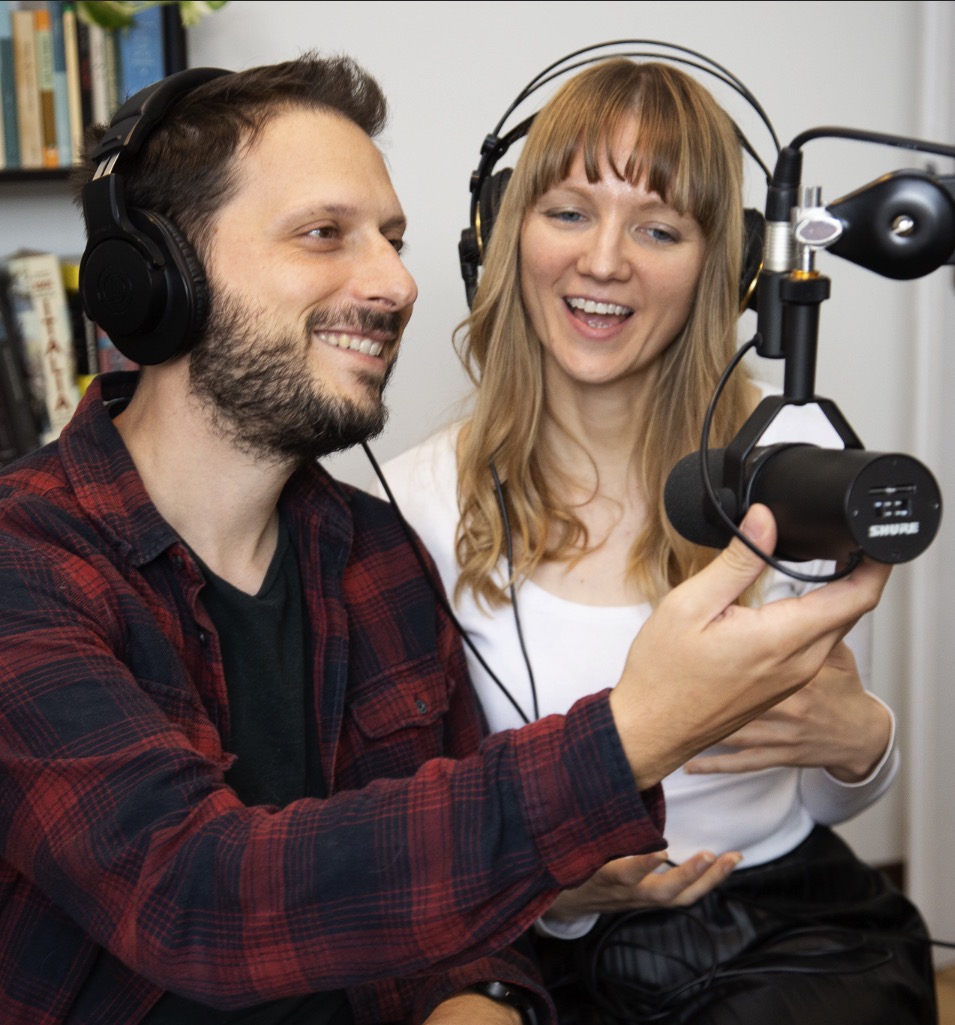
K: Ciao a tutti e benvenuti! Hi everyone and welcome to Learn Italian with Joy of Languages.
In this episode, you’ll learn some phrases you can use with “no” in Italian to sound polite.
M: Not just phrases you might have already come across, like no grazie , or no thanks, but other phrases Italians use all the time.
K: You’ll also hear how you pronounce “no” in Italian, because lots of learners don’t realise you pronounce it differently from English.
But before we get started, can we ask you a quick favore ? If you’re listening to this on your podcast app, could you click the subscribe or follow button? This way you’ll get notified when we release a new episode and you’ll help our podcast grow so we can keep making free lessons like this. Grazie !
M: You’re going to hear a conversation between me and Katie where Katie is trying to convince me to go to a museum exhibition.
K: But Matteo doesn’t love going out of the quartiere , or area, of Milan where we live. Sometimes our friends joke that he even needs a passport to visit other parts of Milan.
M: […]
K: See if you can hear the different ways Matteo tries to turn down my idea.
K: Andiamo alla mostra di…
M: No!
K: Dai, è bella!
M: Forse un altro giorno.
K: Ok… quando?
M: Magari domani
K: Davvero?
M: No, non penso.
K: I started out by saying:
M: Andiamo alla mostra di… - Let’s go to the exhibition of…Literally:
Andiamo - we go
Alla - to the
Mostra - exhibition
Di - of
K: So if you’re looking up a museum you might like to go to in Italy, you can look out for this word mostra and see if they have a particular exhibition that you’d like to go see.
M: Mostra is connected to the word mostrare , to show, which makes sense in a way because at a museum exhibition you’re showing something.
K: But before I could even say which exhibition I wanted to go to, Matteo said
M: No
K: So no in Italian is spelt the same as English, n-o, but it’s pronounced differently. Instead of a long “o” on the end like in English, no, it’s a short, straight sound.
M: No (x2)
K: In English, the “o” in words like “no” is longer and it slides all over the place: nou. In Italian it’s a short straight “oh”.
M: No.
K: Then I said to Matteo:
M: Dai, è bella! - Come on, it’s nice! Literally:
Dai - come on
È - it is
Bella - beautiful
K: There are a couple of very Italian expressions here. Italians use the word bello (beautiful) a lot to mean that something is nice, or lovely. So here, when I was talking about la mostra, which is a feminine word, I used bella , with an -a on the end, to say that it was nice. And I also used the word dai. Italians use this a lot and it has a few different meanings, but here it’s like saying “please, come on”.
Then Matteo said:
M: Forse un altro giorno - Maybe another day. Literally:
Forse - maybe
Un - a
Altro - another
Giorno - day
Forse un altro giorno
K: Forse un altro giorno is a polite way to say “no” to an invitation in Italian. You usually use this phrase if you can’t or don’t feel like doing something. You’re sort of saying no indirectly, because you’re putting it off to some point in the future and not committing to an exact time. That’s why Matteo used this phrase here, because he wasn’t so keen on going to the exhibition.
M: Or if your Italian friend asked if you wanted to go hiking in montagna, in the mountains, but you’re someone who usually prefers to relax on the beach on holiday, you could say forse un altro giorno to put it off
K: Since Matteo suggested another day, I asked:
M: Quando - when?
K: And then Matteo said:
M: Magari domani - maybe tomorrow. Literally:
Magari - maybe
Domani - tomorrow
Magari domani
K: So now you’ve heard two words for maybe in Italian, forse and magari , and might be wondering what the difference is. They’re often interchangeable, so you don’t have to worry too much about the differences in meaning and you can just learn these phrases as they are. Sometimes forse can feel a bit like you’re less keen, whereas magari can sound more positive and enthusiastic, like you’d like something to happen. So when Matteo said magari domani he was sort of saying “maybe tomorrow will actually work”.
And because I wasn’t expecting him to be so willing to go the exhibition in the end, I said:
M: Davvero? - really
K: If it helps to remember this word, it has the word vero in it, which is Italian for real or true. So you’re literally saying really in Italian as well.
M: Davvero?
K: Then Matteo said:
M: No, non penso. - No, I don’t think so. Literally:
Non - not
Penso - I think
No, non penso
K: If you want to soften your “no” a bit in Italian, so you don’t just say a blunt “no”, you can use this phrase: No , non penso.
M: Like if an Italian asked you è libero questo posto , is this seat free, è libero questo posto , instead of just saying no, you could make it softer and friendlier by saying No , non penso .
K: Now that you’ve heard how to say “no” in Italian and some friendly phrases that you can use with it, let’s see what you can remember.
How do you say “no” the Italian way, making sure not to make the “o” on the end too long?
[...]
M: No (x2)
K: And what about a phrase that you can use if you’re not so keen on an idea, so you want to put it off to another time without making any concrete plans? We’d translate it as “maybe another day” in English.
[...]
M: Forse un altro giorno (x2)
K: And what about the phrase “maybe tomorrow”, if you’re a bit hopeful that tomorrow would work out better?
[...]
M: Magari domani (x2)
K: And lastly, what’s a phrase you can use to not just say a blunt “no”? It’s the Italian phrase for “I don’t think so”.
M: No, non penso.(X2)
K: So Matteo will live another day without leaving the quartiere, the neighbourhood. Let’s hear the whole conversation again:
K: Andiamo alla mostra di…
M: No!
K: Dai, è bella!
M: Forse un altro giorno.
K: Ok…quando?
M: Magari domani
K: Davvero?
M: No, non penso.
K: You’ve heard a few different phrases that you can use to say “no” in a friendly way in Italian, but there are lots more.
M: And you'll want to know each one because they suit different situations. Like the phrase you'd use if an Italian offers to help and you want to politely say you don't need it, or what you can say when you'd really like to accept an invitation, but you just can't make it.
K: To see all these phrases, so you don’t just repeat no , or no grazie , just click the link in the description to head over to our website, or go to italian.joyoflanguages.com/podcast and search for episode 242.
K: See you next time.
M: Or as we say in Italian:
Alla prossima!
Time to check your understanding and remember everything you just learned! Below you’ll find a mini-quiz and some vocabulary cards to help it all go in.
Quiz: Learn How to Say “No” in Italian and Still Sound Nice
How much did you learn? Find out in the quiz!
Click here to take the quiz for this episode: Learn How to Say “No” in Italian and Still Sound Nice
Vocabulary
No, mi dispiace = No, I’m sorry
No, ma grazie lo stesso! = No, but thanks anyway!
Vorrei, ma non posso = I’d like to, but I can’t
Purtroppo no. Magari l’anno prossimo! = Unfortunately not. Maybe next year!
Purtroppo no, non abbiamo tempo = Unfortunately not, we don’t have time
Non penso. Mi dispiace. = I don’t think so. I’m sorry.
Forse/magari un altro giorno = Maybe another day
Forse/magari domani = Maybe tomorrow
No, non penso = No, I don’t think so
Flashcards: Learn How to Say “No” in Italian and Still Sound Nice
Not sure how it works? Click here to watch the tutorial