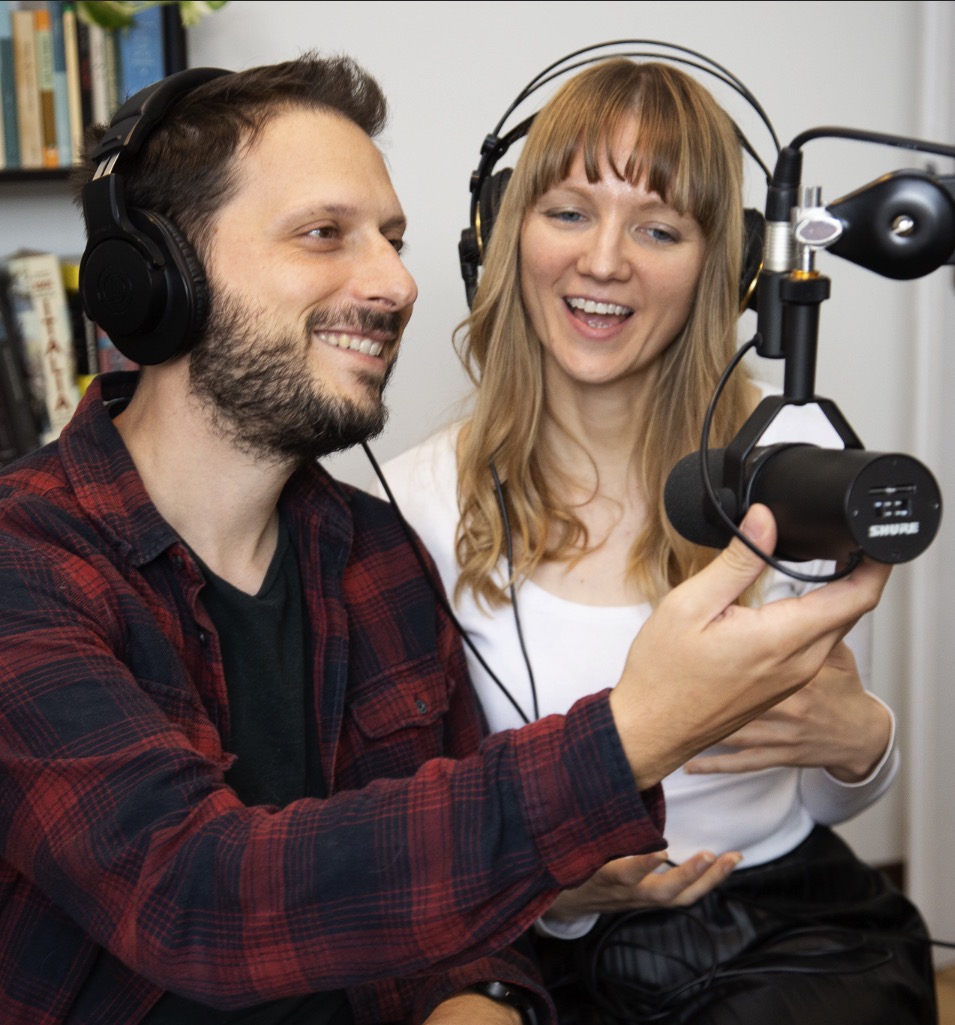
If you're learning Italian, it's probably because you'd like to speak it one day. Maybe to get around Italy, or to chat to Italian friends and relatives.
But lots of learners tell us that it’s hard to find ways to speak Italian if they don’t have anyone to practise with.
In this post, you'll learn three things that you can do straight away to practise speaking Italian by yourself.
Psst! After you’ve done speaking exercises by yourself, you (probably) want to find someone to have real conversations with. For lots of speaking practise with our friendly teachers and students, you can join our online Italian school. Registration is opening soon! We’d love to see you there.
Exercise 1: Use Your Mouth!
To speak Italian, you need one thing you already have: la bocca (your mouth) 😉
It sounds obvious, but it's surprisingly easy to spend lots of time studying Italian without actually speaking it. We read, we listen, we learn grammar… but our mouths stay closed.
So one simple thing you can do is start talking to yourself in Italian as you go about your day. You can describe what you’re doing or what you can see around you.
For example, if you're cooking dinner, you could name the ingredients:
-
Il basilico - Basil
-
Il sale - Salt
-
Il pomodoro - Tomato
-
La patata - Potato
Or you could list what you see in the house and extra details, like colours or size. For example:
-
Il divano blu -The blue sofa
-
Il tavolo piccolo - The small table
-
La lampada gialla - The yellow lamp
You can also use slightly longer sentences to describe what you’re doing. For example:
Preparo la cena. -I'm making (lit. preparing) dinner.
Faccio giardinaggio. -I'm doing gardening.
Porto fuori il cane. -I’m taking the dog out.
Ascolto la musica. -I’m listening to music.
Bevo un caffè. -I’m drinking a coffee.
By doing this, you're using everyday words and expressions. And because you’re using phrases about your own life, you're more likely to use the same phrases later when you're chatting with Italians, like if they ask what you like doing in your free time or what you're doing at the weekend.
You might be thinking: what if I don’t know all the words to describe what I’m saying or doing? You can look up the missing words, and then practise saying them out loud as well.
If you learn a new word, and then put it into practice straight away, it also tells your brain that it’s important, so it will be easier to remember later.
Exercise 2: Record Yourself Speaking
Recording yourself speaking might feel a little awkward at first (most of us cringe when we hear our own voice!), but it's something the students do at our Italian school and they find it really useful.
To make it really effective (so you’re not just saying random words and phrases into the phone) you can do it this way:
Topics could be things like:
Your favourite Italian city.
What you usually have for breakfast.
What you enjoy doing at weekends .
The important thing is to speak from memory rather than read.
That's much closer to what happens in a real conversation, where you won't have a script in front of you.
The effort of recalling words and phrases is also something that helps strengthen your memory, so you're practising both speaking and remembering at the same time.
And the good thing about recording is that you can listen back to yourself. You might not be able to spot every mistake, but you might get a general sense of where you hesitate or don’t pronounce something all’italiana (the Italian way), so you know what to improve on.
Exercise 3: Be an Actor and Copy
For the last exercise, we’d say to be an attore , or actor.
When actors practise their lines, they’re not thinking about what to say. They already know the words. Instead, they focus on how to say them: the pronunciation, the rhythm and the intonation. You can use the same idea to practise speaking Italian.
To do this, find some Italian audio that comes with the written text, like:
-
a podcast with a transcript
-
a YouTube video with subtitles
-
an audiobook with the written text
Listen to one or a couple of sentences, then pause and repeat it, trying to copy the pronunciation, rhythm and intonation as closely as possible.
When you’re choosing what to listen to, try to find natural conversations rather than artificial textbook dialogues. That way you'll pick up useful phrases that Italians use in everyday life. For example, on our YouTube channel, we have the “natural conversations" playlist . Or you can listen to the conversations on our podcast .
And don’t worry if you don't understand every single word. At this stage, you're also training the physical side of speaking. Your mouth is learning how Italian sounds are made and how Italian sentences flow together.
If you’re wondering what type of books to read in Italian, you can go to our lesson on learn Italian with books: what (not) to do .
Bonus Tip: Join Our Italian School
The three exercises in this lesson are all things you can do by yourself. But there'll probably come a point when you want to actually chat with real people and find out how your Italian is coming along.
At our Online Italian School , you'll have weekly speaking lessons with friendly teachers and other Italian learners, so you can use everything you've been practising in real conversations. The atmosphere is relaxed and supportive, so there's no pressure if you make mistakes.
If you'd like even more speaking practice, you can also get in touch with other students and practise together outside the lessons.
Every week, you'll also send us a recording of yourself speaking Italian, and one of our teachers will give you personalised feedback. So instead of wondering how you're getting on, you'll know what you’re doing well and what you can work on.
How to Speak Italian Without Anyone to Practise With: Review
Let’s recap the three things that you can do to practise speaking Italian, even if you don’t have anyone to practise with.
-
Exercise 1: Narrate your day by listing what you see or describing what you're doing. Like saying the ingredients you’re using when you’re cooking, or the objects you see in the room.
-
Exercise 2 : Prepare a short talk on something that interests you and record yourself saying it from memory on your phone. That way you can listen back to get a general sense for what’s going well and what you still need to work on.
-
Exercise 3: Be an actor and copy Italians. Listen to a sentence from a podcast, YouTube video or audiobook, then pause and repeat it, copying the pronunciation, rhythm and intonation as closely as you can.
-
Bonus Tip: When you want to find real people to practise with, you can join our online Italian school. We think speaking is a really important part of learning Italian, so the courses are designed for lots of opportunities for speaking, including weekly conversation classes, and you’ll get lots of encouraging feedback from our friendly teachers.
K: Ciao a tutti e benvenuti! Hi everyone and welcome to Learn Italian with Joy of Languages.
M: Before we get started, I just wanted to let you know we have some Ottime notizie! That’s Italian for good news.
K: Registration for our Online Italian School is opening in a few days. We sold out very quickly last time, so if you think you might like to join us and you’d like a reminder so you don’t miss it, click the link in the description.
K: Lots of learners write to us saying they want to improve their speaking, but they don't have anyone to practise with. In today’s episode, you’ll hear three exercises you can do by yourself to get better at speaking Italian.
M: Time for the first exercise. To speak Italian, you need… la bocca the mouth! It might sound obvious, but it's surprisingly easy to spend lots of time studying Italian without ever actually speaking it.
K: A nice, low pressure way to start using your mouth and speaking Italian is to talk to yourself in Italian as you go about your day, describing the things you see and do. For example, maybe you’re making food in the kitchen and as you go along you say the ingredients that you’re using.
M: Like il basilico. Basil. ll basilico. Or il sale. Salt. Il sale. Or you could list what you see in the house for example il divano. The sofa. Il divano. And you can add extra details if you like. The blue sofa. In Italian, we usually put describing words like colours at the end: il divano blu (x2).
K: You could also use slightly longer phrases to describe what you’re doing.
M: For example, you could say bevo un caffè. I’m drinking a coffee. Bevo un caffè. Or ascolto la musica. I’m listening to music. Ascolto la musica.
K: The nice thing is that because you’re learning Italian connected to your everyday life, you’re using phrases that you’re more likely to use again in real-life conversations. For example, if you’re chatting with an Italian and they ask you what you’re doing at the weekend, or what you like doing in your free time, you’ll have already practised saying the kinds of things you usually get up to.
M: And you might be thinking, what if I don’t know the words or phrases in Italian that I’d need to describe my day. You can look up the missing words, and then practise saying them out loud as well.
K: Your brain is always trying to work out what's worth remembering. If you learn a word because you need it right then and there, then immediately put it into practice, your brain gets the message that it's useful and will hold onto it, so it will be much easier to remember later. It still takes a lot of repetition, that’s normal, but I find it works a lot better compared to trying to remember things from a list or from an app.
M: Ok, now exercise number two. Record yourself speaking.
K: It can feel strange doing this at first and we all find it a bit cringe to hear our voices back, but once you practise a few times, you can get used to it. This is something students do at our online Italian school and they find it really useful.
M: And there’s a way to do this to make sure it’s effective, so you’re not just saying random words and phrases into your phone and not really noticing much progress.
K: What we find works best is: Prepare a short talk about something that’s connected to your life. Like what your favourite Italian city is and why, or what you enjoy having for breakfast. Then look up the words and phrases you need and write a very short speech, just four or five sentences is enough. If you're not sure how to say something, you can borrow useful phrases from a podcast episode or YouTube video, or use an online dictionary or AI tool to fill in the gaps. Then read the speech out loud a few times until you can say it without thinking too much. And finally put the text away and record yourself on your phone.
M: The important thing is to speak from memory rather than read. It’s completely fine if you’re slow, and you forget a lot, and need to try it a few, or perhaps many many times. That’s normal and it’s important. Trying to work from memory means practising the same skill you’ll need in a real conversation, where you won’t have a script in front of you.
K: And that effort of recalling the phrases is actually what helps your brain remember them better, according to what the science says. The other good thing about recording yourself is that you can listen back to it. It might not be possible by yourself to notice every mistake you're making, but you might get an idea of where you hesitate a lot, or sound less Italian with your pronunciation, so you know what to work on. And on the flip side it can also be rewarding when you hear back what you’re saying well.
M: And if you do know any Italians, you can be brave and get them to correct your audio and make suggestions – we’re often very happy to help!
K: Our teachers do this for our students in the school, and getting that extra layer of feedback from an Italian can be really useful too.
M: And now for the last tip for speaking Italian by yourself. Become an attore, an actor, and do lots of copying.
K: All you need is some audio with the text to follow along. Like an audiobook with the book, a podcast with a transcript or a YouTube video with the subtitles turned on. Listen to a sentence, then say it out loud, trying to imitate what you hear as closely as you can. It’s like being an actor because you're not trying to think of what to say, you’re just copying the pronunciation and the intonation of the sentence.
M: If possible, try to find materials that are appropriate for your level. You can try with the dialogues in this podcast as they’re slower and simpler, for learners. But ultimately, it doesn't matter if you don't understand every single word. You just want to make sure your mouth is getting used to making new sounds and getting used to the rhythm of Italian.
K: And don't worry if it feels awkward at first, or if your mouth can't quite keep up. That's completely normal. It’s easy to forget that speaking a new language is a physical skill, and just like any other skill, like driving and swimming, it gets easier with practice.
M: The useful thing about things you listen to, like audiobooks and podcasts, is that you can listen to them as many times as you like. Each time, you'll notice a little more about how Italians speak.
K: When you’re choosing what to listen to, try and find natural conversations in Italian, like the ones on our podcast, so not the kinds of random phrases you sometimes find in apps. That way you’re more likely to pick up some useful phrases that you’ll actually use in Italy.
M: So you’ve heard three exercises for things that you can do to speak Italian by yourself. Let’s do a quick recap, so you can remember them next time you want to practise.
K: Number one, narrate what you’re doing or seeing as you go about your day.
M: Number two, prepare a few phrases on a topic and record them on your phone.
K: Number three, using things like audiobooks and podcast transcripts, read aloud what you’ve just listened to.
M: And finally we also have a bonus tip. Practising speaking Italian by yourself will help you get better at Italian, but there will probably come the point when you want to actually speak with real people and get feedback on how you’re doing.
K: At our online Italian school, we have weekly speaking lessons, where you get the chance to use everything you've been practising in real conversations with a teacher and other Italian learners. The environment is very friendly and supportive, so you can build confidence before you go to Italy and have a go at chatting with Italians.
M: If you want to, you can also be put in touch with other students so you can practise speaking together outside of the lessons. It’s optional of course, but a lot of our students really like it as a way to not only get better at speaking Italian, but to meet new people.
K: And every week, you send us a recording of yourself speaking Italian, and one of our teachers will give you personalised feedback. For example, they might let you know if you made a mistake or if your pronunciation wasn’t quite right, and they’ll show you how you should say it instead. And of course they’ll also highlight what you did well. So instead of wondering whether you're improving, you'll know exactly what's going well and what you can do next.
M: If you think you’d like to join us this term, click the link in the description to learn more about our Online Italian School. We’d love to see you there.
K: A presto!
Time to check your understanding and remember everything you just learned! Below you’ll find a mini-quiz and some vocabulary cards to help it all go in.
Quiz: How to Speak Italian Without Anyone to Practise With
How much did you learn? Find out in the quiz!
Click here to take the quiz for this episode: How to Speak Italian Without Anyone to Practise With
Vocabulary
Preparo la cena = I'm making (lit. preparing) dinner
Faccio giardinaggio = I'm doing gardening
Porto fuori il cane = I’m taking the dog out
Bevo un caffè = I’m drinking a coffee
Ascolto la musica = I’m listening to music
Flashcards: How to Speak Italian Without Anyone to Practise With
Not sure how it works? Click here to watch the tutorial