Che lavoro fai , or “what job do you do”, is a really common question that Italians ask to get to know you better.
In this post, you’ll see how to answer it using different words for jobs in Italian.
And if your job doesn’t fit into just one title, you’ll also learn some useful phrases to help you explain it.
Jobs in Italian
Below is a list of common jobs in Italian that you can use as a reference.
But don’t worry about learning them all. You don’t need every job title to chat about work with Italians. Just pick the ones that are useful for you, so you can talk about what you (or people around you) do for work.
| Un avvocato | A lawyer (m) | Oon ahv-voh-KAH-toh |
| Un'avvocata | A lawyer (f) | Oon ahv-voh-KAH-tah |
| Un cameriere | A waiter | Oon kah-meh-RYEH-reh |
| Una cameriera | A waitress | Oon-ah kah-meh-RYEH-rah |
| Un casalingo | A homemaker (m) | Oon kah-sah-LEEN-goh |
| Una casalinga | A homemaker (f) | Oon-ah kah-sah-LEEN-gah |
| Un cuoco | A cook/chef (m) | Oon KWOH-koh |
| Una cuoca | A cook/chef (f) | Oon-ah KWOH-kah |
| Un dentista | A dentist (m) | Oon den-TEE-stah |
| Una dentista | A dentist (f) | Oon-ah den-TEE-stah |
| Un direttore | A director (m) | Oon dee-reht-TOH-reh |
| Una direttrice | A director (f) | Oon-ah dee-reht-TREE-cheh |
| Un giornalista | A journalist (m) | Oon jor-nah-LEE-stah |
| Una giornalista | A journalist (f) | Oon-ah jor-nah-LEE-stah |
| Un idraulico | A plumber (m) | Oon ee-drow-LEE-koh |
| Un'idraulica | A plumber (f) | Oon ee-drow-LEE-kah |
| Un impiegato | An office worker (m) | Oon eem-pyeh-GAH-toh |
| Un'impiegata | An office worker (f) | Oon eem-pyeh-GAH-tah |
| Un infermiere | A nurse (m) | Oon een-fehr-MYEH-reh |
| Un'infermiera | A nurse (f) | Oon een-fehr-MYEH-rah |
| Un insegnante | A teacher (m) | Oon een-seh-NYAN-teh |
| Un'insegnante | A teacher (f) | Oon een-seh-NYAN-teh |
| Un meccanico | A mechanic (m) | Oon meh-KAH-nee-koh |
| Una meccanica | A mechanic (f) | Oon-ah meh-KAH-nee-kah |
| Un medico | A doctor (m) | Oon MEH-dee-koh |
| Una medica | A doctor (f) | Oon-ah MEH-dee-kah |
| Un muratore | A builder (m) | Oon moo-rah-TOH-reh |
| Una muratrice | A builder (f) | Oon-ah moo-rah-TREE-cheh |
| Un operaio | A factory worker (m) | Oon oh-peh-RYE-oh |
| Un'operaia | A factory worker (f) | Oon oh-peh-RYE-ah |
| Un poliziotto | A police officer (m) | Oon poh-lee-TSYOT-toh |
| Una poliziotta | A police officer (f) | Oon ah poh-lee-TSYOT-tah |
| Uno scrittore | A writer (m) | Ooh-noh skree-TOH-reh |
| Una scrittrice | A writer (f) | Oon-ah skree-TREE-cheh |
💡Good to know : If you’re not working anymore, you might want to know the phrase sono in pensione: I’m retired (SOH-noh een pen-SYOH-neh).
Gender Differences
You usually change the ending job title in Italian depending on whether you’re male or female.
Here’s how it works:
-
-o → -a e.g. cuoco (male cook), cuoca (female cook)
-
-ore → -rice e.g. direttore (male director), direttrice (female director)
-
-ista stays the same e.g. barista (male or female) — only the word for “a” changes ( un/un’/una )
How to Talk About Your Job in Italian
Sono (I am) and Ero (I was)
When you’re talking about what you do or used to do in Italian, it’s useful to know how to say sono (I am) or ero (I was).
For example:
Sono infermiere. -I’m a nurse
Ero dentista. -I was a dentist.
Ero medica, ma ora sono in pensione. -I was a doctor, but now I’m retired.
💡Good to know When talking about your job in Italian, you can leave out the word “a” (or un/un’/una). It’s both correct with it or without it. For example, sono medico or sono un medico.
Explaining Your Job in Italian
Capiamo (we understand) that sometimes your job doesn’t fit into one neat title. You might need to explain it so that an Italian understands what you do or used to do.
Here are some phrases that you can use to try and explain your job in Italian in a simple, roundabout way, so you don’t have to memorize complicated phrases.
Lavoro con - I work with
Lavoro con is a useful phrase when your job is easier to describe through people or things.
For example:
Lavoro con i bambini. -I work with children.
Lavoro con i dati. -I work with data.
Lavoro con le aziende di marketing. -I work with marketing companies.
Lavoro in…- I work in…
You can use lavoro in to say where you work.
For example:
Lavoro in ospedale. -I work in a hospital.
Lavoro in banca. -I work in a bank.
Lavoro in ufficio. -I work in an office.
Lavoro per… - I work for
You can use lavoro per to talk about the company or person you work for.
For example:
Lavoro per un’azienda internazionale. -I work for an international company.
Lavoro per clienti americani. -I work for American clients.
Aiuto… - I help…
You can use aiuto…a… to say who you help.
For example:
Aiuto gli studenti. -I help students.
Aiuto gli infermieri. -I help nurses.
And if you add aiuto…a …you can explain what you help someone do.
For example:
Aiuto gli studenti a imparare l’italiano. -I help students learn Italian.
Aiuto le persone a organizzare viaggi. -I help people organize trips.
Aiuto le aziende a crescere. -I help companies grow.
Aiuto con… - I help with…
You can say aiuto con to show the things you help with.
For example:
Aiuto con il marketing. -I help with marketing.
Aiuto con l’amministrazione. -I help with admin.
Aiuto con l’organizzazione degli eventi. -I help with organizing events.
È complicato, ma… - It’s complicated, but…
You can use this phrase when your job is hard to explain simply.
It helps you buy time and sounds natural when you’re not sure how to describe your job clearly.
For example:
È complicato, ma aiuto le persone a organizzare viaggi. -It’s complicated, but I help people organize trips.
È complicato, ma lavoro in farmacia. -It’s complicated, but I work in a pharmacy.
Jobs in Italian: Say What You Do or Did: Review
-
To answer the question che lavoro fai (“what job do you do”), you can use common job words like:
Sono insegnante -I’m a teacher
Ero dentista -I was a dentist
You use sono to talk about what you do now, and ero to talk about what you used to do.
-
If your job is hard to sum up in one word, you can explain it with simple phrases:
Lavoro con… - I work with
Lavoro in/a… - I work in
Lavoro per… - I work for
Aiuto con…
Aiuto…a… - I help…to
È complicato, ma… - It’s complicated, but…
For example:
Lavoro con i bambini. -I work with children
Lavoro in ospedale. -I work in a hospital
Aiuto gli studenti a imparare italiano. -I help students to learn Italian
È complicato, ma lavoro in farmacia. -It’s complicated, but I work in a pharmacy
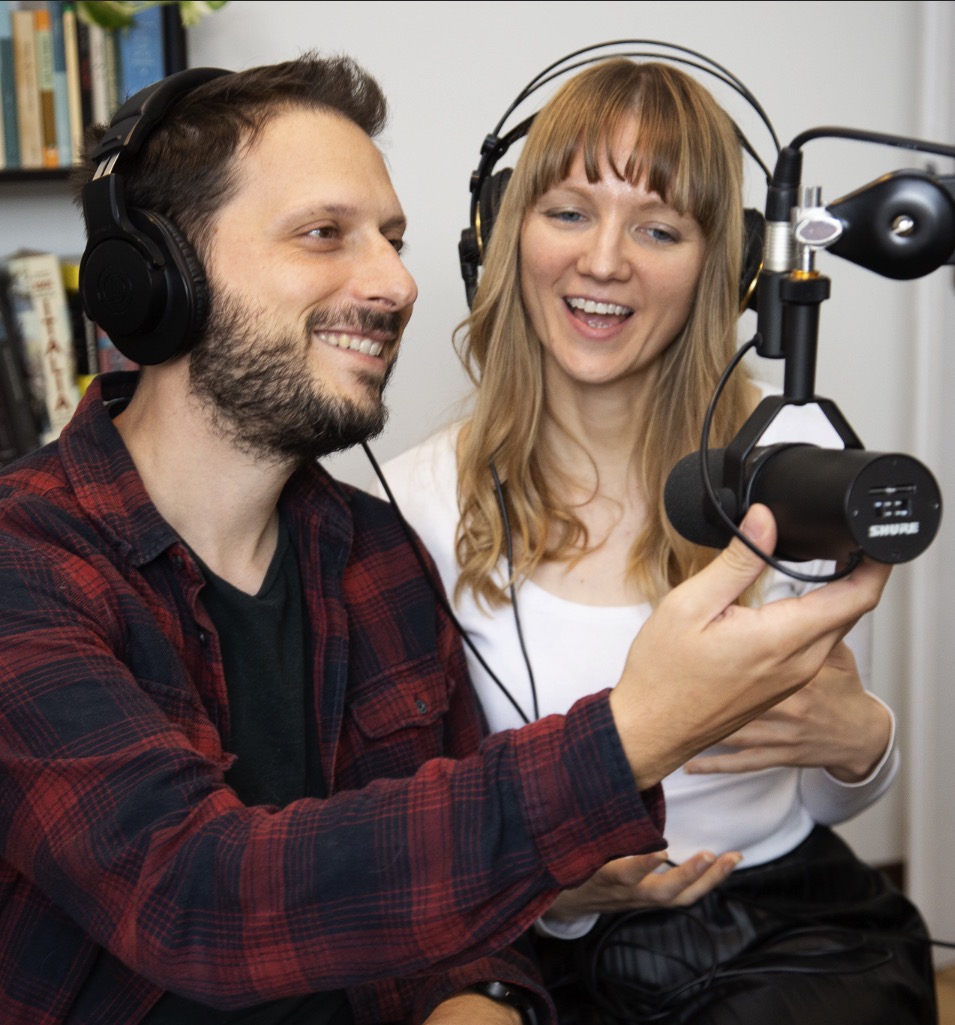
M: Ciao a tutti e benvenuti! Hi everyone and welcome to Learn Italian with Joy of Languages.
K: We’re going to talk about jobs in Italian, but we’re not going to make you listen to an endless list of job titles. You’ll find out how you can talk about jobs in a way that’s useful and relevant for your conversations.
M: But before we get started, can we ask you a quick favore ? If you’re listening to this on your podcast app, could you click the subscribe or follow button? This way you’ll get notified when we release a new episode and you’ll help our podcast grow so we can keep making free lessons like this. Grazie !
K: So, recently, we had to call a plumber out, because our electric water heater is always causing problems.
M: And a plumber in Italian is idraulico . So you’ve just heard the first job title. Idraulico.
K: And the idraulico asked Matteo: che lavoro fai? What job do you do?
M: Che lavoro fai? It’s hard to answer this question, because I work on the YouTube channel and for the online school, and that involves doing lots of different things.
K: In this conversation between me and Matteo, you’ll hear how we try and explain what Matteo does. See if you can hear the different job titles we use.
M: Alla fine ho detto che sono video editor.
K: Ma sei anche manager, insegnante, cameraman...
M: Quando ero grafico era più facile spiegare il mio lavoro.
K: Ah, a volte sei anche cuoco!
M: Giusto. Ora il mio lavoro è più complicato, ma anche più divertente!
K: Matteo explained:
M: Alla fine ho detto che sono video editor - In the end, I said that I’m a video editor. Literally:
Alla - at the
Fine - end
Ho - I have
Detto - said
Che - that
Sono - I am
Video editor
K: You’ve heard one of the first job titles: video editor. It’s an English word, but an Italian would pronounce it the Italian way.
M: Video editor (x2) .
K: For some jobs, especially the modern, less traditional ones, it’s really common for Italians to use the English name.
You also heard how we can use the Italian for “I am” to say what job we do.
M: Sono. I am. Sono. For example, sono video editor. I’m a video editor.
K: You can use sono and then just replace the word after depending on what job you do. But in Italian, you don’t have to put the word for “a” when you say what job you do. So instead of saying “I am a video editor”, Matteo just said: sono video editor . literally, I am video editor. Or you could also say sono insegnante. I am a teacher, but literally I am teacher. Or sono medico. Literally, I am doctor.
If you're retired, there's a different way to talk about what you used to do, which we'll hear soon, but first, I said to Matteo:
M: Ma sei anche manager, insegnante, cameraman… - But you’re also a manager, teacher, camerman…Literally:
Ma - but
Sei - you are
Anche - also
Manager - manager
Insegnante - teacher
Cameraman - cameraman
K: Again, you’ve heard some more modern titles where Italians often just use the English word, like manager and cameraman. There are Italian versions of these job titles, but it’s often more common to use the English version, so you can just go with those! But there was a word that’s different in Italian and English.
M: Insegnante. Teacher. Insegnante. The simple thing about this word is that it’s the same whether you’re male or female. So Katie could say sono insegnante, or I am a teacher , as well.
K: Then Matteo explained:
M: Quando ero grafico - When I was a graphic designer. Literally:
Quando - when
Ero - I was
Grafico - graphic designer
K: And then he said: era più facile spiegare il mio lavoro - it was easier to explain my job. Literally:
Era - it was
Più - more
Facile - easy
Spiegare - to explain
Il - the
Mio - my
Lavoro - job
K: You’ve heard another job title:
M: Grafico (x2). It ends in an -o because I’m talking, but if you were female you’d say grafica, with an -a on the end. Grafica.
K: Usually, if you have a job ending with an -o, you swap it for an -a for the feminine version.
Matteo also used a really useful word that you can use when you’re talking about what you used to do for work:
M: Ero . I was. Ero. So you use sono, “I am”, for the job you do now, and ero, “I was”, to talk about the job you used to do.
K: So if you’re retired, ero is a great phrase to use to talk about what you used to do. You say ero and then put the job title after. For example, ero grafico , I was a graphic designer. Or ero insegnante, I was a teacher.
M: You can also use the phrase in Italian “I am retired” and that’s sono in pensione (x2) .
K: Literally “I am in pension” kind of makes sense! Sono in pensione.
M: If you want to say “I’m retired, but I used to be a teacher”, you could say sono in pensione, ma ero insegnante (x2) .
K: Then I added another job that Matteo usually does
M: Sei anche cuoco - You’re also a cook. Literally:
Sei - you are
Anche - also
Cuoco - cook
K: This is because Matteo is usually the person who does the cooking at home, but he also does cooking classes for the online Italian school.
M: [...]
M: And for the feminine version of “cook”, we take the -o off the end and put an -a. Cuoca (x2)
K: You can use cuoco , or cuoca , to say “cook” or also “chef”, if you cook for a living.
M: But you can use the word chef in Italian as well.
K: After I said Matteo was a cook, he said:
M: Giusto. True, or right.
K: And then he said: Ora il mio lavoro è più complicato, - Now my job is more complicated.
Ora - now
Il - the
Mio - my
Lavoro - job
È - is
Più - more
Complicato - complicated
K: And then he added:
M: ma anche più divertente! - but also more fun! Literally:
Ma - but
Anche - also
Più - more
Divertente - fun
K: You might want to use some of the words that Matteo has used to talk about your own job.
Now that you’ve heard a few different phrases to talk about jobs in Italian. Let’s see what you can remember.
Can you remember the word for “plumber” that you heard at the start of the episode?
[...]
M: Idraulico (x2) .
K: There are also lots of job titles which are the same in English and Italian. Can you remember which ones you heard in this conversation?
[...]
M: We said video editor, cameraman and manager.
K: And how would we say “cook”, like “you are a cook”.
M: Cuoco (x2). For example, sei cuoco. Or for the feminine, cuoca (x2).
K: What’s the Italian for “I am”? It’s really useful when you want to talk about what job you do now, like “I’m a video editor”. In Italian, you can remove the “a” and just say: “I am video editor”.
M: Sono. For example, sono video editor.
K: And what about “I was” to talk about the jobs you used to do? For example “I was a graphic designer”.
M: Ero (x2) . For example, ero grafico.
K: What about the Italian for “I’m retired”? You could also use it to say a sentence like “I’m retired, but I was a teacher”.
M: Sono in pensione (x2) . And you could say sono in pensione, ma ero insegnante.
K: Let’s hear the whole conversation again:
M: Alla fine ho detto che sono video editor.
K: Ma sei anche manager, insegnante, cameraman...
M: Quando ero grafico era più facile spiegare il mio lavoro.
K: Ah, a volte sei anche cuoco!
M: Giusto. Ora il mio lavoro è più complicato, ma anche più divertente!
K: You’ve heard a few different jobs in Italian, but you might not have heard the one that’s most useful to you to talk about what you or people close to you do for a living. You can find more Italian words for jobs on our website.
M: But we also know that jobs don’t fit into neat lists. You might do a job that doesn’t have an easy translation into Italian and needs a bit more explaining.
K: So you’ll also find simple phrases that you can use to explain your job. That way you can keep the conversation going and help Italians understand what you do or used to do for work, even if it’s a bit complicated! It’s worth getting right because it’s one of the most common questions you’ll get asked.
M: To find these phrases, just click the link in the description to head over to our website, or go to italian.joyoflanguages.com/podcast and search for episode 228.
K: See you next time.
M: Or as we say in Italian.
Alla prossima!
Time to check your understanding and remember everything you just learned! Below you’ll find a mini-quiz and some vocabulary cards to help it all go in.
Quiz: Jobs in Italian: Say What You Do or Did
How much did you learn? Find out in the quiz!
Click here to take the quiz for this episode: Jobs in Italian: Say What You Do or Did
Vocabulary
Ora sono insegnante, ma ero avvocato = Now I’m a teacher, but I was a lawyer
È complicato, ma lavoro in farmacia = It’s complicated, but I work in a pharmacy
Lavoro per un’azienda internazionale = I work for an international company
Aiuto gli studenti a imparare l’italiano = I help students learn Italian
Sono in pensione = I’m retired
Sono in pensione, ma ero insegnante = I’m retired, but I was a teacher
Che lavoro fai = What job do you do?
Sono video editor = I’m a video editor
Sei anche cuoco = You’re also a cook
Sei anche manager, insegnante, cameraman = You’re also a manager, teacher, cameraman
Ero grafico = I was a graphic designer
Flashcards: Jobs in Italian: Say What You Do or Did
Not sure how it works? Click here to watch the tutorial