The Italian verb uscire (Italian for “to go out” or “to leave”) is one you’ll hear a lot in everyday conversations in Italy.
But uscire is an irregular verb, which means it doesn’t follow the normal pattern. Here you’ll see how it works with everyday phrases you can practise for your next trip to Italy.
Uscire – To go out
Here are a few ways you can use uscire to talk about going out:
Esco a prendere un caffè, vuoi venire? -I’m going out to get a coffee, do you want to come?
Esco adesso, ma torno subito! -I’m going out now, but I’ll be right back! (Lit. I’ll return straight away)
Esci stasera? -Are you going out this evening?
A che ora usciamo? -What time are we going out?
Usciamo a fare una passeggiata? -Shall we go out for a walk?
Stasera uscite a mangiare? -This evening are you (plural) going out to eat?
Katie e Mary escono spesso insieme. -Katie and Mary often go out together.
Uscire – To Leave
Uscire can also mean “to leave” or “to come/go out of” a place.
When you say which place you’re leaving in Italian, you usually add da , Italian for “from”. It’s similar to English, where we sometimes say we’re leaving “from” somewhere too.
For example:
Usciamo dall’hotel alle otto . -We’re leaving the hotel at eight .
Molti italiani escono dall’ufficio alle sei. -Lots of Italians leave the office at six .
A che ora esci dal lavoro? -What time do you leave work?
Se esci dall’autostrada alla prossima uscita, eviti il traffico. - If you leave the motorway at the next exit, you’ll avoid the traffic.
Matteo esce raramente dal suo quartiere di Milano . -Matteo rarely leaves his area of Milan.
But there is one common expression in Italian where instead of using uscire da (“leave from”) you say uscire di (literally “leave of”):
Uscire di casa - To leave the house.
For example:
Non esco mai di casa senza un buon libro -I never leave the house without a good book.
Uscire: Present Tense
We find it’s not that effective (or fun 😁) to memorise lots of verb tables. So rather than worry about all the possible forms of uscire , here’s how it works in one of the tenses you’re mostly likely to need: the present.
And the good news about the present tense is that you can use it to talk about the future as well.
For example, you could say usciamo adesso (“ we’re going out now”) or usciamo domani (we’re going out tomorrow”).
| Io* | esco | I go out / leave | EH-skoh |
| Tu | esci | You go out / leave | EH-shee |
| Lui / Lei | esce | S/he goes out / leaves | EH-sheh |
| Noi | usciamo | We go out / leave | Oo-SHAH-moh |
| Voi | uscite | You (plural) go out / leave | Oo-SHEE-teh |
| Loro | escono | They go out / leave | EH-skoh-noh |
*A little reminder: we normally leave out pronouns like “I” and “you” in Italian because the verb ending already makes it clear who we’re talking about.
Uscire: Imperative
Another useful way of using uscire in Italy is with the imperative. That’s just the fancy name for when you give orders or instructions.
| Tu | esci | Go out / leave | Eh-shee |
| Lui / Lei | esca | Go out / leave (formal) | Eh-skah |
| Noi | usciamo | Let’s go out / leave | Oo-shah-moh |
| Voi | uscite | Go out / leave (plural) | Oo-shee-teh |
For example:
Uscite senza di me, arrivo dopo. -Go out without me, I’ll be there (lit. arrive) later.
Esca da questo lato se preferisce. -Leave from this side if you (formal) prefer.
Usciamo stasera! È la nostra ultima sera in Italia! -Let’s go out this evening! It’s our last evening in Italy!
Italian Verb Uscire and Useful Phrases for Italy: Review
-
Uscire is the Italian for “to go out” or “to leave”.
-
Apart from the common phrase uscire di casa (to leave the house), when you talk about leaving from somewhere in Italian, you usually say uscire da.
For example:
Usciamo dall’hotel alle otto. -We’re leaving the hotel at eight.
-
Uscire is an irregular verb, meaning it doesn’t follow the normal rules and you just have to learn it as it is. You can focus on the present tense and the imperative as these are the ways you’re most likely to use uscire in Italy.
Present tense:
Esco - I go out / leave
Esci - you go out / leave
Esce - he/she goes out / leaves
Usciamo - we go out / leave
Uscite - you (plural) go out / leave
Escono - they go out / leave
Imperative:
Esci - go out / leave
Esca - go out / leave (formal)
Usciamo - let’s go out
Uscite - you (plural) go out / leave
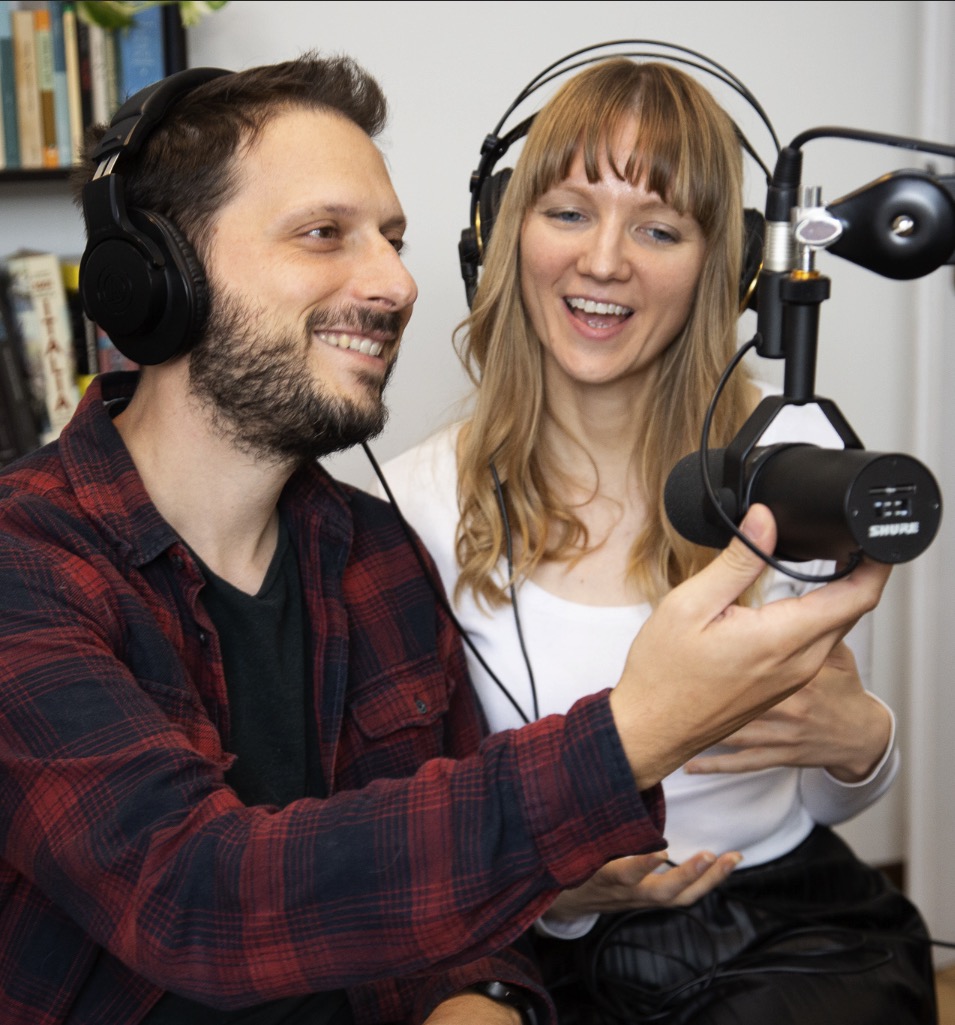
K: Ciao a tutti e benvenuti! Hi everyone and welcome to Learn Italian with Joy of Languages.
M: In this episode, you'll learn how to use uscire in some everyday Italian phrases. You’ll also hear about a place that you can go to if you’re ever visiting Milan.
K: But before we get started, can we ask you a quick favore ? If you’re listening to this on your podcast app, could you click the subscribe or follow button? This way you’ll get notified when we release a new episode and you’ll help our podcast grow so we can keep making free lessons like this. Grazie!.
M: If you’ve listened to some of the other episodes, you might remember that I am sometimes a bit pigro, lazy. I avoid going out and leaving our neighbourhood in Milan when I can!
K: As you listen to the conversation, see if you can listen to the different forms of uscire .
M: Esci?
K: Sì, esco con Mary. Vuoi venire?
M: Ok, dove andiamo?
K: Ai Navigli.
M: Ah… Uscite senza di me allora
K: Perché?
M: Sono le 6, tutti i milanesi escono dall’ufficio ora e vanno lì a fare l’aperitivo.
K: Sei veramente un pantofolaio.
K: So Matteo started by asking me:
M: Esci - are you going out? Literally, “you go out”.
K: So you’ve heard the first form of the verb uscire.
M: Esci (x2)
K: Uscire , “to go out”, starts with a “u”, pronounced ooo. But when you say “you go out”, the first letter changes to an “e”, pronounced as eh.
K: Esci, you go out, ends in the letter -i, pronounced as ee. This ending tells us we mean “you”, as in “you go out”. If we want to, we can use the word for you “tu” before it and say “tu esci”. But because the ending already tells us, we normally leave these little words out. So the most natural way to say you go out is:
M: Esci (x2)
M: And you can turn esci into a question by raising your voice at the end, like I did with Katie to ask if she was going out. Esci?
K: And after Matteo asked this, I replied:
M: Sì, esco con Mary . - Yes, I’m going out with Mary. Literally:
Sì - yes
Esco - I go out
Con - with
Mary - Mary is one of our friends and is also a teacher at Joy of Languages.
K: So you heard another form of uscire
M: Esco (x2)
K: Again, this form of uscire starts with an “e”, pronounced “eh”, like you heard with esci , you go out. This time, the -o on the end tells us we’re saying “I go out”. Esco.
We could use “io”, whic is the little word for “I” in Italian. We could say “io esco”. But like with all of these verb forms, the ending already tells us who is going out, so we don’t need it. So I go out, again is:
M: Esco (x2).
K: And then I asked Matteo:
M: Vuoi venire? - Do you want to come?
Vuoi - you want
Venire - to come
At first Matteo wasn’t against the idea, so he said:
M: Ok, dove andiamo? - ok, where are we going? Literally:
Ok
Dove - where
Andiamo - we go
K: Then I replied:
M: Ai Navigli - to the Navigli canals. Literally:
Ai - to the
Navigli - Navigli, which is the name of the canals.
K: Navigli are the historic canals in Milan and there are lots of bars and restaurants around there. It’s a nice spot because you can have a drink or food by the water and there’s often a very lively atmosphere. But after I said that’s where we’d be going, Matteo said:
M: Ah… uscite senza di me allora . - Ah, go out without me then. Literally:
Uscite - you (plural) go out
Senza - without
Di - of
Me - me
Allora - then
K: As a side note, it might sound strange to say “without of” in Italian, but it’s one of those things where that’s the most natural Italian expression, but the literal translation doesn’t make much sense in English. In these cases, it’s best just to learn the little chink of words: without me = senza di me.
You also heard the next form of uscire .
M: Uscite (x2).
K: You use uscite when you’re talking to two or more people in Italian. That’s why Matteo used it when he was talking about me and Mary. It’s a bit like saying “you guys go without me”. This time is sounds more like the base form of the verb. To go out is: uscire (x2). And you plural go out is uscite (x2). A quick tip, to find the “you plural form”, you usually take the base form, like uscire , and just replace the last r, the ruh sound, with a t. So usci-re becomes usci-te. You plural go out again is:
M: Uscite (x2)
K: After Matteo said that just Mary and I should go without him, I replied:
M: Perché? - Why?
K: And he said: sono le 6, tutti i milanesi escono dall’ufficio ora - it’s 6 pm, all the Milanesi are leaving the office now. Literally:
Sono - they are
Le - the
sei - six
Tutti - All
I - the
Milanesi - Milanese
Escono - they go out
Dall ’ - from the
Ufficio - office
Ora - now
K: So now you heard another form of uscire in Italian
M: Escono . They go out. Escono .
K: This one also starts with an “e”, pronounced “eh”, like you heard with esci , “you go out”, and esco, “I go out”.
M: As a little tip, with quite a few irregular verbs in Italian, the “I” and “they” forms can start in a similar way.
K: So again, we’ve got “I go out”:
M: Esco (x2)
K: And they go out:
M. Escono (x2)
K: In Italian, though, you usually have to include the equivalent of “from” when you talk about leaving a place. That’s why you heard it in the phrase "they leave the office", literally “they leave from the office”:
M: Escono dall’ufficio - they leave from the office. Escono dall’ufficio .
K: And then Matteo added:
M: e vanno lì a fare l’aperitivo - and they’re going there to have an aperitif. Literally:
E - and
Vanno - they go
Li - there
A - to
Fare - do
L’aperitivo - the aperitif, which is that very Italian, pre-dinner drinks and nibbles.
K: It’s true that the Navigli area is a very popular place to have an aperitivo , but I knew that Matteo was using it as a good excuse, so I said:
K: Sei veramente un pantofolaio - You’re such a homebody. Literally:
Sei - you are
Veramente - really
Un - a
Pantofolaio - slipper wearer
K: Pantofolaio is one of those lovely Italian word that’s hard to translate! Una pantofola is Italian for a slipper, so if you’re a pantofolaio it gives the idea of someone who likes staying at home in their slippers, taking things easy.
M: So if you wanted to joke around a bit in Italian, you could say sono un pantofolaio if you're someone who likes staying at home relaxing.
K: Now that you’ve heard a few different forms for uscire let’s see what you can remember.
K: How would you say “are you going out?” or literally “you go out”. It was the question Matteo asked me at the start of the conversation.
[…]
M: Esci? (x2)
K: How would you say “I go out” or “I’m going out”? For example, “I’m going out with Mary”
[…]
M: Esco (x2) . For example, esco con Mary .
K: And how would you say “you (plural) go out”? Like Matteo used when he said, “you go out without me”.
[…]
M: Uscite (x2) . For example, uscite senza di me .
K: And what about “they go out”? We could also translate it as “they leave” like in the phrase “everyone is leaving the office now”.
[…]
M: Escono (x2) . For example tutti escono dall’ufficio ora .
K: So you’ve heard most of the different forms of uscire , but there are two left that you didn’t hear in the conversation.
M: One is usciamo (x2) . We go out. Usciamo . For example, stasera, usciamo con amici . This evening we’re going out with friends. Stasera usciamo con amici .
K: And the next one is how to say “he or she goes out”.
M: Esce (x2) . For example, Katie esce con Mary . Katie is going out with Mary. Katie esce con Mary .
K: Esce is also a useful one to know because it’s also the way you’d say “you (formal) go out”.
M: For example, to check that your room is free so they can clean it, a hotel receptionist might ask you esce ora ? Are you (formal) going out now? Esce ora?
K: Since you’ve heard quite a few different forms of uscire, we’ll do a quick recap. This time you’ll hear the forms in the order you’ll usually find them in tables if you ever look uscire up online, like in a dictionary or on our website.
M: Esco - I go out
Esci - you go out
Esce - he or she goes out, or you formal go out
Usciamo - we go out
Uscite - you (plural) go out
Escono - they go out
K: But instead of trying to memorise all the different forms in a list, what we find helps make them stick better is to learn them as part of everyday phrases that you’ll use in Italy, like you heard in the conversation between me and Matteo.
M: Let’s hear the conversation again:
M: Esci?
K: Sì, esco con Mary. Vuoi venire?
M: Ok, dove andiamo?
K: Ai Navigli.
M: Ah… Uscite senza di me allora
K: Perché?
M: Sono le sei, tutti i milanesi escono dall’ufficio ora e vanno lì a fare l’aperitivo.
K: Sei veramente un pantofolaio.
M: On our website, you can find some everyday phrases with uscire that you can use to practise. For example, you could try saying them out loud a few times, or use the flashcards to see what you can remember.
K: There, you’ll also find a way of using uscire that we haven’t mentioned yet. It’s something that you might see on signs, or if an Italian gives you instructions. To find out how it works, just click the link in the description to head over to our website, or go to italian.joyoflanguages.com/podcast and search for episode 245.
M: See you next time.
K: Or as we say in Italian:
Alla prossima!
Time to check your understanding and remember everything you just learned! Below you’ll find a mini-quiz and some vocabulary cards to help it all go in.
Quiz: Italian Verb Uscire and Useful Phrases for Italy
How much did you learn? Find out in the quiz!
Click here to take the quiz for this episode: Italian Verb Uscire and Useful Phrases for Italy
Vocabulary
Esci stasera? = Are you going out this evening?
Esco adesso, ma torno subito! = I’m going out now, but I’ll be right back!
A che ora usciamo? = What time are we going out?
Usciamo a fare una passeggiata? = Shall we go out for a walk?
Stasera uscite a mangiare? = Are you (plural) going out to eat this evening?
Molti italiani escono dall'ufficio alle sei = Lots of Italians leave the office at six
Esca da questo lato se preferisce = Leave from this side if you (formal) prefer
Usciamo stasera! È la nostra ultima sera in Italia! = Let’s go out this evening! It’s our last evening in Italy!
Flashcards: Italian Words: Italian Verb Uscire and Useful Phrases for Italy
Not sure how it works? Click here to watch the tutorial