The name “direct object pronouns” sounds fancy, but it’s just the grammar term for words like “it” and “them”.
You need direct object pronouns in Italian for everyday phrases like “can I try it on” and “you can buy them online”.
But in Italian, these words work differently from English. They change based on whether what you’re talking about is masculine or feminine, and they come at a different place in the sentence.
In this post, you’ll learn the different ways to say words like “it” and “them” in Italian, with lots of everyday examples to help you see how they work.
What exactly is a direct object pronoun in Italian?
If you’re looking at a dessert menu in a restaurant in Italy, your Italian friend could say:
Prendiamo un dolce? - Shall we get a dessert?
And if you want to suggest sharing it, you probably don’t want to repeat il dolce :
Sì, dividiamo il dolce? . Yes, shall we share the dessert?
That would sound a bit repetitive. Instead, you could say:
Sì, lo dividiamo? - Yes, shall we share it?
That little word lo , or “it”, is what grammar books call a direct object pronoun.
The name might sound complicated, but these are little, everyday words you need to say lots of phrases in Italian.
You’d never have to explain what a direct object pronoun means in Italy! But knowing a bit about why they’re called that might help you understand how they work.
They’re called pronouns because they replace a noun (in other words, the name of a person or thing). In the example above, lo (“it”) replaces il dolce (“the dessert”):
Dividiamo il dolce? → Lo dividiamo?
—Shall we share the dessert? → Shall we share it?
You can do the same thing in lots of other everyday phrases:
Mangio il risotto. → Lo mangio.
—I eat the risotto. → I eat it.
Compro il cappello. → Lo compro.
—I buy the hat. → I buy it.
And they’re called direct object pronouns because they replace the person or thing which is directly affected by the action.
If you eat the risotto, the risotto is the thing being eaten. If you buy a hat, the hat is the thing being bought.
You might have also noticed that the word for “it” in Italian comes before the action. So instead of “I eat it”, it’s literally “it I eat” ( lo mangio ).
Lo - It (for masculine words) or Him
Mi piace molto il caffè. Lo prendo senza zucchero. -I like coffee a lot. I have (lit. take) it without sugar.
Questo ristorante è molto buono. Lo consiglio sempre. -This restaurant is really good. I always recommend it .
You use lo to replace words like caffè and ristorante which are masculine.
Here are some more examples:
C’è un bel parco vicino al centro. Lo conosci? -There’s a nice (lit. beautiful) park near the centre. Do you know it ?
Questo vino è molto buono. Lo vuoi assaggiare? -This wine is very good. Do you want to try it ?
Lo in Italian can also mean “him”. For example:
Lo chiamo stasera. - I’ll call him tomorrow.
Mi piace il mio insegnante di italiano. Lo trovo molto simpatico. -I really like my Italian teacher. I find him very nice.
La - It (for feminine words), her or polite you
La carbonara qui è molto buona. La prendo spesso. -The carbonara here is very good. I get it often.
You use la to say “it” in Italian when you’re talking about things like carbonara, which is feminine.
And like with lo , this word for “it” usually comes in front of the action. For example, you literally say “it I take” ( la prendo).
Here are some more examples:
Mi piace questa borsa. La compro per mia figlia. -I like this bag. I’ll buy it for my daughter.
Questa giacca è molto bella. La posso provare? -This jacket is very nice (lit. beautiful). Can I try it on?
La can also mean “her” in Italian. For example:
La chiamo stasera. -I’ll call her this evening.
And la can also mean formal “you” in Italian, for example:
La posso aiutare con le valigie? - Can I help you (formal) with the suitcases?
It’s just context that helps you know whether la means it, her or you (formal).
Li - them for masculine words
Questi piatti sono tipici della Toscana. Li trovi in molti ristoranti. -These dishes are typical of Tuscany. You find them in lots of restaurants.
Questi dolci sono fatti in casa. Li prepariamo freschi ogni giorno. -These desserts are handmade. We prepare them fresh everyday.
You use li to say “them” in Italian when you’re replacing words like piatti and dolci which are masculine.
Li can also mean “them” when you’re talking about people if it’s a group of men or a group of men and women.
Here are some more examples:
I miei nipoti vivono vicino. Li vedo ogni weekend. -My grandchildren live nearby. I see them every weekend.
Può comprare i biglietti qui o li può anche comprare online. -You (formal) can buy the tickets here or you can also buy them online.
And you also usually put “them” in front of the action, so instead of saying “I see them” like in English, you literally say “them I see” ( li vedo ).
Le - them for feminine words
Ecco le chiavi. Le può lasciare sul tavolo alla fine del soggiorno. -Here are the keys. You can leave them on the table at the end of your stay.
Queste tazze sono carine. Le prendiamo come souvenir? -These cups are pretty. Shall we get them as a souvenir?
You use le to say “them” in Italian when you’re replacing words like chiavi and tazze which are feminine.
You can also use le to mean “them” when you’re talking about a group of women.
Here are some more examples:
Come stanno Mary e Giorgia? Le invitiamo a cena domani? -How are Mary and Giorgia? Shall we invite them to dinner tomorrow?
Abbiamo due bottiglie d’acqua in frigo. Le portiamo con noi? -We have two bottles of water in the fridge. Shall we bring them with us?
Dove sono le panetterie più vicine? Non le vedo sulla mappa. -Where are the nearest bakeries? I don’t see them on the map.
You also put this word for them in front of the action in Italian, so instead of “we bring them”, you literally said “them we bring” ( le portiamo ).
Direct Object Pronouns in Italian: What Exactly Are They?: Review
-
“Direct object pronouns” is the grammar name for words like “it”, “them”, “him” and “her”.
-
Direct object pronouns in Italian usually come before the action. For example, you literally say “it I drink” ( lo bevo ) and “them I see” ( li vedo ).
Here’s a table to help you remember them better:
| Pronoun | Meaning | Used for | Example |
| lo | it/him | masculine words | lo bevo -I drink it ( lo = il caffè ) lo chiamo - I call him (lo = him) |
| la | it/her | feminine words | la prendo -I get it ( la = la carbonara ) la chiamo - I call her ( la = her) |
| li | them | masculine words | li trovi -you find them ( li = i piatti ) |
| le | them | feminine words | le prendiamo -we get them ( le = le tazze ) |
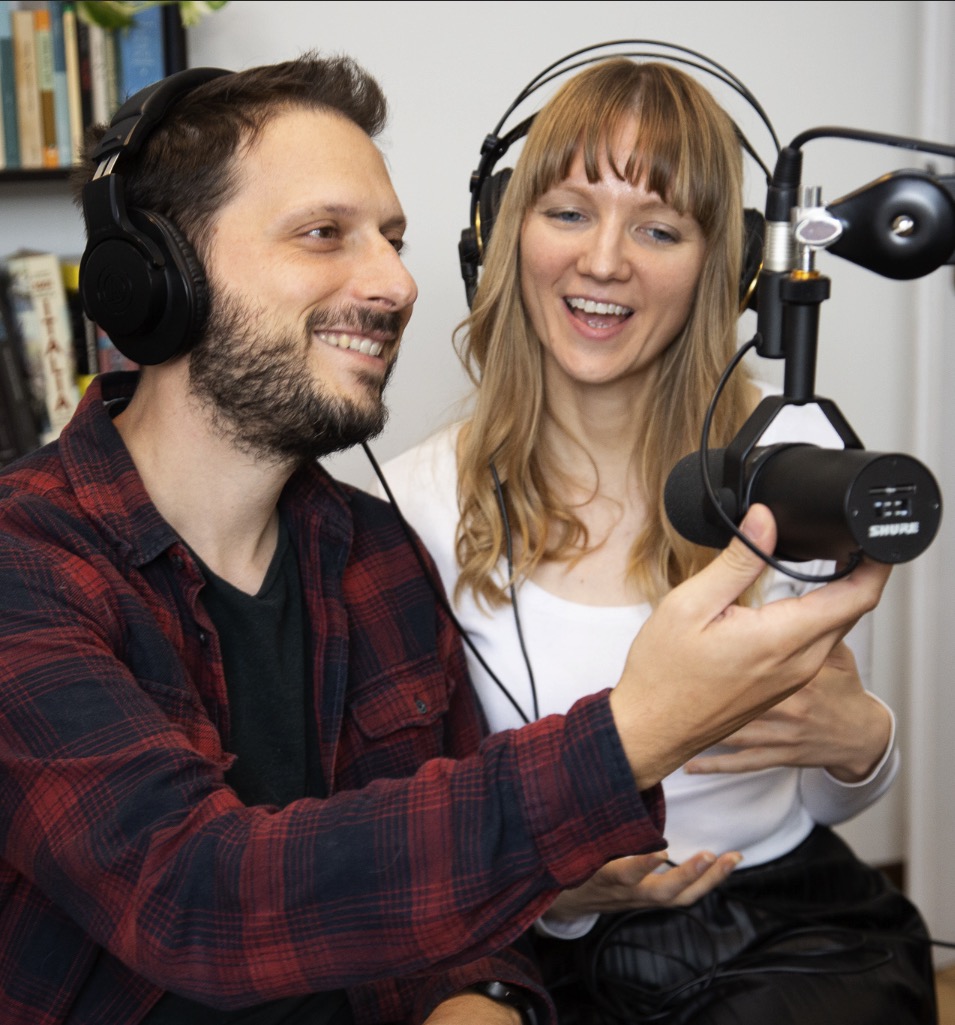
K: Ciao a tutti e benvenuti! Hi everyone and welcome to Learn Italian with Joy of Languages.
M: In today’s episode, we’re going to talk about something that grammar nerds call “direct object pronouns”. It’s the fancy name for words like “it” and “them”.
K: And because we know that these words can be really tricky, this is actually the first episode in a mini series that we’re doing on these. We wanted to spend a bit more time on them so it’s not rushed and you don’t get all the information thrown at you in one go. If you want to get notified about when the next episode’s out, you can sign up to our newsletter. The link’s in the description.
M: You’re going to hear a conversation between me and Katie where we’re in a restaurant and we’re having a look at the dessert menu. And I can’t always eat everything on the menu because I’m lactose intolerant.
K: See if you can hear the different ways we say “it” and “them”.
K: Prendiamo il dolce?
M: Lo dividamo?
K: Ok. Uh, c'è la zuppa inglese!
M: Non la posso mangiare...
K: Giusto. mm...il sorbetto?
M: Perfetto.
K: Ah, ci sono anche i profiteroles!
M: Non li posso mangiare!!!!
K: I started by asking:
M: Prendiamo il dolce? - Shall we get a dessert? Literally:
Prendiamo - we take
Il - the
Dolce - dessert
K: And then Matteo replied:
M: Lo dividiamo - shall we share it? Literally:
Lo - it
Dividiamo - we share
K: So you just heard the first word for “it”
M: Lo (x2)
K: Lo , spelt l-o, is the Italian word for “it” that you use when you’re talking about a masculine thing, like il dolce . One way we know that it’s masculine is because the word for “the” that goes with it is il, which we only use with masculine words.
M: And instead of saying “we share it” like in English, in Italian we literally say “it we share”. Lo dividiamo.
K: And that’s usually where we put the word for “it” in Italian. It comes in front of the action.
M: For example, if you were looking at a hat you liked, you would also say lo compriamo? Shall we buy it, or literally “it we buy”. Lo compriamo?
K: After Matteo suggested eating the dessert, I said:
M: Ok. Uh, c'è la zuppa inglese! - Ok. Uh, there’s trifle. Literally:
Ok
C’è - there is
La - the
Zuppa - soup
Inglese - English
K: “English soup” might sound a bit strange, but that’s just the Italian name for this dessert, which is actually very traditionally Italian even though it has inglese in the name. It’s a lot like trifle, if you’ve ever tried that in the UK, so its has sponge fingers, custard and some kind of liqueur. For the Italian recipe, they usually use an Italian liqueur called “alchermes”.
But because la zuppa inglese isn’t dairy free, Matteo said:
M: Non la posso mangiare - I can’t eat it. Literally:
Non - not
La - it
Posso - I can
Mangiare - to eat
K: You heard another Italian word for “it”.
M: La (x2)
K: So earlier you heard that lo was the Italian word for “it”. Now you’ve heard that “it” can also be la, spelt l-a.
M: The reason that this time we’re using la is because we’re talking about la zuppa inglese, which is a feminine word. One clue that zuppa is a feminine word is that it ends in an -a.
K: And again, instead of “I can’t eat it, Matteo said literally “it I can’t eat”.
M: Non la posso mangiare (x2). Or if you wanted to try on a jacket, or giacca , in a shop, you could ask la posso provare? Literally, “it I can try?”. La posso provare?
K: After Matteo said he couldn’t eat la zuppa inglese, I said:
M: Giusto. mm...il sorbetto? - Right. Hmm, the sorbet? Literally:
Giusto - right
Il - the
Sorbetto - sorbet
K: And because sorbet has no milk products in it, Matteo said:
M: Perfetto! - Perfect!
K: But then I spotted something else on the menu, so I said:
M: Ah, ci sono anche i profiteroles! - Ah, there are also the profiteroles. Literally:
Ci sono - there are
Anche - also
I - the
Profiteroles
K: But then Matteo was getting a bit frustrated that I was forgetting about the things he couldn’t eat, so he said:
M: Non li posso mangiare!!! - I can’t eat them! Literally:
Non - not
Li - them
Posso - I can
Mangiare - to eat
K: So you heard one of the Italian words for them:
M: Li (x2)
K: Li, spelt l-i, is the Italian word for them that we use when we’re talking about a word like profiteroles that’s masculine. And we have a couple of hints that profiteroles is masculine. One is that it’s a foreign word brought into Italian and these words are often masculine. And then the word for “the” that goes with it is i, which you use when you have more than masculine thing in Italian.
M: And like before, instead of saying “eat them”, we literally say “them eat” in Italian, or in this case “them I can’t eat”.
K: Another phrase to show you how this works would be “they sell them here”, if you were talking about a word like souvenirs.
M: “They sell them here” in Italian is li vendono qui. Literally “them they sell”. Li vendono qui.
K: And just like there are two words for “it” in Italian, there are also two words for “them”. So you heard one, li , that you use for masculine words. There’s also a word for “them” that you use for feminine words and it’s le, spelt l-e.
M: For example, if I was saying “they sell them here” and I was talking about a word like magliette, or t-shirts, which is feminine, I’d say le vendono qui (x2) .
K: So now you’ve heard the two ways to say “it” in Italian and the two ways to say “them”, let’s see what you can remember.
How would you say “it” when you’re talking about a word like il dolce , or dessert, which is masculine? Like in the phrase “shall we share it”, or literally “it let’s share”.
[...]
M: Lo (x2). For example, lo dividiamo?
K: And how would you say “it” when you’re talking about something like la zuppa inglese , or trifle, which is feminine? You heard it in the phrase “I can’t eat it”, or literally “not it I can eat”.
[...]
M: La (x2). For example, non la posso mangiare.
K: And how do you say “them” when you’re talking about a word like profiteroles, that’s masculine. You literally say “not them I can eat”.
M: Li (x2) . For example, non li posso mangiare.
K: And what about the word for “them” that you use in a phrase like “they sell them here” if you’re talking about something feminine, like le magliette, the t-shirts.
M: Le (x2). For example, le vendono qui.
K: Let’s hear the whole conversation again.
K: Prendiamo il dolce?
M: Lo dividamo?
K: Ok. Uh, c'è la zuppa inglese!
M: Non la posso mangiare...
K: Giusto. mm...il sorbetto?
M: Perfetto.
K: Ah, ci sono anche i profiteroles!
M: Non li posso mangiare!!!!
K: You’ve heard how to say “it” and “them” in Italian, but there are other direct object pronouns that are handy to know in Italian, like the words for “me” or “us”. For example, you’d need them to say phrases like “can you help me?” or “can you take us to the centre?”.
M: In next week’s episode, you’ll find out about how those pronouns work as well.
K: And don’t forget that you’ll get notified when the next episode’s out if you're signed up to our newsletter. You can sign up by following the link in the description.
M: See you next time.
K: Or as we say in Italian:
Alla prossima!
Time to check your understanding and remember everything you just learned! Below you’ll find a mini-quiz and some vocabulary cards to help it all go in.
Quiz: Direct Object Pronouns in Italian: What Exactly Are They
How much did you learn? Find out in the quiz!
Vocabulary
Questo vino è molto buono. Lo vuoi assaggiare? = This wine is very good. Do you want to try it?
La chiamo stasera = I’ll call her this evening
Le invitiamo a cena? = Shall we invite them to dinner? (them = Mary and Giorgia)
Li vedo ogni weekend = I see them every weekend (them = i nipoti)
Lo dividiamo? = Shall we share it? (it = il dolce)
La posso provare? = Can I try it on? (it = la giacca)
Li vendono qui = They sell them here (them = i souvenir)
Le vendono qui = They sell them here (them = le magliette)
Non li posso mangiare = I can’t eat them (them = i profiteroles)
Flashcards: Direct Object Pronouns in Italian: What Exactly Are They
Not sure how it works? Click here to watch the tutorial