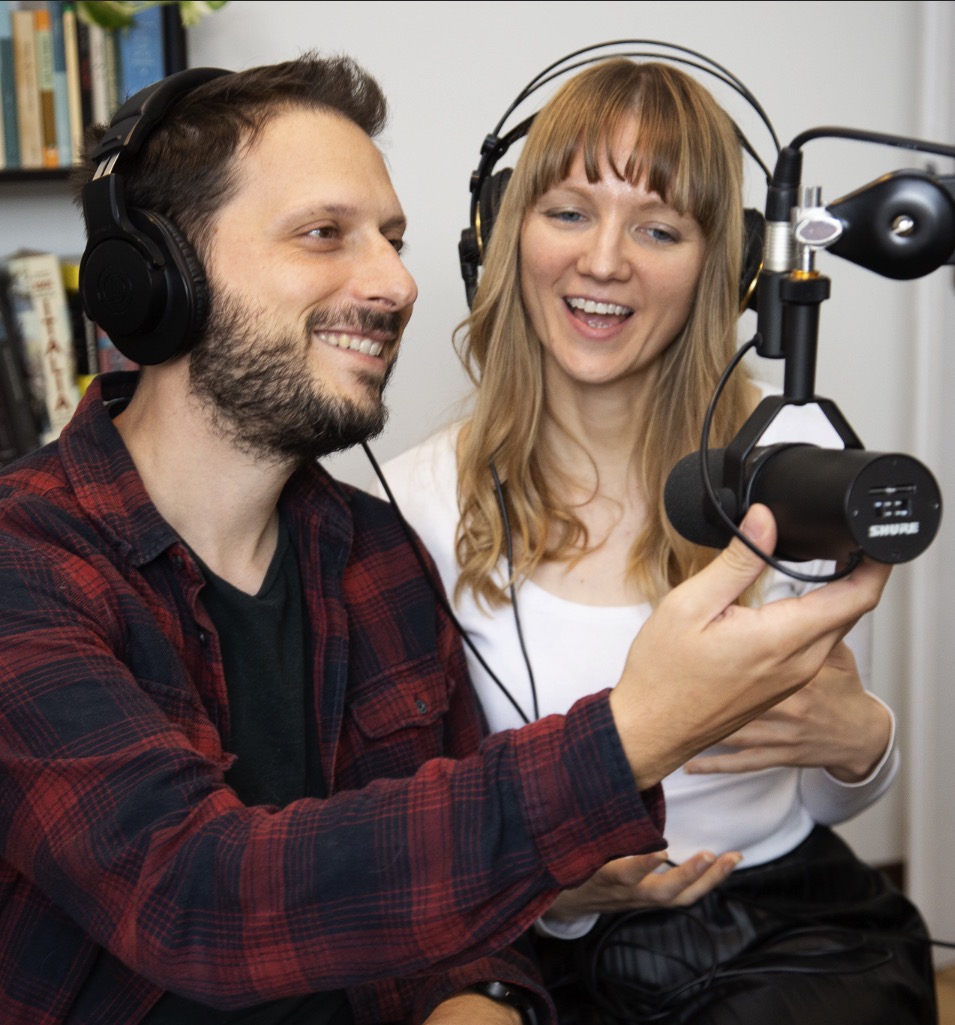
If you’ve ever felt that you have to memorize every possible word and verb form to get better at Italian, we have good news: you don’t.
Because not only is this not particularly fun or motivating, it isn’t even the best way to learn Italian. ( Phew…)
In this post, you’ll see what the best way to learn Italian really is, based on our humble opinion and our experiences at our online school, but also based on what the science says.
Psst! If you’d like to follow a step by step plan to learning Italian, our Online Italian School is opening soon and we’d love to welcome you.
Tip 1: Focus on the most frequently used Italian words
When you learn Italian, you might think that being fluent means knowing almost every Italian word that’s ever been in existence.
But in realtà (in reality), 100 words make up about half of everything we say. And knowing 1,000-2,000 words means you know 90% of the words used in everyday conversations.
So you can still say and understand a lot in Italian by focusing on the most commonly used words. The rest you can learn as a bonus later.
For example, here are some phrases using the most frequently used words in Italy, and which will hopefully be useful for your next trip to Italy.
Il treno è in ritardo. -The train is late.
Vorrei prenotare per stasera. -I’d like to book for this evening.
Dove posso lasciare i bagagli? -Where can I leave my (lit. “the”) luggage?
If you want more common travel phrases for your next holiday to Italy, you can read on our blogpost on 100+ common travel phrases for your trip , or watch this video.
In this video, Matteo and Katie give 11 useful phrases that you can use in lots of everyday situations in Italy.
Tip 2: Learn words that matter to you
When you learn from a textbook, you might see pages of words and phrases on a particular topic.
But in your everyday conversations with Italians, you might not need to say all of those words.
For example, if you’re learning nationalities, you might just need the phrase sono americano (“I’m American”) . Or if you’re talking about countries, you might just need vivo in Canada (“I live in Canada”).
Tip 3: Learn words as part of sentences
Lots of Italian learners spend hours trying to memorise words, maybe even using apps to help them, but when you learn vocabulary with no context it’s really hard to make it stick.
If you learn a word as part of a sentence, though, you’ll not only have a set, ready-to-use phrase for Italy, it will also help you remember the word better.
To give you an idea of how this works: have you ever gone into a room, forgotten why you went in, and then remembered as soon as you walked back out? This happens because our brain attaches memories to specific contexts and situations.
For example, a word like prenotazione (“reservation”) is tricky to remember on its own. But if you learn it inside a phrase like ho una prenotazione (“I have a reservation”), it’s much easier to remember.
That’s partly because you have something concrete to visualise, like standing at a hotel desk to check in, or arriving at a restaurant and letting a waiter know you’ve booked for that evening.
Tip 4: Listen to lots (and lots) of Italian
Listening to Italian as much as possible will really help you remember words and phrases.
When you hear a word, you start noticing its rhythm and stress, you learn how it’s used in everyday sentences and you hear it repeated naturally, which reinforces it.
It’s like hearing a song over and over. Eventually, the lyrics stick without you trying.
At first, we recommend just listening to Italian as much as possible. Maybe even having it on in the background while you’re doing other things, like cooking or walking the dog.
As a beginner, you can also start with simplified conversations or conversations at a slower speed.
Then, once you’ve listened several times, you can use the transcript or subtitles to see which words and phrases you don’t know yet. Don’t try and learn them all, just the ones you think you’re most likely to need for everyday conversations.
Tip 5: Practice speaking
Saying words and phrases out loud is another great way to get better at Italian.
You’re doing lots of things when you say a word out loud: there’s the muscle memory as your mouth makes the movement, your ears hear the sound and your brain has to recall the meaning.
So your brain gets extra signals that this is important information to hold onto.
This doesn’t mean that you need to already start having complicated conversations in Italian. You can start practicing with even simple words or phrases.
Speaking can feel intimidating, so before you practice with real Italians, you might want to practice by yourself at first, try with a conversation partner who’s also learning Italian, or talk with a teacher who can give you feedback.
Tip 6: Grammar is important, but up to a point
Lots of Italian learners tell us that it can be hard to remember all the different grammar rules.
Like: how do I form the past tense again? Or: how do I know if a word is masculine or feminine?
Remembering abstract rules with difficult grammar terms (like “to form the past tense you need essere and avere , plus the past participle”) isn’t easy for anyone.
Instead, you can pick up grammar rules as part of a sentence.
For example, you might want to order a beer and you’re wondering, how do I know if birra, (“beer”) is masculine or feminine? Should I say un birra or una birra?
If you just learn the phrase vorrei una birra (“I’d like a beer”), you know that you’re getting the phrase right every time and you start to learn the patterns naturally, without having to memorize them as separate rules.
By the way, if you did accidentally say vorrei un birra , an Italian would still understand you.
So yes, grammar is important, but you can use it more to tidy up the words and phrases you already know after you’ve used them in everyday conversations.
Tip 7: Learn a little bit of Italian every day
In our humble opinion, and also according to science, it’s better to learn in small, frequent doses.
So, rather than cramming Italian learning into a two-hour lesson once a week, where you risk forgetting what you’ve learnt between sessions, it’s better to do a bit of Italian (e.g. 30 minutes) every day.
Plus, regular practice also helps it become more of a habit.
The Best Way to Learn Italian (In Our Humble Opinion): FAQs
Is it normal that I keep forgetting the words I’ve learnt?
Short answer: Assolutamente sì! (“Absolutely, yes!”).
Forgetting words is a very normal part of learning a language, but there are techniques which can make forgetting less likely.
Learning words as part of a sentence, doing lots of listening and speaking practice and practicing in small doses are all ways to help words stick better.
Why do I freeze every time I speak to Italians?
It’s very normale to find speaking intimidating, especially with native Italian speakers.
But the more you practice saying the phrases out loud in a more low stakes environment, like by yourself or with a friendly teacher, the more you’ll get used to speaking. And when the moment comes to talk to real Italians, you’ll feel so much more prepared.
In this video, Katie talks about how she got over her fear of speaking Italian and why it's also very normal to find speaking Italian scary sometimes.
How do I actually practice Italian?
Apps and textbooks can give you words without context, or can give you phrases that you’re unlikely to ever hear or use in Italy.
It’s best to focus on listening to natural conversations in Italian. After you’ve listened a few times, you can use the subtitles or transcript to study words or phrases that you haven’t come across before.
Do I really need to study grammar to get better at Italian?
Grammar can definitely help, but learning the rules in isolation can leave you feeling confused. And they’re hard to remember.
Instead, if you focus on learning phrases, you know that you’re getting the grammar right every time and, with practice, you start to notice patterns naturally.
How long does it take to get fluent in Italian?
Although there are more effective ways to study than others, becoming fluent in Italian doesn’t happen overnight. (After all, Rome wasn’t built in a day 😉).
But if you practice consistently over time, you’ll start to be able to have longer and longer conversations in Italian.
Also, remember that you don’t need to know every single Italian word to be able to have a conversation because you can say and understand a lot (about 90% of everyday conversations) by focusing on just 1,000-2,000 words.
K: Ciao a tutti e benvenuti! Hi everyone and welcome to “Learn Italian with Joy of Languages”.
M: In today’s episode, you’ll hear about the best way to learn Italian… in our humble opinion!
K: Before we get started, we have a quick announcement: registration for our Online Italian School is opening in a couple of days.
M: Last term we sold out molto velocemente , very fast, so if you think you might like to join us and you’d like a reminder so you don’t miss it, click the link in the description – we’d love to see you there!
K: Today’s episode is about the best way to learn Italian, but just a little caveat: we’re not promising you can become fluent in a few months. Learning Italian takes time. But it’s probably possible to learn it faster than you are at the moment, and in this episode, we’ll be looking at ways to help you do that.
M: Ok, time for the first tip: focus on the most frequently used Italian words.
K: Did you know that just 100 words make up roughly half of everything we say every day? And if you know between 1,000 and 2,000 common words, you’ll already know most of the vocabulary people use in everyday conversations.
M: So don’t worry about learning every single word in the dizionario , the dictionary. Focus on the words that come up a lot in conversation and you’ll have what you need to say and understand lots in Italian. You can learn the less common words as a bonus later.
K: Linked to this, our next tip is to focus on the words and phrases that are most relevant to your life and conversations. You can open a textbook and find a list of 20 different nationalities, but you might not need them very often.
M: For example, you might just need to learn sono americano - I’m American. Or if you’re learning about countries, you might just need to say vivo in Inghilterra - I live in England, or vivo in Canada - I live in Canada to get you started.
K: Trying to remember everything in those lists in textbooks can slow you down quite a lot – it’s much more efficient to make a strategic selection of the words you think you’ll use regularly and learn how to use them in real life. That brings us to our next tip: learn words in context.
M: You might have tried going over and over words in Italian before, maybe even using apps to help you, but if you don’t learn them in a sentence, it’s harder to associate them with real life situations, and they’re less likely to stick.
K: And you might be worried that you’re not getting better at Italian because you can’t remember the words you learnt from one week to the next, but it’s probably just that you need to change the way that you learn them.
M: Not remembering everything is very normale , normal, but you can remember words a lot better if you learn them as part of useful phrases.
K: If you’re trying to learn a word like prenotazione , which means ‘reservation’ or ‘booking’, memorising it on its own makes it much harder to recall. But if you learn the phrase ho una prenotazione , “I have a reservation” it’s easier to remember.
Because your brain has something concrete to picture: like standing at a hotel desk, checking in, or arriving at a restaurant and telling the waiter you’ve made a booking. When you’re actually in those situations in Italy, the phrase comes back more easily because you linked it to the situation.
M: We remember things better in the same kind of situation where we first learned them. It’s like walking into another room and forgetting why you went — then remembering as soon as you go back. If you learn ho una prenotazione while imagining a hotel or restaurant, it’s more likely to pop into your mind when you’re really there.
K: It’s also quite common to know words but struggle to say sentences, but by learning this way, you’ll have phrases ready that you can use in real life in Italy.
M: The fourth tip is listen to Italian as much as you can.
K: Hearing natural conversations in Italian is really useful, even if it’s just in the background while you’re doing things like cooking and brushing your teeth. This way your brain can start to get used to the sounds and, as long as you can get the gist of what’s being said, you can also absorb a lot of common phrases.
M: If you’re a beginner, you can start with simplified conversations, or conversations at a slower speed. Like the ones on this podcast.
K: Once you’ve listened a few times, you can turn on the subtitles or read the transcript to see which words and phrases you don’t know yet.
M: But coming back to our earlier tip: don’t try to learn them all. Pick out the ones you think you’ll hear and use most often in conversation.
K: Our next tip is one that we think is molto importante , very important. Try speaking Italian out loud early on.
M: That doesn’t mean that you have to already be able to have a whole conversation in Italian. But saying words and phrases out loud, even short and simple ones, is another great method to help you remember them better.
K: One way to practice speaking is by finding someone who you can talk to and who knows how to give you helpful, encouraging feedback, like a conversation partner or an Italian teacher.
M: Our next tip is to do with one of my least favourite things, la grammatica. Grammar.
K: Lots of learners tell us they feel disheartened because they can’t remember all of the different rules, like remembering how to form the past tense, or whether words are masculine or feminine. That’s because it’s not easy to remember difficult, abstract rules like this.
M: Instead, you can pick up grammar as you go along from the everyday phrases that you’re learning. For example, you might learn the phrase vorrei uno spritz, grazie - I’d like a spritz, thank you. Vorrei uno spritz.
K: We could spend a lot of time talking about complicated grammar rules for this sentence, for example how we use the indefinite article uno , with words starting with s plus a consonant in Italian like sp, spritz, uno spritz . But if you just learn the phrase vorrei uno spritz , you can be confident you’re saying it correctly every time. Then over time, your brain starts to notice the pattern naturally, that uno is used with words that begin with s plus a consonant, like uno spritz or uno studente (a student) without having to constantly think about complicated rules.
M: Also, if you did accidentally say vorrei un spritz instead of uno spritz, Italians would still understand you, even if it’s technically not grammatically correct. The important thing is to communicate.
K: Our advice is, grammar is important, but think of it more as a tool to tidy up the details as you go along, rather than something you need to know perfectly before you can communicate.
M: Finally, our last tip is to spend a little time with Italian everyday. In our experience, and the science agrees, the brain learns best in small, frequent doses.
K: If you only do a two-hour lesson once a week, plus half an hour of homework, it’s easy to forget what you learned between lessons. But if you spread that out, say 30 minutes a day over five days, you’ll remember things much more easily.
M: Everything we talked about today is something you can do on your own — what matters most to us is that you keep learning Italian. But it’s often easier to get started and move faster with the done for you version, so you don’t have to use up extra brain space figuring out what to do next. That’s exactly what we can help you with in our Online Italian School.
K : Yes, this is our extra tip! Everything we’ve talked about so far… learning words in context, listening to Italian, practising speaking early on — we created the online school so you can do all of that in one place.
M: As a member you get new, natural conversations every week with us and our teachers. And because one of the best ways to learn new words is in real situations, we always talk about everyday life and the things Italians actually say.
M : We also have resources for every level, even if you’re starting from zero. For beginners, each conversation comes in two versions: a slower, clearer “story speed,” and then the same conversation at a more natural “bar speed,” so you can start getting used to how Italians actually talk.
K: And everything includes transcripts, so that you can listen a few times first. Then you’ll find lessons with the phrases and grammar we think will be most useful to help you communicate at your level. And flashcards to review to help them stick in your mind.
M: You’ll also get speaking practice with friendly, experienced teachers who’ll help you build your confidence in speaking Italian and give you personalized feedback.
K: This way, you can practise speaking in a relaxed, low-pressure way right from the start, which (as we mentioned earlier) is really helpful for making words and phrases stick.
M: If you think you’d like to join us and our lovely group of Italian learners and teachers, click the link in the description to learn more about our online Italian school. It would be great to have you with us.
M: See you next time.
K: Or as we say in Italian.
Alla prossima!
Time to check your understanding and remember everything you just learned! Below you’ll find a mini-quiz and some vocabulary cards to help it all go in.
Quiz: The Best Way to Learn Italian (In Our Humble Opinion)
How much did you learn? Find out in the quiz!
Click here to take the quiz for this episode: The Best Way to Learn Italian (In Our Humble Opinion)
Vocabulary
Il treno è in ritardo = The train is late
Vorrei prenotare per stasera = I’d like to book for this evening.
Dove posso lasciare i bagagli? = Where can I leave my (lit. “the”) luggage?
Vorrei una birra = I’d like a beer
Vorrei uno spritz = I’d like a spritz
Ho una prenotazione = I have a reservation
Sono americano = I am American
Vivo in Canada = I live in Canada
Vivo in Inghliterra = I live in England
Flashchards: The Best Way to Learn Italian (In Our Humble Opinion)
Not sure how it works? Click here to watch the tutorial