There’s a faster way to learn Italian than learning long lists of words and phrases to suit every possible situation.
Instead, by focusing on a few really useful words that work in different contexts, you can already say lots of things.
In this post, you’ll learn what these common words are and how to use them to learn Italian faster 🏎️.
Vorrei - I would like
Pronunciation: Voh-RRAY-ee
When you’re ordering food or drink, or asking for something in Italian, there are lots of phrases you could potentially learn.
But to make it simple and save you time, you can learn the word vorrei . You just need to substitute the word after to say what it is that you’d like.
For example:
Vorrei uno spritz. -I’d like a spritz.
Vorrei una limonata. -I’d like a lemonade.
Vorrei una camera singola. -I’d like a single room.
Vorrei mezzo chilo di pomodori. -I’d like half a kilo of tomatoes.
You can also use vorrei with verbs in Italian to say what you’d like to do.
For example:
Vorrei prenotare un tavolo. -I’d like to book a table.
Vorrei comprare una maglietta. -I’d like to buy a t-shirt.
Vorrei visitare il Duomo domani. -I’d like to visit the cathedral tomorrow.
Vorrei uscire alle otto. -I’d like to go out at eight.
💡Good to know : In Italian when we use vorrei , the verb that follows always stays in the base form, the infinitive (like prenotare or uscire ).
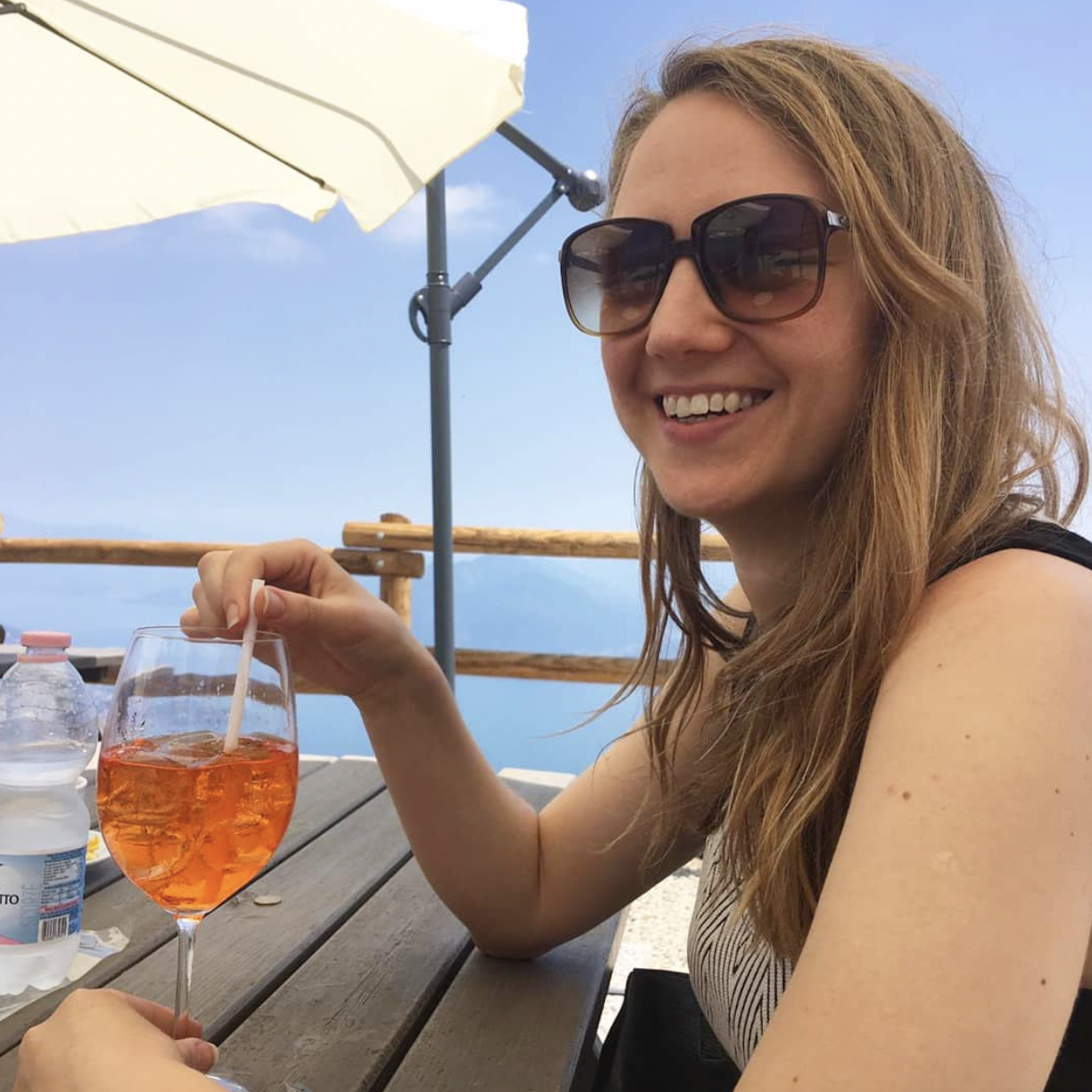
Vorrei uno spritz per favore - I’d like a spritz please
Posso - Can I?, May I?
Pronunciation: POHS-soh
Posso in Italian literally means “I can”, but by raising your voice at the end of the sentence you can turn it into a question.
You can use the word posso to make lots of questions in Italian, like ordering something or making polite requests.
You just have to change the verb after posso to fit what you need. Like with vorrei, the verb after posso stays in the base form.
For example:
Posso avere un limoncello? -Can I have a limoncello?
Posso prendere un taxi qui? -Can I get a taxi here?
Posso mangiare fuori? -Can I eat outside?
Posso fare una foto ? -Can I take (lit. make) a picture?
Sometimes, you can use posso by itself and not worry about the rest of the phrase. It still makes sense (Italians use it like this too) and it’s polite.
For example, you could say posso (“may I?)” while pointing at an empty chair to ask if you can take it, or while pointing at a seat on the train to ask if you can sit there.
You can see how posso works, and some other useful words in Italian, in this video on 11 words to learn before your next trip to Italy.
Devo - I have to
Pronunciation: DEH-voh
Once you know the word devo, you can use it in questions to ask for more information, or to give an explanation, like an excuse for why you can’t make something. You just swap the verb after it depending on what you want to say.
For example:
Devo preparare la cena. -I have to make (lit. prepare) dinner.
Devo prendere il treno. -I have to get the train.
Devo comprare un biglietto? -Do I have to buy a ticket?
Devo scendere qui? -Do I have to get off here?
Prendo - I take
Pronunciation: PREHN-doh
When you order food or drink in Italian, you can use prendo , and then say whatever food or drink item you’d like afterwards .
Prendo literally means “I take”, but it’s used to mean “I’ll have” or “I’ll get”.
For example:
Prendo la carbonara. -I’ll have the carbonara.
Prendo una birra. -I’ll have a beer.
Prendo una margherita. -I’ll have a margherita (pizza).
You can read more about how to use prendere our blogpost prendere: why you need to know this Italian verb.
Cerco - I’m looking for
Pronunciation: CHEHR-koh
You can use cerco when you’re looking for something, like a place to visit or something you’d like to buy.
For example:
Cerco una maglietta. -I’m looking for a t-shirt.
Cerco la pizzeria Sorbillo. -I’m looking for the pizzeria Sorbillo.
Cerco un negozio di scarpe. -I’m looking for a shoe shop.
Cerco un ristorante tipico. -I’m looking for a typical restaurant.
Vado - I go, Andiamo - we go
Pronunciation: VAH-doh, Ahn-DYAH-moh
There are lots of possible ways that you can use the verb andare (to go) in Italian.
But instead of needing to learn every possible form of the verb, you can focus on what you’re most likely to use. Like vado - I go and andiamo - we go.
For example:
Vado a Roma in treno . -I go to Rome by train.
Andiamo in Toscana ogni anno. -We go to Tuscany every year.
Andiamo is also useful because if you use it as a question, it means “shall we go?”, so you can use it to suggest plans.
For example:
Andiamo al Duomo? -Shall we go to the cathedral?
Questo - This
Pronunciation: KWEHS-toh
If you don’t know the name for something, you can point at it and say questo!
Like if you’re at the market and see a cheese you like the look of, but you’re not sure what it’s called or how to pronounce it.
You can combine questo with vorrei to say vorrei questo - I would like this.
Cos’è? - What’s this?
Pronunciation: Koh-ZEH
You can also use cos’è (lit. “what is it”) when you point at something if you’re not sure what it’s called in Italian. Or if you see something for the first time and you’d like an Italian to explain what it is.
For example, if you wonder what’s in a certain Italian dish or spot something unusual in a shop.
Come si dice… - How do you say…
Pronunciation: KOH-meh see DEE-cheh
If you’re trying to speak Italian and your mind goes blank on a certain word, you can get an Italian to help you by asking come si dice…
That way you can start speaking even if you don’t have all the words yet.
For example:
Cerco un…come si dice “supermarket” in italiano? -I’m looking for a…how do you say “supermarket” in Italian?
Vorrei un…come si dice “hairdryer” in italiano? -I’d like a…how do you say “hairdryer” in Italian?
Lo stesso - The same
Pronunciation: Loh STEHS-soh
If you like the sound of what someone else has ordered, you can simply say lo stesso instead of repeating the whole dish. You can also point to something and say lo stesso to show you’d like the same.
It’s especially handy when you don’t know (or can’t remember) the name of what was mentioned before.
So rather than struggling through something long like vorrei anch’io una brioche con gelato, I’d like a brioche with ice-cream (a typical Sicilian dish), you can just say lo stesso . Or you can say lo stesso per favore (“the same please”) to sound even more polite.
Per favore - Please
Pronunciation: Pehr fah-VOH-reh
You don’t have to learn every single polite phrase in Italian to sound friendly. Instead, you can use a simple phrase like per favore (and maybe use un sorriso, a smile) to show that you’re trying to be polite.
For example:
Lo stesso per favore. -The same thing please.
Due caffè per favore. -Two coffees please.
Un tavolo fuori per favore. -A table outside please.
La password del WIFI per favore. -The WIFI password please.
Grazie - Thank you
Pronunciation: Grats-YEAH
You can also use grazie as a starting point to sound friendly instead of learning lots of polite separate phrases.
For example:
Questo, grazie! -This one, thank you!
Vorrei uno spritz, grazie! -I’d like a spritz, thank you!
Due biglietti, grazie! -Two tickets, thank you!
Altrettanto - The same to you
Pronunciation: Ahl-treht-TAHN-toh
If an Italian tells you something nice and friendly, like buona giornata (have a good day), you can reply with altrettanto! (same to you!).
Italians use this all the time and it’s a way of returning well-wishes without having to worry about saying long complicated phrases, like “I hope you also have a good day!”.
For example:
- Buon appetito! -Enjoy your meal!
-Altrettanto! -You too!
Or:
-Buona serata! -Have a good evening!
-Altrettanto! -You too!
And:
Buon weekend! -Have a good weekend!
Altrettanto! -You too!
Scusi - Excuse me
Pronunciation: SKOO-zee
Scusi is the formal way of saying “excuse me” in Italian, so it’s very useful when you’re speaking to people you don’t know in Italy, like waiters or shop assistants.
You can use scusi by itself to get someone’s attention. And you can also combine it with other phrases to ask for things.
For example:
Scusi, posso avere un menu? -Excuse me, can I have a menu?
Scusi, posso avere un tovagliolo? -Excuse me, can I have a napkin?
Scusi, dov’è il bagno? -Excuse me, where is the bathroom?
Salve - Hello
Pronunciation: SAHL-veh
Salve is a useful way to say hello because you can use it at any point of day. So instead of worrying about the different words for good morning, afternoon and evening, you can just say: salve!
The Most Common Italian Words To Know For Italy: Review
You don’t need loads of vocabulary to start speaking Italian. With just a few common Italian words, you can handle lots of everyday situations while travelling in Italy.
-
Words like vorrei , posso and prendo help you order food and make requests.
For example:
Vorrei uno spritz. -I would like a spritz.
Posso prendere un taxi qui? -Can I take a taxi here?
Prendo la carbonara. -I’ll have the carbonara.
-
Vado and andiamo help you get around and talk about your plans.
For example:
Vado a Roma in treno. -I go to Rome by train.
Andiamo in Toscana ogni anno. -We go to Tuscany every year.
-
If you get stuck, you can use simple phrases like questo , cos’è? and come si dice… to keep the conversation going, even if you don’t know all the words yet.
For example:
Vorrei questo. -I’d like this
Cerco un…come si dice “supermarket” in italiano? -I’m looking for….how do you say “supermarket” in Italian?
-
Adding per favore , grazie and scusi helps you sound polite and friendly, even with very basic Italian
For example:
Due caffè per favore. -Two coffees please.
Vorrei uno spritz, grazie! -I’d like a spritz, thank you!
Scusi, dov’è il bagno? -Excuse me, where is the bathroom?
K: Ciao a tutti e benvenuti! Hi everyone and welcome to Learn Italian with Joy of Languages. Before we get started, I just wanted to quickly let you know that registration for our Online Italian School is opening on Tuesday 5th May.
M: We’d love to see you there! We sold out very quickly last time, so if you think you might like to join us and you’d like a reminder so you don’t miss it, click the link in the description.
K: In today’s episode, you’ll learn some of the most common words in Italian and how you can use them to help you get by in lots of different situations.
For example, when you’re ordering food or drink, or asking for something in general, there are lots of phrases you could potentially learn. But instead of learning all of these at once, you can save yourself time by picking a common one that you can use again and again.
M: Like vorrei, I would like. Vorrei. For example, vorrei uno spritz . I’d like a spritz. Vorrei uno spritz. Or vorrei una camera . I’d like a room. Vorrei una camera.
K: This one’s really useful because you can just use vorrei and then add the thing that you want after it.
You can also use vorrei to say not only the things you’d like, but what you’d like to do.
M: For example, vorrei prenotare. I’d like to book. Vorrei prenotare. Or vorrei pagare. I’d like to pay. Vorrei pagare.
K: All you have to do is add the verb that you need after vorrei . For example pagare - to pay. Or prenotare - to book.”.
Speaking of ordering food, if you hear somebody order something you like and want the same thing, instead of trying to learn a full sentence to ask for it, or learning the name for every Italian dish, you can just say:
M: Lo stesso. Lo stesso literally means “the same”. You could also add per favore to the end to say “the same please”. Lo stesso, per favore (x2) .
K: Lo stesso is one of those phrases that helps pointing go a long way! Like if you see someone's gelato, ice-cream, and you’d think you’d like the same flavor, you can point and say lo stesso, per favore . Pointing is really useful when you’re just starting out learning Italian because you can use it to show what you’re talking about when you don’t have the words for it. If you’re shy, you can do it discretely, but if you’re a bit more outgoing and you do it with a smile, it’s a lovely way to connect - Italians will probably find it quite fun that you decided to order the same thing they did.
M: Or if you’re with an Italian, you can say lo stesso whenever they order things so you can have the full Italian experience!
K: Here’s a word so you don’t have to learn every single word for every object in Italian, you can learn the word questo. This. Questo.
This is another word which helps pointing go a long way - to order something, you can just point at it and say questo. You can also add per favore on to the end: this please, questo, per favore.
M: And you could put the word we saw earlier, vorrei, with this one and say: vorrei questo. I would like this. Vorrei questo. With per favore, we’ve got a nice phrase: I’d like this, please = vorrei questo, per favore.
K: And another tip, instead of learning lots of polite questions, there’s another simple Italian word you can use when you’re pointing at something. Posso (x2) . It literally means “I can”, but if you raise your voice at the end it turns into a question and it becomes “may I?”.
For example, if you want to check that a seat is spare on the train and you want to sit on it, or if you’re wondering if you can take a chair from a table at a café. It’s a lot easier than asking “can I take this chair please” or “do you mind if I sit here” and it’s perfectly polite. In fact, you might hear waiters or waitresses using it in Italy to ask if you’ve finished with your meal and they can clear away the plates.
M: Yes, they might come along and say posso? May I? And you could say, sì, grazie, “yes, thank you” if you’ve finished.
K: You can also use posso to ask for things.
M: For example, you could ask posso avere un limoncello? - can I have a limoncello. Posso avere un limoncello? Or you can use posso to ask for more information, like posso prendere un taxi qui? Can I take a taxi here? Posso prendere un taxi qui?
K: We’ve spoken about common words for asking for things and common words you can use to point at things so you don’t have to worry about full phrases. The last group are words you can use for greetings.
M: These ones are really useful to sound polite to Italians. One word you can use for this is salve. Hello. Salve.
K: The useful thing about salve is that you can use it at any time of day, so you don’t have to worry about whether you should say buongiorno, good morning, or buona sera, good evening.
M: Another useful one, especially for when you’re leaving a place, altrettanto. It’s a bit like saying “same to you” in English. Altrettanto. For example, if an Italian has said something nice and friendly, like buona giornata, have a good day, you can say altrettanto back.
K: Altrettanto is useful because you’re still giving well-wishes, but you don’t have to worry about longer phrases like “have a great day as well” or “enjoy the rest of your weekend too”.
M: Now that you’ve heard some of the common Italian words you can focus on to say lots of different things in Italian, let’s see what you can remember.
K: How do you say “I would like”, for example “I would like a spritz” or “I would like to pay”.
[...]
M: Vorrei (x2). For example, vorrei uno spritz or vorrei pagare .
K: How would you say “the same”, like if you were pointing at someone’s gelato to say you wanted the same order?
[...]
M: Lo stesso.
K: And how would you say the word “this” in Italian, like “I would like this” when you’re pointing at something and you don’t know the Italian word for it?
[...]
M: Questo (x2) . For example, vorrei questo.
K: What’s the Italian for “may I”? Or “can I”? Like you might use in the phrase “can I take a taxi here?”
[...]
M: Posso (x2). For example, posso prendere un taxi qui?
K: And how would you say “hello” in a way that works at any time of day.
[...]
M: Salve (x2).
K: And finally, what’s a very simple way to reply to friendly phrases in Italian like buona giornata, have a good day?
[...]
M: Altrettanto (x2)
K: So you’ve heard some common words that can help you say lots of different things in everyday conversations with Italians. When you’re learning Italian, it’s not always easy to know which words are the most useful to learn first, which means that you can spend a lot of time memorising stuff in textbooks, that you might not actually use when you get here - that’s why a lot of people feel like they’ve been learning Italian for a long time, but still struggle to communicate.
M: This is one of the main things we try to help our students with in our Online Italian School - to take the most direct route to speaking Italian, without wasting time.
K: We’ve written the courses using a database of the most common words in Italian, to help you familiarise yourself with the language you’ll hear and use every day in Italy.
M: We also have a speaking club, with practical topics so you can get a head start and get used to speaking Italian before you arrive. You’ll get personal feedback from our lovely, experienced teachers who’ll gently encourage you to speak Italian (even if it feels a bit scary at first!) and help you improve.
K: If you think you might like to join us, click the link in the description to learn more about our Online Italian School. We’d love to see you there.
K: A presto!
Time to check your understanding and remember everything you just learned! Below you’ll find a mini-quiz and some vocabulary cards to help it all go in.
Quiz: The Most Common Italian Words: How to Learn Italian Faster
How much did you learn? Find out in the quiz!
Vocabulary
Vorrei comprare una maglietta = I’d like to buy a t-shirt
Andiamo in Toscana ogni anno = We go to Tuscany every year.
Scusi, posso avere un menu? = Excuse me, can I have a menu?
Cerco un ristorante tipico = I’m looking for a typical restaurant
Un tavolo fuori per favore = A table outside please
Devo scendere qui? = Do I have to get off here?
Lo stesso per favore = The same thing please
Vorrei prenotare = I’d like to book
Altrettanto = The same to you
Vorrei questo per favore = I’d like this please
Flashcards: The Most Common Italian Words: How to Learn Italian Faster
Not sure how it works? Click here to watch the tutorial