Sapere (to know) is a really common Italian verb. You can use it in lots of situations to help your trip around Italy smoother, like asking an Italian if they know the best way to the monuments you’d like to visit, or if they know what time museums open or close.
Here, you’ll see how sapere works, including how it compares to English, practical phrases to help you get around Italy and common mistakes to watch out for.
How to Use Sapere
To Know a Piece of Information
When you talk about facts or something that you know in Italian, you use sapere .
For example:
So che la delizia al limone è un dolce napoletano. -I know that delizia al limone is a Neapolitan dessert.
Sappiamo dov’è l’hotel. -We know where the hotel is.
Sanno che il teatro è in centro. -They know that the theatre is in the centre.
Sai dove siamo? -Do you know where we are?
So che siamo in centro -I know that we’re in the centre
To Know How To
When you want to talk about things that you know how to do, you can use sapere followed by another verb.
For example:
So parlare italiano. -I know how to speak Italian
Sappiamo fare gli arancini -We know how to make arancini.
Sapete sciare? -Do you (plural) know how to ski?
Common Mistakes with Sapere
Sapere vs Conoscere
There are actually two verbs for “to know” in Italian: sapere and conoscere.
Although they both translate the same way, they aren't interchangeable because they have slightly different meanings. But without knowing these small differences, it’s easy to get them mixed up.
Sapere is used for things you know about or know how to do. Conoscere is often used with people and places. It can also have the meaning of “to be familiar with”.
For example:
✅ Conosco bene Milano. -I know Milan well.
❌ So bene Milano. -I know Milan well.
✅ Conosci Annaluna? -Do you know Annaluna?
❌ Sai Annaluna? -Do you know Annaluna?
In this video, our insegnante (teacher) Mary explains the difference between sapere and consocere with some useful examples.
So vs Lo so
If you say “I know” in Italian (and don’t add anything else to the phrase), you also have to add the word lo (“it”).So “I know” is:
| Lo so | I know | Loh soh |
As you probably noticed, in Italian, “it” comes in front of the verb. So you literally say “it I know”.
For example:
Il cibo a Bologna è molto buono! -The food in Bologna is very tasty.
Lo so! -I know! (lit. It I know)
“I don’t know” also works in a similar way:
| Non lo so | I don’t know | Nohn loh soh |
-Sai dov’è la libreria? -Do you know where the bookstore is?
-Mi dispiace, non lo so! -I’m sorry, I don’t know.
It might seem strange to say “I know it” or “I don’t know it” in Italian, but this is the most natural way to say it.
It’s like saying “I know the thing you were just talking about”. In fact, leaving out lo (“it”) would make the sentence sound incomplete.
Sapere in the Past and Present Tense
To help you see exactly how sapere changes based on who is doing the knowing, here are the conjugation tables for the present and past tenses. We've prioritized these tenses because (we think) they're the most useful for going about your day in Italy.
Sapere in the Present Tense
You use the present tense in Italian to talk about what’s happening now, regularly or even what you’re planning to do soon in the future. A little reminder: in Italian, we usually leave out pronouns like “I” and “you” because the verb ending already shows who’s speaking.
| So | I know | Soh |
| Sai | You know | Sye |
| Sa | S/he knows ; you (formal) know | Sah |
| Sappiamo | We know | Sahp-pee-AH-moh |
| Sapete | You (plural) know | Sah-PEH-teh |
| Sanno | They know | SAHN-noh |
For example:
Sai come arrivare al centro? -Do you know how to get (lit. arrive) to the centre?
Sa a che ora parte il treno? -Do you (formal) know what time the train leaves?
Sappiamo che ci sono molti turisti a Venezia -We know that there are lots of tourists in Venice
Sapere in the Past Tense
When you’re talking about what you used to know in Italian, it’s most likely that you’ll need to use a past tense called the imperfetto.
Here’s how it works:
| Sapevo | I knew | Sah-PEH-voh |
| Sapevi | You knew | Sah-PEH-vee |
| Sapeva | S/he knew ; you (formal) knew | Sah-PEH-vah |
| Sapevamo | We knew | Sah-peh-VAH-moh |
| Sapevate | You (plural) knew | Sa-peh-VAH-teh |
| Sapevano | They knew | Sah-PEH-va-noh |
For example:
Capisco bene l’italiano perché sapevo parlare francese -I understand Italian well because I used to know how to speak French
I miei nonni sapevano cucinare molti piatti italiani -My grandparents knew how to cook lots of Italian dishes
Italian Verb Sapere (To Know): When and How to Use It: Review
-
Sapere can mean “to know” in the sense of knowing a piece of information or knowing how to do something. For example:
Sappiamo che ci sono molti turisti a Venezia -We know that there are lots of tourists in Venice
So parlare italiano -I know how to speak Italian
-
If you say “I know” or “I don’t know” by itself (without continuing the sentence) remember to add the word lo (“it”)
-Sai dov’è la libreria? -Do you know where the bookstore is?
-Mi dispiace, non lo so! -I’m sorry, I don’t know.
-
Conoscere also means “to know” in Italian. It’s usually used when you’re talking about a person or a place. It can also sometimes be translated as “to be familiar with”.
For example:
Conosco bene Milano -I know Milan well
Conosci Annaluna? -Do you know Annaluna?
-
Here’s how sapere works in the present and past tense:
| Present Tense | Past Tense | ||
| So | I know | Sapevo | I knew |
| Sai | You know | Sapevi | You knew |
| Sa | S/he knows ; you (formal) know | Sapeva | S/he knew ; you (formal) knew |
| Sappiamo | We know | Sapevamo | We knew |
| Sapete | You (plural) know | Sapevate | You (plural) knew |
| Sanno | They know | Sapevano | They knew |
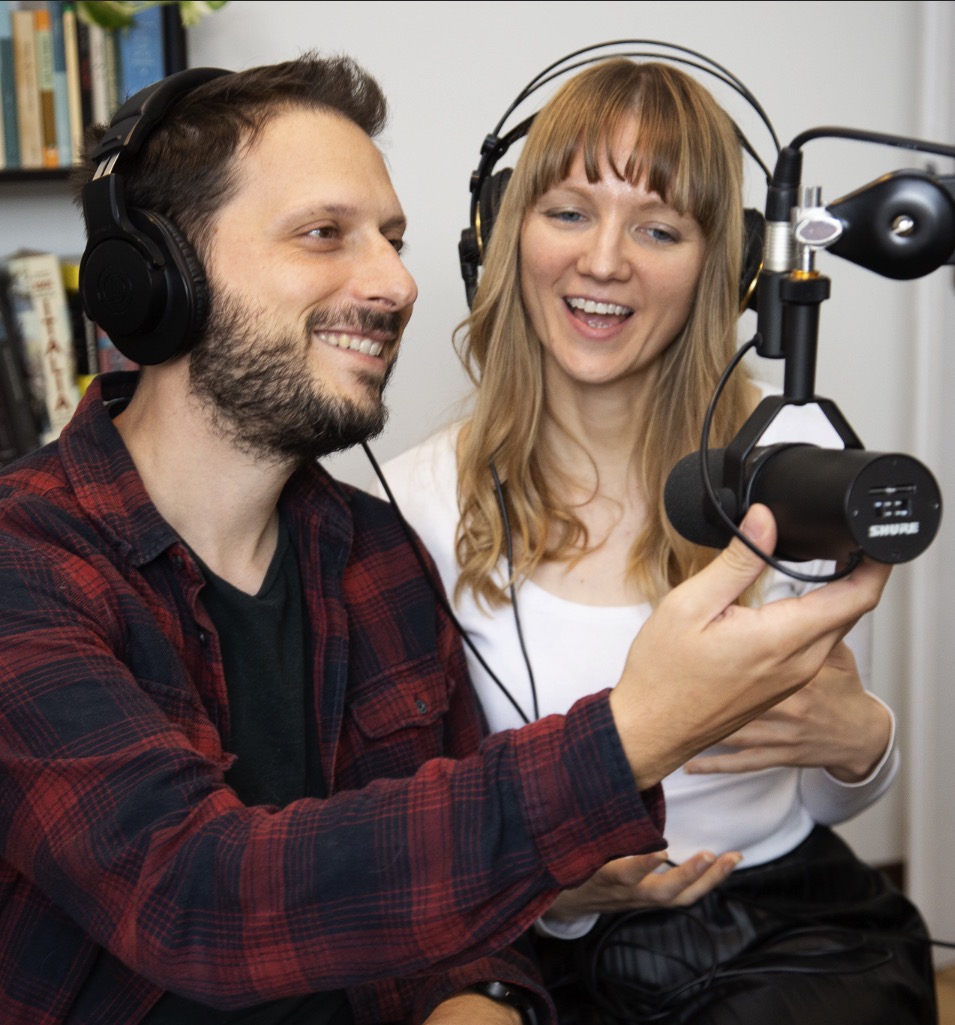
K: Ciao a tutti e benvenuti! Hi everyone and welcome to “Learn Italian with Joy of Languages”.
M: In today’s episode, you’ll hear the different ways that you can use sapere , to know.
K: But before we get started, can we ask you a quick favore ? If you’re listening to this on your podcast app, could you click the subscribe or follow button? This way you’ll get notified when we release a new episode and you’ll help our podcast grow so we can keep making free lessons like this. Grazie!
M: You’re going to hear a conversation between me and Katie where we’re looking for a restaurant in Treviso.
K: Treviso is a city in the North East of Italy and it has lots of canals like Venice, but without all the tourist crowds and cruise ships, so you get more of a local Italian experience. Two of our colleghe, colleagues, live around there: Antonella (our videomaker) and Annaluna (our course coordinator), so we like to go there when we can.
M: As you listen to the conversation, see if you can hear the different ways we use the verb sapere.
K: Sai dov'è quel posto con il risotto al radicchio buonissimo?
M: Mm 😋 ...no...non lo so…
K: Sicuramente Antonella e Annaluna sanno dov’è.
M: Perfetto. Mando un messaggio per avere indicazioni
K: Sai dove siamo?
M: Mmm… non esattamente. So che siamo in centro…
K: So che non vuoi usare Google Maps… ma per il risotto sappiamo che puoi fare un'eccezione.
K: I asked Matteo:
M: Sai dov'è quel posto… - Do you know where that place is… Literally:
Sai - you know
Dov’è - where is
Quel - that
Posto - place
…con il risotto al radicchio buonissimo – with the delicious radicchio risotto?
Con - with
Il - the
Risotto - risotto
Al - to the
Radicchio - radicchio (a purple leaved vegetable)
Buonissimo - very good
K: When you talk about the flavour of something in Italian, you usually use this al , to say what flavour it is.
M: So here it’s risotto al radicchio. Or another example would be torta al cioccolato, chocolate cake.
K: You also just heard the first form of sapere.
M: Sai . You know. Sai.
K: As usually happens in Italian, we don’t need words like “I” and “you” in front of the verb because the ending already makes it clear who we’re talking about.
M: So sai means “you know”. Sai.
K: To show you’re asking a question (as in “do you know”) you can use the same word, but just raise your voice at the end. For example, to ask “do you know where is…?”, we just say “you know where is…?”
M: Sai dov’è? (x2)
K: This phrase is perfect for asking an Italian for directions. Just remember it uses the informal “you,” so it’s best for someone you know well.
M: If you did want to use the formal “you” to say “you know” it would be sa, spelled s-a . Sa.
K: So to ask the same question, with the formal you, for someone you don’t know, would be:
M: Sa dov’è….? (x2)
M: Katie also asked me about a place where you can eat risotto al radicchio. This is a famous dish that originated in Treviso. It’s sometimes also called risotto alla trevigiana (x2), which literally means “risotto from Treviso”.
K: I really enjoyed the risotto al radicchio the last time I went there. Treviso is famous for radicchio, a bitter, red leafed vegetable. And because I liked it so much I described it as buonissimo. We can add this very Italian sounding -issimo on the ends of certain words to make them mean “really” or “very”.
M: For example here we’ve added -issimo to the end of buono , which means “good”, to make it mean “really good”. Buonissimo is a really natural Italian phrase to use if you particularly liked the food, which hopefully will happen often in Italy!.
K: Matteo also remembered it was yummy, but he couldn’t remember where the place was either, so he said:
M: Mm 😋 ...no...non lo so… - Mmm, no, I don’t know. Literally:
Mm
No - no
Non - not
Lo - it
So - I know
K: You’ve just heard the next form of sapere.
M: So . I know. So.
K: It’s spelt SO, like so in English, but in Italian, it’s soh, with a short sharp oh sound. Not sou, but soh.
M: So (x2)
K: Coming back to the whole expression, non lo so, when we say “I don’t know” in Italian, we literally say “I don’t know it”.
M: Non lo so (x2) . Literally:
Non - not
Lo - it
So - know
K: We add the word “it” in front of the word “know”. So it’s technically “not it I know”.
K: Or you if you wanted to say that you did know, you’d also have to use “it”.
M: Lo so . “I know”, or literally “I know it”. Lo so.
K: It can feel a bit strange at first to include “lo”, but it’s one of those things that’s just different in Italian. I’d suggest just remembering the phrases as they are. I know is:
M: Lo so (x2)
K: And I don’t know is:
M: Non lo so (x2)
K: The exception to this is if we continue the sentence and say what we do or don’t know in Italian, then we don’t need “lo”. .
M: So to say “I know that Treviso is very beautiful”, I say so che Treviso è molto bella , without “lo” (“it”). So che Treviso è molto bella.
K: Matteo didn’t know where to find the place for risotto, but since our two colleagues are from the Veneto region, where Treviso is, I thought they’d be the perfect people to ask.
So I said: M: Sicuramente Antonella e Annaluna sanno dov’è. - Antonella and Annaluna will definitely know where it is. Literally:
Sicuramente - surely, or definitely Antonella – Antonella
E - and
Annaluna – Annaluna
Sanno - they know
Dov’è - where it is
K: You’ve now heard the next form of sapere .
M: Sanno . They know. Sanno.
K: This one can be hard to pronounce in Italian, because there’s a double NN. In Italian a double letter means that the sound is held a little longer. It’s not sano , but sanno .
M: Sanno (x2)
K: And since Antonella and Annaluna seem likely to know where the risotto restaurant is, Matteo said:
M: Perfetto. Mando un messaggio per avere indicazioni - Perfect. I’ll send a message to have directions. Literally:
Perfetto - perfect
Mando - I send
Un - a
Messaggio - message
Per - for
Avere - to have
Indicazioni - directions
K: Matteo said mando which can mean “I send” or “I will send”. You can often use the present tense to talk about the future in Italian.
Then I asked Matteo:
M: Sai dove siamo? - do you know where we are? Literally:
Sai - you know
Dove - where
Siamo - we are
K: So again you heard the word for “you know”.
M: Sai (x2) Then Matteo said:
M: Mmm… non esattamente. So che siamo in centro… - Mmm, not exactly. I know that we’re in the centre. Literally:
Non - not
Esattamente - exactly
So - I know
Che - that
Siamo - we are
In - in
Centro - centre
K: You heard the word for “I know” again
M: So (x2)
K: This time, we don’t have the word “lo”, in the phrase to say “I know” because as we mentioned before, when we continue the phrase, and say what it is that we know, we don’t need it.
M: You also heard “che” which means “that”. I know that is so che (x2) .
K: Matteo’s sense of direction is much better than mine, so he’s more likely to know where we are and not need to use google maps. This time, though, it seemed like we might need it, so I said:
M: So che non vuoi usare Google Maps… - I know that you don’t want to use google maps. Literally:
So - I know
Che - that
Non - not
Vuoi - you want
Usare - to use
Google Maps
K: And here again you heard so che for “I know that”. Then I addedM: ma per il risotto sappiamo che puoi fare un'eccezione - but for risotto we know that you can make an exception. Literally:
Ma - but
Per - for
Il - the
Risotto - risotto
Sappiamo - we know
Che - that
Puoi - you can
Fare - to make
Un’eccezione - an exception
K: Now you’ve heard another form of sapere.
M: Sappiamo. We know. Sappiamo.
K: Now that we’ve heard a few of the different forms of sapere, let’s see what you can remember. How do you say “you know”?
[...]
M: Sai (x2) . For example, sai dov’è quel posto? - Do you know where that place is? Just remember that this is the informal “you” that we’re using here.
K: And how would you say “do you (formal) know”?
[...]
M: Sa (x2). For example, sa dov’è quel posto. Do you (formal) know where that place is?
K: What’s the Italian phrase for “I don’t know?” Literally “not, it I know”
[...]M: Non lo so (x2) .
K: And how would I say “I know”? When it's on its own, literally “it I know”
[...]
M: Lo so (x2)
K: How about if you’re continuing the sentence, as in I know that… (we don’t need “lo” when we say the thing that we know).
M: So (x2) . Like so che siamo in centro, I know that we’re in the centre.
K: How would you say “they know”?
[...]
M: Sanno (x2) . For example, Antonella e Annaluna sanno dov’è - Antonella and Annaluna know where it is.
K: And last one, how do we say “we know?”
[...]
M: Sappiamo (x2). For example sappiamo che puoi fare un'eccezione - we know that you can make an exception.
K: Let’s listen to the whole conversation again.
K: Sai dov'è quel posto con il risotto al radicchio buonissimo?
M: Mm 😋 ...no...non lo so…
K: Sicuramente Antonella e Annaluna sanno dov’è.
M: Perfetto. Mando un messaggio per avere indicazioni
K: Sai dove siamo?
M: Mmm… non esattamente. So che siamo in centro…
K: So che non vuoi usare Google Maps… ma per il risotto sappiamo che puoi fare un'eccezione.
K: In this episode, you heard lots of different forms of the verb sapere , but there’s one common mistake we haven’t mentioned yet. It happens when learners confuse sapere with another similar word.
M: To see how to use (and how not to use) sapere, with practical sentences that you can use as you go about your day in Italy, just click the link in the description to head over to our website, or go to italian.joyoflanguages.com/podcast and search for episode 211.
M: See you next time.
K: Or as we say in Italian.
Alla prossima!
Time to check your understanding and remember everything you just learned! Below you’ll find a mini-quiz and some vocabulary cards to help it all go in.
Quiz: Italian Verb Sapere
How much did you learn? Find out in the quiz!
Click here to take the quiz for this episode: Italian Verb Sapere (To Know)
Vocabulary
Sai come arrivare al centro? = Do you know how to get (lit. arrive) to the centre?
Sa a che ora parte il treno? = Do you (formal) know what time the train leaves?
Sappiamo che ci sono molti turisti a Venezia = We know that there are lots of tourists in Venice
Sai dov’è la libreria? = Do you know where the bookstore is?
Mi dispiace, non lo so! = I’m sorry, I don’t know!
So parlare italiano = I know how to speak Italian
Sappiamo fare gli arancini = We know how to make arancini
Non lo so = I don’t know (lit. I don’t know it)
Sai dove siamo? = Do you know where we are?
So che siamo in centro = I know that we’re in the centre
Sai dov'è…? = Do you know where is…?
Flashchards: Italian Verb Sapere
Not sure how it works? Click here to watch the tutorial