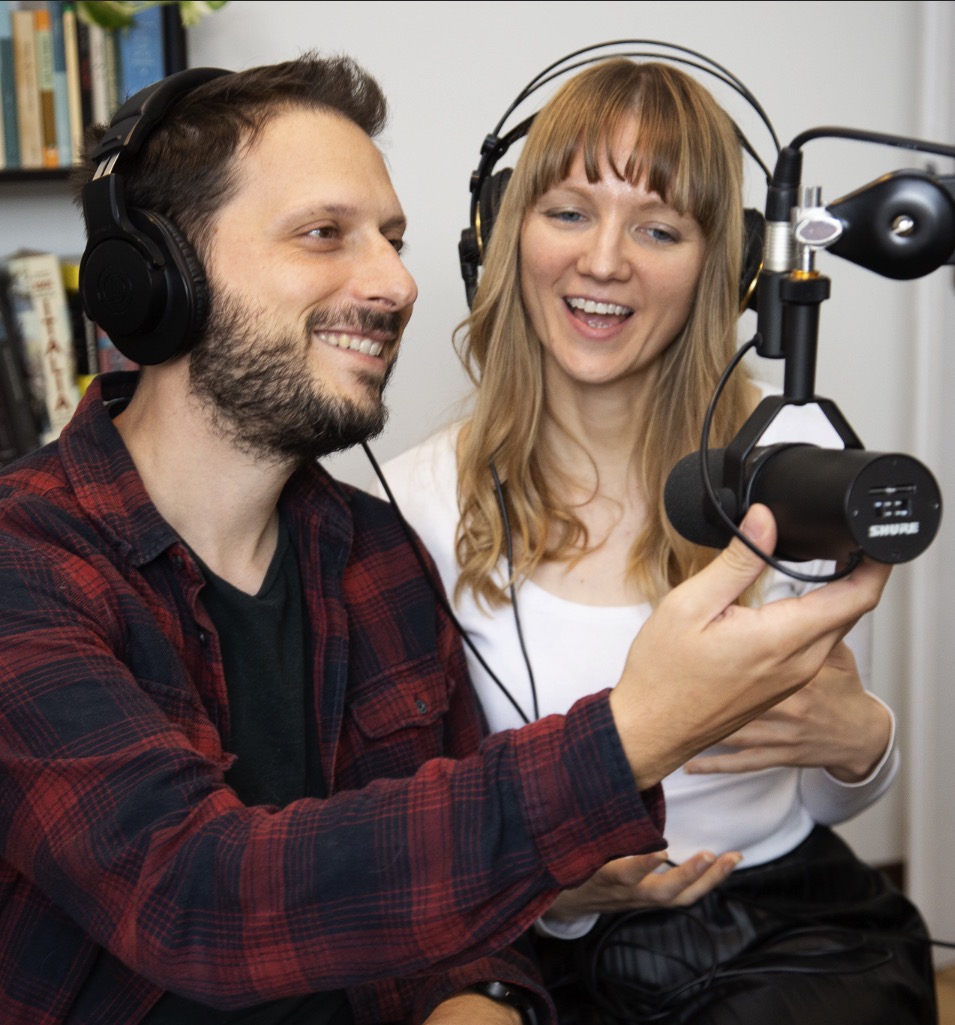
You’ll use potere all the time in Italy, whether you’re checking if you can pay by card, or asking an Italian if they can speak un po’ più piano (a little bit slower) 😅
It often translates as “can” in English. But it doesn’t always work in the same way.
In this post, you’ll see how potere works, and the practical phrases you can use straight away, plus a very common mistake to watch out for.
How to use potere in Italian
Before we look at the different meanings of potere , let’s start with how you can use potere in the present tense.
| Posso | I can | POHS-soh |
| Puoi | You can | PWOY |
| Può | S/he can, you (formal) can | PWOH |
| Possiamo | We can | pohs-SYAH-moh |
| Potete | You (plural) can | poh-TEH-teh |
| Possono | They can | POHS-soh-noh |
Psst! A little reminder: in Italian, we usually leave out pronouns like “I” and “you” because the verb ending already shows who we’re talking about.
For example:
Possiamo andare . - We can go.
Puoi prendere l’ombrello? - Can you take the umbrella?
Posso venire con voi? - Can I come with you?
In Italian when we use potere , meaning “can,” the verb that follows always stays in the base form, the infinitive (like andare, prendere, venire ).
Only potere changes to tell us who is doing the action. So, once you know the different forms of potere, you can make sentences without worrying about changing the form of the next verb.
Here are a few more examples:
Posso prenotare un tavolo per due? - Can I book a table for two?
Possiamo avere il menu? – Can we have the menu?
How to use Potere to express a possibility
When talking to Italians, you can use potere to talk about something that is possible, or that you have the opportunity to do. For example:
Quando vado in Italia posso vedere la mia famiglia. – When I go to Italy, I can see my family.
Con i miei amici posso praticare italiano. – With my friends, I can practise Italian.
Stasera possiamo andare in pizzeria! – We can go to the pizzeria tonight!
I tuoi cugini possono venire con noi? – Can your cousins come with us?
Per andare a Roma possiamo prendere il treno. – To go to Rome, we can take the train.
How to Use Potere to Ask for Permission
You can also use potere to ask for permission, when you want to check if something is allowed.
For example:
Posso pagare con la carta? – Can I pay by card?
Possiamo entrare? – Can we come in?
Posso fare una foto? – Can I take a photo?
Posso prendere questa sedia? - Can I take this chair?
Possiamo lasciare le valigie qui? - Can we leave the suitcases here?
You can use the same structure to give or refuse permission:
Sì, puoi entrare. – Yes, you can come in.
Mi dispiace, non potete parcheggiare qui. – I’m sorry, you can’t (plural) park here.
How to use Potere to Make Requests
You can also use potere to ask someone to do something for you.
In this case, it works a bit like “can you…?” in English.
For example:
Puoi prenotare il ristorante? – Can you book the restaurant?
Possiamo parlare in italiano? - Can we speak in Italian?
Può aiutarmi con la prenotazione, per favore? – Can you (formal) help me with the booking, please?
Puoi parlare più lentamente? – Can you speak more slowly?
How to sound super polite: Potere in the Conditional Tense
Italians often use the conditional of potere , to make requests sound more polite
It translates as “could” in English. For example:
Potrei avere il menù, per favore? – Could I have the menu, please?
| Potrei | I could | poh-TREH-ee |
| Potresti | You could | poh-TREH-stee |
| Potrebbe | S/he could, you (formal) could | poh-TREHB-beh |
| Potremmo | We could | poh-TREM-moh |
| Potreste | You could (plural) | poh-TREH-steh |
| Potrebbero | They could | poh-TREHB-beh-roh |
For example:
Potresti ripetere, per favore? – Could you repeat, please?
Potresti parlare più lentamente? – Could you speak more slowly?
Potrebbe aiutarmi? – Could you help me? (formal)
Common Mistakes with Potere
Because potere often translates as “can”, it’s easy to use it in places where Italian prefers a different verb.
Here are a few common mistakes to watch out for.
-
Using potere when you’re talking about trying.
In English, we often say “I can’t…” when we’re trying to do something and it’s not working. But in Italian, when something doesn’t work despite your effort, we usually use riuscire .
For example:
❌ Non posso capire quando gli italiani parlano veloce. – I can’t understand when Italians speak quickly.
If you want to say you tried to understand them, but it didn’t work it’s more natural to say:
✅ Non riesco a capire quando gli italiani parlano veloce.
– I can’t manage to understand when Italians speak quickly.
Some more examples:
Non riesco a prenotare la visita guidata. – I can't book the guided tour (= I’m trying, but it doesn’t work)
Non riesco a trovare un taxi. – I can't find a taxi (I’m trying, but I can’t find one)
-
Using potere for abilities and skills
If you’re talking about knowing how to do something, a skill you’ve learned, Italians often use the verb sapere .
For example:
❌ Posso parlare italiano. – I can speak Italian.(This can sound like “I’m allowed to speak Italian” or “I have the opportunity to speak Italian in this situation.”)
If you mean that you know how to speak Italian, it’s more natural to say:
✅ So parlare italiano.
Here, sapere expresses ability as a skill — something you’ve learned and know how to do.
Some more examples:
So cucinare la Carbonara - I can cook Carbonara (= I know how)
So ballare la Tarantella - I can dance Tarantella (= I know how)
Italian Verb Potere: Review
-
Potere means “can” or “to be able to”. It’s used to talk about possibility, permission, or making requests.
-
It’s always followed by another verb in the infinitive (the base form). For example:
Possiamo andare. – We can go.
-
You can use potere to talk about something that’s possible:
Quando vado in Italia, posso praticare italiano. – When I go to Italy, I can practise Italian.
-
Or to ask for permission:
Posso fare una foto? – Can I take a photo?
-
You can also use it to make requests:
Puoi prenotare il ristorante? – Can you book the restaurant?
And you can use the conditional to make them sound more polite:
Potresti prenotare il ristorante? – Could you book the restaurant?
-
Sometimes English uses “can” where Italian prefers another verb. If you want to say that something doesn’t work despite your effort, you can use the verb riuscire :
Non riesco a trovare un taxi - I can't find a taxi
If you mean knowing how to do something (a skill), use sapere :
So parlare italiano. – I can speak Italian.
-
Here’s how potere works in the present and conditional tense:
Present Tense
| Posso | I can |
| Puoi | You can |
| Può | S/he can, you (formal) can |
| Possiamo | We can |
| Potete | You (plural) can |
| Possono | They can |
Conditional Tense
| Potrei | I could |
| Potresti | You could |
| Potrebbe | S/he could, you (formal) could |
| Potremmo | We could |
| Potreste | You could (plural) |
| Potrebbero | They could |
K: Ciao a tutti e benvenuti! Hi everyone and welcome to Learn Italian with Joy of Languages.
M: In today’s episode, you’ll learn how to use the verb, or doing word, potere .
K: Just like “can” is a really common word in English, potere is a word that comes up all the time in conversation. But because it works differently in Italian than it does in English, it can sometimes be hard to use correctly, so hearing it in a few natural Italian phrases really helps.
M: But before we get started, can we ask you a quick favore ? If you’re listening to this on your podcast app, could you click the subscribe or follow button? This way you’ll get notified when we release a new episode and you’ll help our podcast grow so we can keep making free lessons like this. Grazie !
K: You’re going to hear a short conversation between me and Matteo as we’re getting ready to leave the house. As you listen, see if you can hear the 5 different ways we use the verb potere .
M: Katiee… Sei pronta? Possiamo andare?
K: Quasi. Se vuoi puoi portare fuori Brody intanto.
M: Brody può venire con noi, no?
K: Giusto. Allora potete scendere. Arrivo.
M: Mm… sicura?
K: Certo. Due minuti!
M: Mm… con te due minuti possono diventare un’ora.
K: Matteo asked:
M: Sei pronta? Possiamo andare? – Are you ready? Can we go? Literally:
Sei - you are
Pronta - ready
Possiamo – we can
Andare – go
K: You’ve just heard the first form of potere :
M: Possiamo- We can.
K: It’s a double SS in the middle, so make it nice and long.
M: PoSSiamo .
K: Just like with other Italian verbs, we don’t need words like “we” and “you” in front of the verb because the ending already makes it clear who we’re talking about. The -iamo ending means “we”.
M: So possiamo means “we can”. Possiamo
K: To show you’re asking a question (as in “can we”) you can use the same word, but just raise your voice at the end.
M: Possiamo ? (x2)
K: Matteo asked me “Possiamo andare?”
Here’s an important thing to notice: when we use potere , meaning “can,” the next verb that follows always stays in the base form.
In this sentence, for example, we use the base form andare — “go” or “to go.”
M: Possiamo andare?
K: Only the first verb, potere changes to tell us who is doing the action, and in this case it’s possiamo (x2) , we can, because Matteo and I are both doing the action.
Don’t worry if that sounds a little confusing right now, as you hear more examples in this episode, hopefully it’ll become much clearer.
K: So, back to the dialogue, I answered:
M: Quasi - Almost
K: It’s not a surprise that I’m not ready when Matteo is. We’re the opposite of the clichés, he’s Italian and always on time and I’m English and often late. To change the subject, I suggested:
M: Se vuoi, puoi portare fuori Brody intanto – If you want, you can walk Brody in the meantime. Literally:
Se- if
Vuoi - you want
Puoi – you can
Portare - take
fuori – outside
Brody –
Intanto - in the meantime.
K: In Italian we don’t say “to walk the dog” or, in our case, “to walk Brody”. We say portare fuori Brody . It makes sense, because when you walk the dog, you take it fuori , outside. Usually, before going out in the evening, we walk Brody or portiamo fuori Brody so we don't have to do it when we get back.
And in the phrase puoi portare fuori Brody there’s the next form of potere.
M: Puoi (x2)
K: Puoi is “you can”, singular and informal. Spelt P-u-o-i but the uuu sounds like a ww: pwoi (x2)
This one is for friends, family, anyone you know well. Like we said before, the second verb is always in the base form. So we say:
M: Puoi portare (x2)
K: The first verb, puoi, (you can) shows us who is doing the action. The second verb – in this case portare (to take) – stays exactly the same.
For example, if we wanted to say “we can take,” we would say:
[...]
M: Possiamo portare (x2)
K: The first verb, becomes possiamo, we can. The second verb always stays the same, no matter who we’re talking about.
This is actually helpful, because once you know the different forms of potere (can), you can make lots of sentences without needing to think about all the different forms of the second verb.
You might also have noticed that at the beginning of the sentence I said:
M: Se vuoi.
Se vuoi, puoi portare fuori Brody.
K: I added se vuoi – “if you want” –at the beginning to make it sound even gentler. So it sounds more like: “You can, if you like.”For example, you might want to say to an Italian friend:
M: Se vuoi, puoi prenotare un tavolo per stasera . If you want, you can reserve a table for tonight. Se vuoi, puoi prenotare un tavolo per stasera (x2) .
K: Then Matteo said:
M: Brody può venire con noi, no ? – Brody can come with us, right? Literally:
Brody
Può – can
Venire – come
Con - with
noi - us
No ?- Right?
K: Può, spelt P-U-O means he can, she can, or it can. Here too, the U sounds like a w. Pwo.
M: Può (x2)
K: Può also means “you can” using the formal you, for Italian adults that you don’t know well. For example, if you’re asking for directions and you’re struggling to understand the reply, you can say:
M: Può ripetere, per favore? Can you repeat, please? Può ripetere, per favore?
K: The “formal you” is always the same as the third person in Italian. So può means “he can”, “she can”, “it can” and “you can” in the formal address. You can say a lot with just one word!
Just like before, after può , we use the base form of the next verb. In this case, venire, to come.
M: Può venire (x2)
K: Now let’s talk quickly about that little no? at the end. Brody can come with us, no? A bit like saying, “right?” or “can’t she?” at the end.
M: We use it to ask for confirmation. Brody può venire con noi, no ?
K: I remember loving learning and saying this, it helped me start to feel really Italian.
M: Sometimes we take Brody with us. It depends on where we're going, although in Italy dogs are usually welcome almost everywhere.
K: Next, I said:
M: Giusto. Allora potete scendere. Arrivo. – Right. So you can go downstairs, I’ll be there in a minute. Literally:
Giusto – right
Allora – so
Potete – you can (plural)
Scendere – go down
Arrivo – I arrive
M: Now you’ve heard the next form of potere . Potete. You can, but this time it’s plural. Potete.
K: Just like puoi means “you can” for one person, potete means “you can” when you’re speaking to two or more people. In this case Matteo and Brody.
M: Potete. (x2)
M: Italians can use this to suggest or let you know that it’s ok if you do something. For example, if you arrive at your B&B before the room is ready, the owner might tell you:
M: Potete lasciare le valigie qui – You can leave your luggage here. Potete lasciare le valigie qui
K: Again, only potere changes. The second verb stays the same. Again, you can go downstairs, literally you plural can go down:
M: Potete scendere. (x2)
K: Back to the dialogue, Matteo doesn't completely believe me when I say I'm almost ready, so he says:
M: Sicura? – Are you sure?
K: Sicura? with an -a at the end, is the way to ask “are you sure?” to a woman.
M: When talking to a man, you’d say Sicuro? (x2)
K: And I answered:
M: Certo. Due minuti! – Of course. Two minutes! Literally:
Certo – Of course Due – two Minuti – minutes
K: Italians often use the word certo to say “of course” in a polite way and to confirm something. For example, if someone asks you if you can take a picture of them, you can reply certo with a smile.
M: Certo. (x2)
K: And due minuti! is something Italians say a lot when they mean “I’ll be really quick.” Matteo doesn’t like when I say it.
M: […]
K: In fact Matteo said:
M: Con te due minuti possono diventare un’ora . – With you, two minutes can turn into an hour. Literally:
Con- with te – you due – two minuti – minutes Possono – they can Diventare – become or turn into Un’ - a Ora - hour
K: Here you’ve heard another form of potere.
M: Possono . They can. With a nice long double SS: Possono .
K: In this sentence, “they” refers to due minuti -“two minutes”. In Italian, due minuti is plural, so we need the “they” form, as in “they can”: possono .
M: Possono (x2)
K: And again, the next verb stays in the base form: diventare , “ to become” or “to turn into” . Diventare. So they can become, or they can turn into:
M: Possono diventare (x2)
K: If you’re still with us, well done! In this episode, we’ve talked about lots of details, so don’t feel like you have to know everything from hearing it just once, feel free to relisten lots of times.
M: “Potere” is a really important verb, so we hope that knowing it will be useful when you go to Italy. Now, let’s see what you can remember.
K: What’s the Italian for “we can”?
[...]
M: Possiamo (x2) .
K: And how would you say “We can go”? Remember: only the verb potere changes, the second verb stays the same.
[...]
M: Possiamo andare (x2)
K: And how do you say “you can?” in the informal?
[...]
M: Puoi (x2). For example, puoi prenotare un tavolo – you can book a table.
K: And what about he, she or it can? And “you can” in the formal address? It’s the same word.
[...]
M: Può (x2). For example, Può ripetere, per favore?- Can you repeat, please?
K: And what about “you can” in the plural?
[...]
M: Potete (x2). For example, potete lasciare le valigie qui - you can leave your luggage here.
K: What about “they can”?
M: Possono ( x2) As in due minuti possono diventare un’ora- two minutes can turn into an hour.
K: Let’s hear the whole conversation again:
M: Katiee… Sei pronta? Possiamo andare?
K: Quasi. Se vuoi, puoi portare fuori Brody intanto.
M: Brody può venire con noi, no?
K: Giusto. Allora potete scendere, arrivo.
M: Mm… sicura?
K: Certo. Due minuti!
M: Mm… con te due minuti possono diventare un’ora.
M: We have seen nearly all the present tense forms of the verb potere. Only the first person is missing: I can, which is Posso (x2), with a nice long double SS . Posso.
K: If you raise your voice at the end and say it as a question, like “Can I” or “May I?”, you have a very useful word! In fact, even if you don't know how to finish the sentence perfectly, you can use it to point at something and say “ Posso? ” For example, on a crowded train, you can point at the empty seat and say “ Posso? ”
M: So, you’ve heard how you can use potere but we haven’t covered a very common mistake that most learners make with this verb. Especially when they try to say “ I can speak Italian”
K: On our blogpost, you’ll find a simple explanation with handy tables so you can see everything written out clearly.
M: Just click the link in the description to head over to our website, or go to italian.joyoflanguages.com/podcast and search for episode 221
M: See you next time.
K: Or as we say in Italian.
Alla prossima!
Time to check your understanding and remember everything you just learned! Below you’ll find a mini-quiz and some vocabulary cards to help it all go in.
Quiz: Italian Verb Potere
How much did you learn? Find out in the quiz!
Click here to take the quiz for this episode: Italian Verb Potere
Vocabulary
Posso prenotare un tavolo per due? = Can I book a table for two?
Posso avere il menu? = Can I have the menu?
Possiamo parlare in italiano? = Can we speak in Italian?
Può aiutarmi con la prenotazione, per favore? = Can you (formal) help me with the booking, please?
Potresti ripetere, per favore? = Could you repeat, please? (singular, informal)
Potrebbe aiutarmi? = Could you help me? (formal)
Posso? = Can I? / May I?
Possiamo andare = We can go
Puoi prenotare un tavolo per stasera = You can reserve a table for tonight (singular, informal)
Potete lasciare le valigie qui= You can leave your luggage here (plural)
Flashcards: Italian Verb Potere
Not sure how it works? Click here to watch the tutorial