
Vino (or wine) is an important part of Italian culture. Every region in Italy produces its own wine, so trying the local one is a great way to get a little “taste” (literally 😅) of the area.
But Italians drink wine in a different way than what you might be used to.
So in this post, you’ll learn useful phrases and cultural tips to help you order wine the Italian way.
Useful Words and Phrases for Ordering Wine in Italy
Phrases for Ordering Wine at the Restaurant
Here are some useful phrases you can use (or might hear the waiter use) when ordering wine in Italy:
| Possiamo vedere la lista dei vini? | Can we see the wine list? | Pohs-SYAH-moh veh-DEH-reh lah LEE-stah day VEE-nee |
| Vorrei provare un vino locale | I’d like to try a local wine | Vohr-RAY proh-VAH-reh oon VEE-noh loh-KAH-leh |
| Che vino mi consiglia? | What wine do you (formal) recommend? | Keh VEE-noh mee kon-SEE-lyah |
| Che vino mi consiglia con…? | What wine do you recommend with…? | Keh VEE-noh mee kon-SEE-lyah kon |
| Che tipo di vino preferisce? | What type of wine do you (formal) prefer? | Keh TEE-poh dee VEE-noh preh-feh-REE-sheh? |
| Cosa sta bene con…? | What goes well with…? | KOH-zah stah BEH-neh kon |
| Sta meglio il bianco | White goes better | Stah MEH-lyoh eel BYAHN-koh |
| Sta meglio il rosso | Red goes better | Stah MEH-lyoh eel ROHS-soh |
| Si abbina bene | It pairs well | See ahb-BEE-nah BEH-neh |
| Chi assaggia? | Who’s tasting? | Kee ahs-SAHJ-jah |
For example:
Che vino mi consiglia con gli spaghetti alle vongole? -What wine do you recommend with spaghetti and clams?
Con il ragù sta meglio il rosso. -With ragù (meat sauce) red is better.
Con gli asparagi forse si abbina meglio il bianco. -With the asparagus maybe white pairs better.
Ordering Different Amounts of Wine
In Italy, there are a few different quantities that you can use when ordering wine.
| Un bicchiere | A glass | Oon beek-KYEH-reh |
| Due bicchieri | Two glasses | DOO-eh beek-KYEH-ree |
| Un calice | A glass of wine | Oon KAH-lee-cheh |
| Due calici | Two glasses of wine | DOO-eh KAH-lee-chee |
| Un quartino | A quarter of a litre | Oon kwar-TEE-noh |
| Mezzo litro | Half a litre | MEHT-tsoh LEE-troh |
| Una bottiglia | A bottle | OO-nah bot-TEE-lyah |
Bicchiere and calice both mean “glass” in Italian, but a calice is a stemmed wine glass. The stem helps stop your hands from warming the wine, so you’ll often use a calice in wine tastings and more elegant restaurants.
And a mezzo litro, which is usually served in a carafe, is very common with house wines or in more relaxed settings, like trattorie , a type of restaurant that’s usually more rustic and serves local food.
For example:
Due calici di Franciacorta* per favore. -Two glasses of Franciacorta please.
Ordiniamo una bottiglia? -Shall we order a bottle?
Prendiamo due calici? -Shall we get (lit. take) two glasses?
*Franciacorta is a type of sparkling white wine from Brescia, in northern Italy. If you want to see a list of different types of Italian wine and what they taste like, you’ll find them on our blogpost how to order wine in Italy .
Common Ways to Describe Wine in Italian
If you want to ask what a particular type of wine is like in Italian, the waiter might use one of the words below to describe it.
Or maybe you want to describe the kind of wine you like, so the waiter can recommend something based on what you prefer.
These are some of the most common words Italians use to talk about wine.
| Vino bianco | White wine | VEE-noh BYAHN-koh |
| Vino rosso | Red wine | VEE-noh ROHS-soh |
| Il vino della casa | The house wine | Eel VEE-noh DEL-lah KAH-zah |
| Corposo | Full-bodied | Kor-POH-zoh |
| Delicato | Delicate | Deh-lee-KAH-toh |
| Dolce | Sweet | DOHL-cheh |
| Fermo | Still | FEHR-moh |
| Frizzante | Sparkling | Freet-TSAHN-teh |
| Fruttato | Fruity | Froot-TAH-toh |
| Morbido | Smooth / soft | MOR-bee-doh |
| Mosso | Slightly sparkling | MOHS-soh |
| Profumato | Fragrant | Proh-foo-MAH-toh |
| Robusto | Robust / strong | Roh-BOO-stoh |
| Secco | Dry | SEHK-koh |
Vorrei provare un vino frizzante. Cosa avete? -I’d like to try a sparkling wine. What do you (plural) have?
Preferisci un vino secco o dolce? -Do you prefer a dry or sweet wine?
Il Donnafugata è un vino bianco fruttato. - Donnafugata is a fruity white wine.
Mezzo litro del vino della casa per favore. -Half a litre of the house wine please.
Tips for Ordering Wine in Italy
Choose wine based on what you’re eating
When you’re ordering wine in Italy, it’s often a little less about your personal preferences and more about what goes well with the food.
For example, prosecco is often something Italians drink before the meal, as an aperitivo, or with a light starter. So if you go to an Italian’s house, they might offer you a glass before dinner while you chat and have some snacks.
Then during the main meal, Italians usually choose wine based on the dish. White wine is often paired with fish or lighter dishes, like vegetable risotto, while red wine is more common with heavier dishes, like red meat or certain cheeses.
And Italians tend to only drink wine or water with a meal, so you wouldn’t usually hear them ordering things like birra (beer), coca cola (coke) or cocktails.
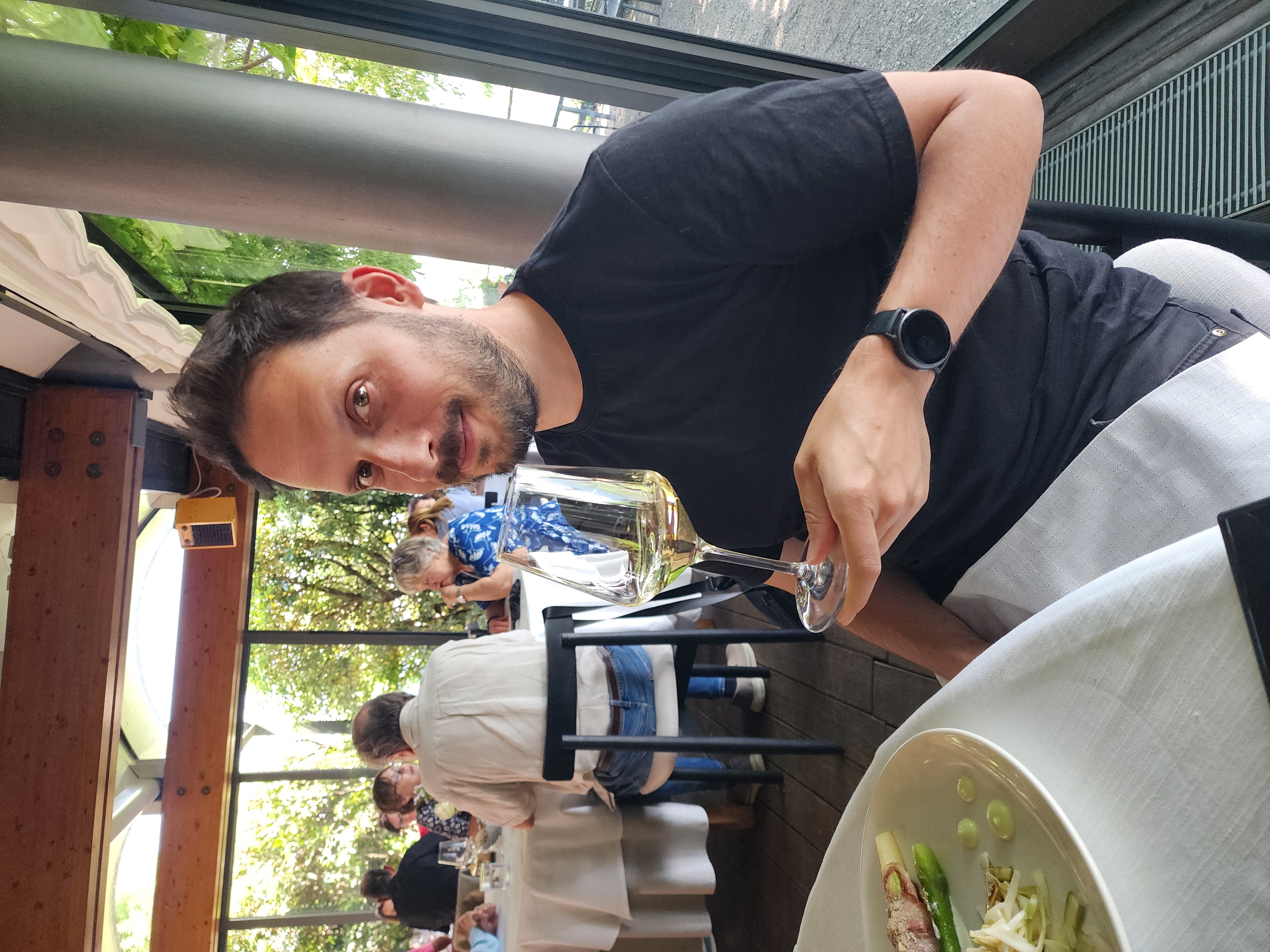
Matteo enjoying a glass of vino bianco with his fish
You can buy wine at an enoteca (wine shop)
In Italy, you can buy wine at the supermercato (supermarket) on the corsia dei vini (wine aisle).
Or you can buy wine at the enoteca.
An enoteca is a wine shop, but usually a bit more specialised than a normal supermarket wine section. You’ll often find a wider selection of local wines, and the staff can usually recommend something based on what you like or what you’re eating.
For example, you might want to say:
Vorrei un vino per stasera. Mangiamo pesce. -I’d like a wine for this evening. We’re eating fish.
Vorrei un vino per stasera. Mangiamo carne. -I’d like a wine for this evening. We’re eating meat.
You don’t have to spend lots of money on wine
In Italy, you might notice different labels on wine bottles that tell you a bit about the wine’s origin and quality.
Here are some of the most common ones:
-
DOC (Denominazione di Origine Controllata)
This means the wine comes from a specific area in Italy and follows certain rules about how it’s produced.
-
DOCG (Denominazione di Origine Controllata e Garantita)
This is similar to DOC, but with even stricter rules and quality checks. You’ll often see this on more famous or prestigious wines.
-
IGT (Indicazione Geografica Tipica)
This label gives winemakers a bit more flexibility with how they make the wine. Some very high-quality and creative wines actually fall into this category.
But you don’t need to spend lots of money or choose the fanciest label to drink good wine in Italy. Even simple local wines or vino della casa (house wine) can be really good.
Why Italians taste the wine first
The waiter might ask your table chi assaggia? (“who’s tasting?”) if you order a bottle of wine.
That’s because in Italy, one person will often taste the wine before it’s poured for everyone else at the table, just to check that the bottle is good. For example, to make sure the wine doesn’t taste corked or overly acidic.
If you’re the one tasting and everything seems fine, you can tell the waiter va bene - it’s fine (lit. it goes well).
What Italians say before drinking
Before you take a sip of your wine, you might want to say cheers to the other people on your table. Doing this is very common in Italy.
When Italians do this, they say salute! which is Italian for cheers . It literally means “health!”.
Ordering Wine in Italy: Useful Phrases and Tips: Review
-
There are some useful phrases that can help you order wine and understand recommendations from the waiter.
For example:
Che vino mi consiglia con gli spaghetti alle vongole? -What wine do you recommend with spaghetti and clams?
Con il ragù sta meglio il rosso. -With ragù (meat sauce), red is better.
Con gli asparagi forse si abbina meglio il bianco. -With asparagus maybe white pairs better.
-
In Italy, wine is often ordered in different quantities, like a glass, half litre or bottle.
For example:
Due calici di Franciacorta per favore . -Two glasses of Franciacorta please.
Ordiniamo una bottiglia? -Shall we order a bottle?
-
There are some common Italian words Italians use to describe wine, like secco (dry), dolce (sweet), fruttato (fruity) or corposo (full-bodied).
For example:
Preferisci un vino secco o dolce? -Do you prefer a dry or sweet wine?
Il Donnafugata è un vino bianco fruttato. -Donnafugata is a fruity white wine.
-
There are also a few cultural tips that can help you order wine the Italian way. Italians often choose wine based on what they’re eating, and if you order a bottle, one person at the table will often taste it first. Before drinking, Italians also commonly say salute! (“cheers!”).
If you’re at the enoteca (wine shop) and you’re looking for a good wine for dinner, you could say:
Vorrei un vino per stasera. Mangiamo pesce . -I’d like a wine for this evening. We’re eating fish.
Vorrei un vino per stasera. Mangiamo carne. -I’d like a wine for this evening. We’re eating meat.
M: Let’s talk about some useful Italian phrases for ordering wine, as well as a few tips about how to order wine in Italy.
K: That way, when you’re next in Italy, you can feel more confident about how to order wine.
M: But before we get started, can we ask you a quick favore ? If you’re listening to this on your podcast app, could you click the subscribe or follow button? This way you’ll get notified when we release a new episode and you’ll help our podcast grow so we can keep making free lessons like this. Grazie !
K: You’re going to hear a conversation between me and Matteo where we talk about the wine we’d like to order. It’s similar to a conversation that we had when we were in Treviso, which is a town in northern Italy. See if you can hear some of the different phrases we use to talk about wine.
M: Ordiniamo una bottiglia di vino?
K: In due?
M: Troppo? Prendiamo due calici?
K: Sì. Rosso o bianco?
M: Con gli asparagi forse si abbina meglio il bianco. Un Prosecco?
K: O possiamo provare il vino della casa.
M: Va bene, allora facciamo mezzo litro?
K: Ok, speriamo di non essere troppo brilli alla fine.
K: Matteo started out by asking:
M: Ordiniamo una bottiglia di vino? - Shall we order a bottle of wine? Literally:
Ordiniamo - we order
Una - a
Bottiglia - bottle
Di - of
Vino - wine
K: So one word that’s useful to talk about ordering wine is ordiniamo, we order. It comes from the verb ordinare , to order.
M: Saying ordiniamo, or “shall we order?...” is a useful way of checking what the other people on your table would like to have if you’re thinking of sharing something.
K: And in Italy, it’s really common to share a bottle of wine at the table, instead of everyone choosing their own individual glass of wine that they’d like.
M: You also heard a useful phrase when it comes to wine: una bottiglia di vino (x2). You might want to use this in a restaurant, or if you’re looking for a bottle of wine in a supermarket or a wine shop.
K: If Italians aren’t just drinking water, they’d usually have wine with their meal, rather than other drinks, like beer or coke.
K: Then I asked:
M: In due? - for two? Literally:
In - in
Due - two
K: I wasn’t sure we could manage a whole bottle between the two of us.
Then Matteo said:
M: Troppo? Prendiamo due calici? - Too much? Shall we order two glasses? Literally:
Troppo - Too much?
Prendiamo - we take
Due - two
Calici - glasses
M: You might have heard bicchiere used as the word for glass, like in the phrase un bicchiere di vino, a glass of wine. But here we used the word calice , with an -e on the end for one glass, or calici, with an -i on the end for glasses, plural. Calici.
K: You can use both calice and bicchiere to talk about a glass of wine. Calice is the typical stemmed wine glass, rather than just any type of glass. It’s the one usually used for wine and cocktails because holding the stem helps stop your hands from warming up the drink. If it helps you to remember this word, it’s a bit like the word “chalice” in English.
M: We also used the word prendiamo. It literally means “we take”, but in Italian we use this when we’re saying what food or drink we’re going to have or order.
K: Then I said:
M: Sì. Rosso o bianco? - Yes. Red or white? Literally:
Sì - yes
Rosso - red
O - or
Bianco - white
K: Like in English, in Italian you don’t always have to say red wine or white wine, you can just say red or white, or rosso o bianco.
Then Matteo said:
M: Con gli asparagi forse si abbina meglio il bianco. - With the asparagus maybe white pairs better. Literally:
Con - with
Gli - the
Asparagi - asparagus
Forse - maybe
Si - itself
Abbina - pairs
Meglio - better
Il - the
Bianco - white
K: And then Matteo added:
M: Un Prosecco? - The highest quality Prosecco, the sparkling, white wine that’s famous all over the world, is made in the hills near Treviso.
K: So, when Matteo was talking about what went with the asparagus we were going to eat, which is a common ingredient in dishes in Treviso, he used a useful expression.
M: Si abbina. It pairs. Si abbina.
K: If you’re wondering what this si means, it’s something Italians use with certain verbs where, literally, they say something like “it pairs itself”. But it’s quite complicated, so you don’t have to worry about that too much for now and you can just practice learning the phrase as it is.
And this one’s useful to know you want to ask the waiter which wine pairs with what you’re eating if you’re not sure.
M: For example, you could ask the waiter, cosa si abbina con gli asparagi? What pairs with the asparagus? Cosa si abbina con gli asparagi?
K: And in Italy, you usually choose whether to have red or white wine not based on which one you like the most, but based on what goes best with your meal.
M: White wine is usually the one for fish and white meat, whereas red goes best with red meat.
K: And you also tend to drink white wine with lighter dishes, like risotto with vegetables, or nibbles at an aperitivo, and red with heavier food, including certain cheeses.
Then I said:
M: O possiamo provare il vino della casa? - Or we can try the house wine? Literally:
O - or
Possiamo - we can
Provare - try
Il - the
Vino - wine
Della - of the
Casa - house
K: Like in other countries, the house wine in Italy is usually a cheaper option. But you don’t have to worry about spending lots of money to get good wine in Italy. Even a lot of the cheaper options are good quality.
Then Matteo said:
M: Va bene, allora facciamo mezzo litro? - Ok, shall we go for half a litre? Literally:
Va - it goes
Bene - well
Allora - then
Facciamo - we do
Mezzo - half
Litro - litre
K: You just heard another way that we can measure wine:
M: Mezzo litro. Half a litre. Mezzo litro.
K: This one’s useful if you want a couple of glasses, but don’t want the full bottle, and it’s often served in a carafe.
M: When you’re ordering il vino della casa, the house wine, it’s less common for it to be served by the glass. You usually order un quartino, so a quarter of a litre. Un quartino. Or mezzo litro. Or un litro, a full litre.
K: But since we were now ordering more than one glass, I said to Matteo:
K: Ok, speriamo di non essere troppo brilli alla fine - Ok, let’s hope we’re not too tipsy by the end. Literally:
Ok - ok
Speriamo di - we hope to
Non - not
Essere - to be
Troppo - too
Brilli - tipsy
Alla - at the
Fine - end
K: You might want to joke about being brilli, or tipsy, in Italy. It’s a nice way to describe being tipsy. It comes from the verb brillare , which means to shine or sparkle.
M: But actually in Italy, there isn’t as much of a culture of getting drunk. Usually, the idea is to drink to appreciate the taste of the wine and food.
K: If you use this word, brilli , just be careful to put the right ending on. So for Matteo and I, we’d say brilli , with an -i on the end, because there are two of us. If it was just me saying I’m tipsy, I’d say sono brilla , with an -a on the end. If it was just Matteo he’d say sono brillo, with an o on the end.
M: But don’t worry if you use the wrong one, Italians will still understand you.
K: Now that you’ve heard a few phrases to do with ordering wine in Italy, let’s see what you can remember.
K: What’s the Italian for “a bottle of wine”, like in the phrase “shall we order a bottle of wine?”
[...]
M: Una bottiglia di vino(x2). For example, ordiniamo una bottiglia di vino? (x2).
K: And what’s the Italian word for “glass” when talking about wine? Like in the phrase “shall we order (or literally “take”) two glasses?
[...]
M: Calice (x2) . For example: prendiamo due calici?
K: What’s the phrase Matteo used to say “it pairsl”? Like you heard in the phrase, "with asparagus maybe white pairs better.”
[...]
M: Si abbina (x2) . For example, con gli asparagi forse si abbina meglio il bianco.
K: How would you say “the house wine?” like in the phrase: “or we can try the house wine?”
[...]
M: Il vino della casa (x2). For example, o possiamo prendere il vino della casa.
K: How would you say “half a litre”. You heard it in the phrase “let’s go for (or literally let’s do) half a litre”
[...]
M: Mezzo litro (x2) . For example, facciamo mezzo litro?
K: And lastly, what’s the Italian for tipsy, like in the phrase “let’s hope we’re not tipsy by the end?”
M: Brilli (x2) . For example, speriamo di non essere troppo brilli alla fine.
K: Let’s listen to the whole conversation again.
M: Ordiniamo una bottiglia di vino?
K: In due?
M: Troppo? Prendiamo due calici?
K: Sì. Rosso o bianco?
M: Con gli asparagi forse si abbina meglio il bianco. Un Prosecco?
K: O possiamo provare il vino della casa.
M: Va bene, allora facciamo mezzo litro?
K: Ok, speriamo di non essere troppo brilli alla fine.
K: You’ve heard a few useful phrases and tips for ordering wine in Italy, but there are lots more, like how to describe the type of wine you want, to make sure it’s not too sweet or dry, depending on what you like best. Or what kind of phrases you might hear the waiter say to you so you can make sure to understand them.
M: To see all these phrases together, as well as more tips on ordering wine in Italy the Italian way, just click the link the description to head over to our website, or or go to italian.joyoflanguages.com/podcast and search for episode 232.
K: See you next time.
M: Or as we say in Italian.
Alla prossima!
Time to check your understanding and remember everything you just learned! Below you’ll find a mini-quiz and some vocabulary cards to help it all go in.
Quiz: Ordering Wine in Italy: Useful Phrases and Tips
How much did you learn? Find out in the quiz!
Click here to take the quiz for this episode: Ordering Wine in Italy: Useful Phrases and Tips
Vocabulary
Due calici di Franciacorta per favore = Two glasses of Franciacorta please
Preferisci un vino secco o dolce? = Do you prefer a dry or sweet wine?
Che vino mi consiglia con gli spaghetti alle vongole? = What wine do you recommend with spaghetti and clams?
Con il ragù sta meglio il rosso = With ragù (meat sauce), red is better
Mezzo litro del vino della casa per favore = Half a litre of the house wine please
Vorrei provare un vino frizzante. Cosa avete? = I’d like to try a sparkling wine. What do you (plural) have?
Ordiniamo una bottiglia di vino? = Shall we order a bottle of wine?
Prendiamo due calici? = Shall we get (lit. take) two glasses?
Possiamo provare il vino della casa = We can try the house wine
Con gli asparagi forse si abbina meglio il bianco = With asparagus maybe white pairs better
Not sure how it works? Click here to watch the tutorial