Adverbs are the fancy grammar term for words like generalmente or assolutamente which can help you add extra detail to what you’re saying in Italian.
Like if you didn’t just want to say that the pizza in Naples is amazing, but assolutamente amazing. Or not just that you drink a cappuccino in the morning, but generalmente, you have a cappuccino in the morning.
In this post, you’ll see a list of some of the most common adverbs in Italian and how to use them.
How Adverbs Work in Italian
In English, lots of adverbs end in -ly, like “slowly” or “easily”. In Italian, they also often have the same ending: -mente .
Now that you know this, you can start to form adverbs from the words you know. For example, if you know the word veloce (quick), you can add -mente to the end and it becomes velocemente (quickly).
This might not work perfectly every time, but it will probably be close enough to the right word that Italians will understand you anyway.
Common Italian Adverbs
Assolutamente - absolutely
Pronunciation: Ahs-soh-loo-tah-MEN-teh
Il cibo a Napoli è assolutamente fantastico. - The food in Naples is absolutely amazing.
Facilmente - easily
Pronunciation: Fah-cheel-MEN-teh
La spiaggia è facilmente raggiungibile a piedi. - The beach is easily reachable on foot.
Fortunatamente - fortunately
Pronunciation: For-too-nah-tah-MEN-teh
Fortunatamente il ristorante ha un tavolo libero. - Fortunately, the restaurant has a table available (lit. a free table).
Sfortunatamente - unfortunately
Pronunciation: Sfor-too-nah-tah-MEN-teh
Sfortunatamente non vado in Italia quest’estate. - Unfortunately, I’m not going to Italy this summer.
Generalmente - generally, usually
Pronunciation: Jeh-neh-rahl-MEN-teh
Generalmente bevo un cappuccino la mattina. - Usually, I drink a cappuccino in the morning.
Immediatamente - immediately
Pronunciation: Ee-meh-dee-ah-tah-MEN-teh
Partiamo immediatamente dopo pranzo. - We’re leaving immediately after lunch.
Lentamente - slowly
Pronunciation: Len-tah-MEN-teh
Può parlare più lentamente, per favore? - Can you (formal) speak more slowly, please?
Onestamente - honestly
Pronunciation: Oh-neh-stah-MEN-teh
Onestamente, non mi piace il pesce. - Honestly, I don’t like fish.
Ovviamente - obviously, of course
Pronunciation: Ov-vyah-MEN-teh
Il treno è in ritardo…ovviamente. - The train is late…obviously.
Probabilmente - probably
Pronunciation: Proh-bah-beel-MEN-teh
Probabilmente piove domani. - It probably will rain tomorrow.
Regolarmente - regularly
Pronunciation: Reh-goo-lahr-MEN-teh
È importante studiare italiano regolarmente. - It’s important to study Italian regularly.
Sicuramente - surely, definitely
Pronunciation: See-koo-rah-MEN-teh
La pizza a Napoli è sicuramente molto buona. - The pizza in Naples is definitely very good.
Solamente - only
Pronunciation: Soh-lah-MEN-teh
Passiamo solamente due giorni a Roma. - We’re only spending two days in Rome.
Tranquillamente - calmly, peacefully, without any problem
Pronunciation: Tran-kweel-lah-MEN-teh
Puoi tranquillamente arrivare in centro da qui. - You can get to the center from here without any problem.
Dormo tranquillamente quando sono in vacanza. - I sleep peacefully when I’m on holiday.
Velocemente - quickly / fast
Pronunciation: Veh-loh-cheh-MEN-teh
Non capisco gli italiani quando parlano velocemente. - I don’t understand Italians when they speak quickly.
Irregular Adverbs in Italian
Not all adverbs in Italian end in -mente , just like in English not all adverbs end in -ly . Here are a few of the most common adverbs in Italian that don’t follow the normal pattern.
Bene - Well
Pronunciation: BEH-neh
Parli bene l’italiano! - You speak Italian well!
Male - Badly
Pronunciation: MAH-leh
Preferisco mangiare fuori perché cucino male. - I prefer to eat out because I cook badly.
Piano - Slowly, quietly
Pronunciation: PYAH-noh
Sto imparando italiano, piano piano. -I’m learning italiano, slowly*.
*💡 Good to know : In Italian you can repeat the word piano twice. It can give the idea of “slowly but surely” or “gradually”.
Useful Italian Adverbs For Everyday Conversation: Review
Here’s a list of the common Italian adverbs you’ve seen and their pronunciation.
| Assolutamente | Absolutely | Ahs-soh-loo-tah-MEN-teh |
| Facilmente | Easily | Fah-cheel-MEN-teh |
| Fortunatamente | Fortunately | For-too-nah-tah-MEN-teh |
| Sfortunatamente | Unfortunately | Sfor-too-nah-tah-MEN-teh |
| Generalmente | Generally / Usually | Jeh-neh-rahl-MEN-teh |
| Immediatamente | Immediately | Ee-meh-dee-ah-tah-MEN-teh |
| Lentamente | Slowly | Len-tah-MEN-teh |
| Onestamente | Honestly | Oh-neh-stah-MEN-teh |
| Ovviamente | Obviously / Of course | Ov-vyah-MEN-teh |
| Probabilmente | Probably | Proh-bah-beel-MEN-teh |
| Regolarmente | Regularly | Reh-goh-lahr-MEN-teh |
| Sicuramente | Surely / Definitely | See-koo-rah-MEN-teh |
| Solamente | Only | Soh-lah-MEN-teh |
| Tranquillamente | Calmly / Without problem | Tran-kweel-lah-MEN-teh |
| Velocemente | Quickly / Fast | Veh-loh-cheh-MEN-teh |
| Bene | Well | BEH-neh |
| Male | Badly | MAH-leh |
| Piano | Slowly / Quietly | PYAH-noh |
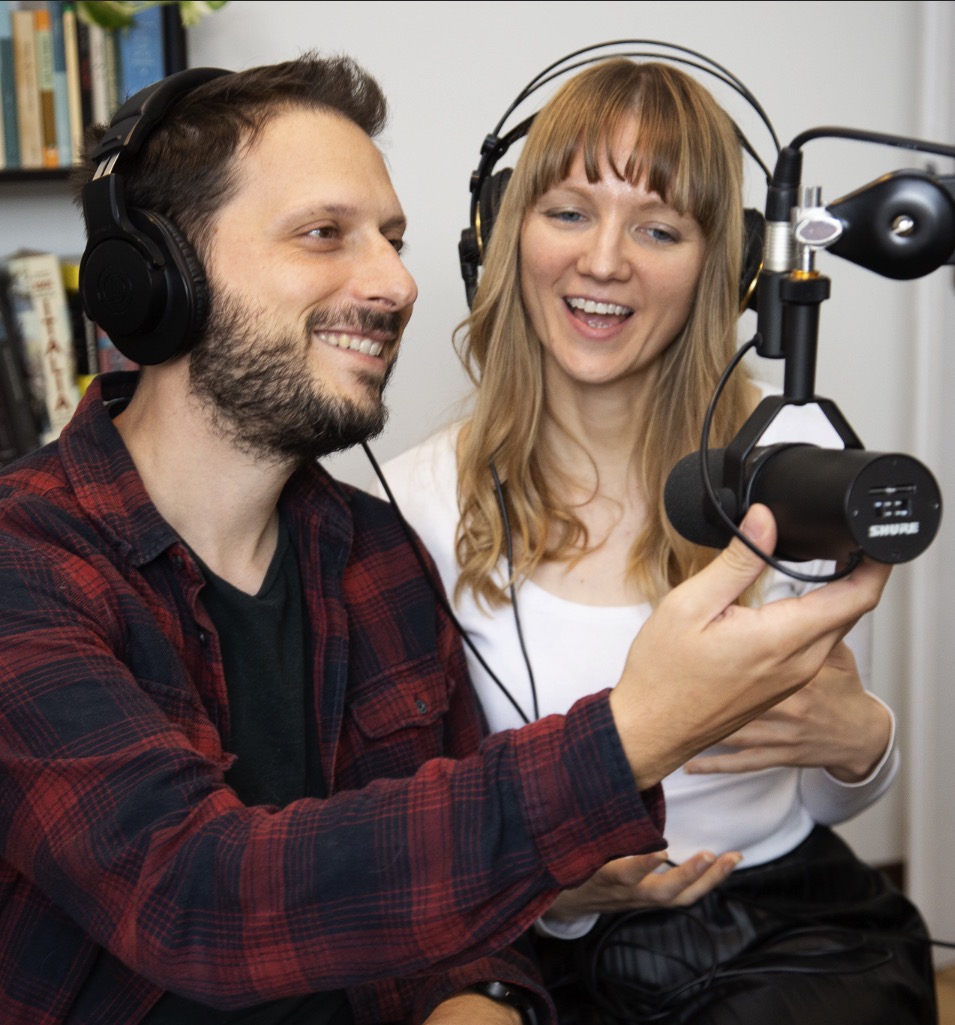
K: Ciao a tutti e benvenuti! Hi everyone and welcome to Learn Italian with Joy of Languages.
Today you’ll get to see how words that come up all the time in Italian like easily, quickly and absolutely work. You might have just noticed, they’re the ones that in English often end in -ly. In Italian they often end in -mente.
M: And once you understand how these kinds of words work, you’ll automaticamente also be able to form lots of new ones, so you can immediatamente say even more in Italian.
K: But before we get started, can we ask you a quick favore ? If you’re listening to this on your podcast app, could you click the subscribe or follow button? This way you’ll get notified when we release a new episode and you’ll help our podcast grow so we can keep making free lessons like this. Grazie !
M: You’re going to hear a dialogue between me and Katie where we talk about some of the things we’ve been trying to learn lately. I’ve been learning how to do archery, and Katie’s been learning how to play the drums.
K: See if you can pick out the words that add more detail to what we’re saying. As a hint, listen for the ones ending in m-e-n-t-e.
K: Sei bravo Matteo, migliori velocemente
M: Beh, sicuramente ho fatto dei progressi... ovviamente c’è ancora molto da imparare.
K: Sì, ma tu impari facilmente
M: Generalmente anche tu
K: Non questa volta, onestamente. Probabilmente sono negata.
M: Hai fatto pratica recentemente?
K: Ehm… sì... 3 mesi fa
K: Talking about how archery is going for Matteo, I said:
M: Sei bravo Matteo, migliori velocemente - You’re good, you’re improving quickly. Literally:
Sei - you are
Bravo - good
Matteo
Migliori - you improve
Velocemente - quickly
K: You heard the first adverb:
M: Velocemente. Quickly. Velocemente.
K: It’s adding more detail to what I’m saying because Matteo isn’t just improving, he’s improving quickly. As we mentioned earlier in English, adverbs often end in -ly, and in Italian, in -mente .
M: You might already know the word veloce , or quick, in Italian. When you add -mente to the end it becomes quickly. Another way you might use this is to say gli italiani parlano velocemente, Italians speak quickly . Gli italiani parlano velocemente.
K: Then Matteo said: M: Beh, sicuramente ho fatto dei progressi - Well, I’ve definitely made progress. Literally:
Beh - well
Sicuramente - definitely, or surely
Ho - I have
Fatto - made
Dei - some
Progressi - progress
K: You’ve heard another adverb, which means “definitely” or “surely” in Italian:
M: Sicuramente (x2)
K: Matteo didn’t just say that he’d made progress, he wanted to show that he was sure he had to make the idea sound a bit stronger. That’s why he used sicuramente.
M: Italians also use this word a lot as a way of saying “for sure” to show you really agree with something someone has said. For example, if someone said that Naples has the best pizza, you could say sì, sicuramente. Yes for sure. Sì, sicuramente.
K: Then Matteo continued:
M: Ovviamente c’è ancora molto da imparare - obviously there’s a lot to learn. Literally:
Ovviamente - obviously
C’è - there is
Ancora - still
Molto - a lot
Da - from
Imparare - learn
K: And here Matteo used another adverb
M: Ovviamente (x2)
K: It sounds like “obviously” in English and that’s exactly what it means!
When Matteo spoke about having a lot to learn still, molto da imparare he used this little word da . Da literally means “from” in Italian, but as we know, expressions often don’t translate perfectly. In Italian, you can also use da in front of a word to give the idea of having to do something.
M: Like if you said you had a lot to do, you’d use molto da fare. Or if you were saying there’s a lot to see in Venice, you could say molto da vedere.
K: But no need to worry about this too much, for now you can just focus on how it works in this conversation. So understanding that molto da imparare means “a lot to learn”.
Then I said to Matteo:
M: Ma tu impari facilmente - But you learn easily. Literally:
Ma - but
Tu - you
Impari - learn
Facilmente - easily
K: You might have recognised the next adverb:
M: Facilmente (x2). You might already know the word facile, easy. Facilmente is easily. For example, you might say in Italia, viaggio facilmente in treno. In Italy, I travel easily by train. In Italia, viaggio facilmente in treno.
K: In Italian, we usually don’t have to use little words like “you” or “I” in front of the verb because the ending already lets us know who we’re talking about. When a verb ends in the letter -i, pronounced ee, like in migliori, you improve, or impari, you learn, we already know we’re talking about you. But this time, when I said to Matteo “you learn easily”, I did use the word for “you”, “tu”. Italians often do this to add emphasis when comparing. I wanted to highlight that you learn quickly compared to others. In this case, tu, you learn quickly compared to me!
After I said that Matteo learns quickly, he replied:
M: Generalmente anche tu - Generally you do too. Literally:
Generalmente - generally
Anche - also
Tu - you
K: Matteo used another adverb:
M: Generalmente (x2)
K: It’s like the word “generally” in English, but you can also use it in Italian to say things like “usually” or “normally”.
M: For example, if an Italian asked you what you drink at breakfast time, you might say generalmente bevo un cappuccino. Normally I drink a cappuccino. Generalmente bevo un cappuccino.
K: Then I replied:
M: Non questa volta, onestamente - not this time, honestly. Literally:
Non - not
Questa - this
Volta - time
Onestamente - honestly
K: So the next adverb is:
M: Onestamente (x2).
K: This is a useful one to know in Italian because you can use it to show how you really feel about something.
And then, after saying that I honestly didn’t feel I was learning the drums very quickly, I added:
M: Probabilmente sono negata - I’m probably hopeless. Literally:
Probabilmente - probably
Sono - I am
Negata - hopeless
K: [...]
I used the next adverb:
M: Probabilmente (x2)
K: Probably.
M: Negata is a word that Italians use all the time if you want to say that you’re hopeless or useless at something. Katie said negata, with an -a. I would say negato, with an -o ending. It gives the idea that you don’t have the natural talent for it basically.
K: Then Matteo asked:
M: Hai fatto pratica recentemente? - have you practiced recently? Literally:
Hai - you have
Fatto - done
Pratica - practice
Recentemente - recently
K: So the next adverb was:
M: Recentemente (x2).
K: And then, to reply to Matteo’s question about whether I’d been practicing, I said:
M: Ehm… sì... 3 mesi fa - Um…yes…three months ago. Literally:
Ehm - Um
Sì - yes
Tre - three
Mesi - months
Fa - ago
K: So now you’ve heard lots of different adverbs in Italian, you can see there’s a very common pattern. They very often end in - mente. And now you know this, you might be able to make new words from the Italian words you already know. For example, if you know the word semplice , simple, you can just add -mente to the end to say semplicemente, simply. This rule might not always work perfectly every time, but it will be close enough that an Italian will probably understand what you mean.
M: Let’s see if you can remember the different adverbs you heard today.
K: How would I say “quickly”, like I said when I told Matteo “you improve quickly”.
[...]
M: Velocemente (x2) . For example, migliori velocemente.
K: What about “definitely” or “surely”? Like when Matteo said “I’ve definitely made progress”.
[...]
M: Sicuramente (x2) . For example: Sicuramente ho fatto dei progressi. I’ve definitely made progress. Or you can use this to agree with something that someone has said, for example sì, sicuramente. Yes, for sure.
K: And how would I say “easily”? Like when I told Matteo “you learn easily?”
[...]
M: Facilmente (x2). For example, tu impari facilmente.
K: And what about the word “generally”? It can also mean “usually” or “normally”.
[...]
M: Generalmente (x2) . For example, generalmente bevo un cappuccino. Generally, or usually, I drink a cappuccino.
K: And what’s the Italian word for “honestly?”
[...]
M: Onestamente (x2) . This one’s useful when you want to show you’re giving a truthful opinion about something.
K: And how would you say “probabily” in Italian? Like I said when I said “I’m probably hopeless”. Italians often put probably at the beginning:
M: Probabilmente. For example, probabilmente sono negata.
K: And then lastly, how would you say “recently” in Italian?
M: Recentemente (x2) .
K: Let’s hear the whole conversation again:
K: Sei bravo Matteo, migliori velocemente
M: Beh, sicuramente ho fatto dei progressi... ovviamente c’è ancora molto da imparare.
K: Sì, ma tu impari facilmente
M: Generalmente anche tu
K: Non questa volta, onestamente. Probabilmente sono negata.
M: Hai fatto pratica recentemente?
K: Ehm… sì... 3 mesi fa
K: In this conversation, you heard that I haven’t really been improving with the drums because I haven’t practiced in three months.
M: And if you don’t practice regularly, it’s hard to make much progress… Ovviamente
K: It can be hard to find the time to practice, but this is basically why Matteo is making a lot more progress than me - he’s practising more! The same thing is true with finding the time to practice Italian.
M: If you’d like a weekly Italian lesson sent to your email, so you can practice regularly and also don’t have to spend time looking for the right resources, you can sign up to our newsletter. Just click the link in the description.
K: By signing up to our newsletter, you’ll also be among the first to find out when our online Italian school opens.
M: See you next time.
K: Or as we say in Italian.
Alla prossima!
Time to check your understanding and remember everything you just learned! Below you’ll find a mini-quiz and some vocabulary cards to help it all go in.
Quiz: Adverbs in Italian
How much did you learn? Find out in the quiz!
Click here to take the quiz for this episode: Adverbs in Italian
Vocabulary
Fortunatamente il ristorante ha un tavolo libero = Fortunately, the restaurant has a free table.
Sfortunatamente non vado in Italia quest’estate = Unfortunately, I’m not going to Italy this summer
Può parlare più lentamente, per favore? = Can you speak more slowly please?
Passiamo solamente due giorni a Roma = We’re only spending two days in Rome
Puoi tranquillamente arrivare in centro da qui = You can easily arrive in the center from here
Parli bene l’italiano! = You speak Italian well!
Gli italiani parlano velocemente = Italians speak quickly
In Italia viaggio facilmente in treno = In Italy, I travel easily by train
Generalmente bevo un cappuccino = I generally drink a cappuccino
Probabilmente sono negata = I am probably hopeless (feminine)
Flaschards: Adverbs in Italian
Not sure how it works? Click here to watch the tutorial